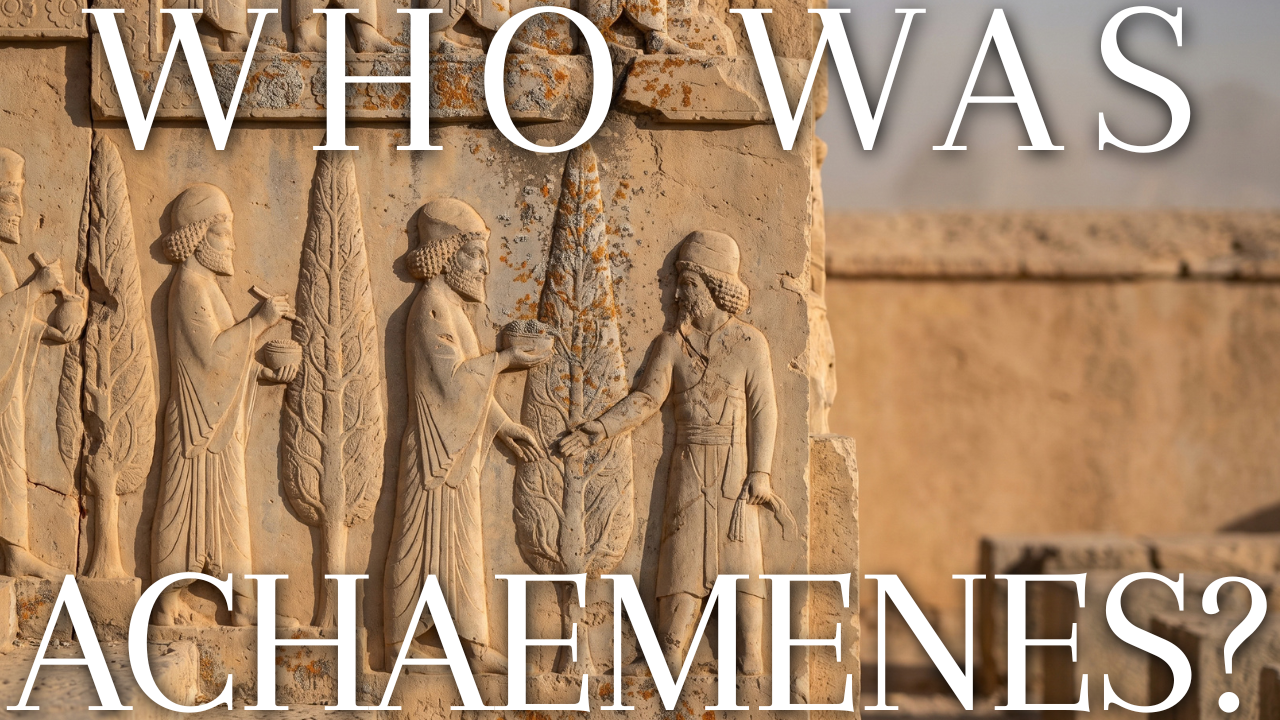
Searches for the Achaemenid Empire tend to start with small, practical questions. What does the word actually mean? How do you say it without tripping over the letters? Is it just another name for the Persian Empire?
Those questions reveal more than they seem to, because the answers depend on how an ancient royal family chose to describe itself and on the older powers it replaced. The sections below reproduce two opening chapters from the full version of this history without changes, with short signposts added for readers arriving from search. By the end, you will know where the name comes from, how it is written in several major languages, and what the Near East looked like just before Cyrus the Great redrew its map.
The ‘Complete Edition’: Everything about Achaemenid Empire

Liberal Arts Bundle

- What Does the Name Achaemenid Empire Mean?
- Achaemenid Empire Pronunciation and the Name in Farsi, Arabic, and Hindi
- Achaemenid Empire vs. Persian Empire: Is There a Difference?
- Before the Achaemenid Empire: Assyria, Media, Elam, and Babylon
- Assyria vs. the Achaemenid Empire, and How Ancient Dates Are Fixed
What Does the Name Achaemenid Empire Mean?
Start with the word itself, since so much of the story hangs on it. The passage below follows the label from its Old Persian original to the encyclopedia entries and search results where most people first meet it.
Every empire needs a label, and the one historians use for this state was never used by its own kings as the name of a country. The Persian rulers called themselves kings of kings, kings of the lands, kings of Persia. What they did claim, loudly and repeatedly, was descent from a single ancestor. The modern word “Achaemenid” preserves that claim, and understanding it is the first step toward understanding how the empire saw itself.
Haxāmaniš: the ancestor behind the name
The ancestor’s name in Old Persian was Haxāmaniš, which Greek writers rendered as Achaimenēs and Latin authors as Achaemenes.
Linguists have long taken the name apart as a compound. The first element, haxā-, is traditionally connected with the idea of a friend or companion, and the second, manah, with mind or thinking. The resulting meaning, roughly “having a friend’s mind,” has become the standard gloss in reference works. A more recent proposal reads the first element as “follower,” which would give something like “characterized by a follower’s spirit.” Neither reading changes the historical point: the dynasty took its identity from a founder figure whose own life is essentially unknown.
Whether Achaemenes was a real man is open to doubt. No contemporary document mentions him, and he may be a legendary ancestor of the kind many royal houses have invented to link rival branches of a family. That possibility matters, because Darius himself was not a direct descendant of Cyrus the Great, the actual founder of the empire. By naming a shared forefather several generations back, Darius could present his own line and Cyrus’s line as two branches of one tree. The name “Achaemenid,” in other words, may owe as much to political repair work as to genealogy.
What “Achaemenid Empire” means in practice
When historians write “Achaemenid Empire,” they mean the state ruled by this royal house from the victory of Cyrus II over the Median king around 550 BCE to the death of Darius III in 330 BCE. The phrase combines two ideas. The first is a dynasty, a sequence of rulers from related families who passed the throne among themselves. The second is an empire, a single political authority governing many distinct peoples and territories, most of whom had once been independent.
This double meaning explains a common confusion. Someone asking what the Achaemenid Empire “means” might be asking about the family, the territory, the period, or the system of government. The answer depends on which.
A coin minted in Sardis in western Anatolia belongs to Achaemenid history because it was issued under Achaemenid authority, even though no Persian may have handled it. A Babylonian contract dated by the regnal year of Darius is an Achaemenid document in the same sense. The dynasty gave its name to the age.
Achaemenid Empire Pronunciation and the Name in Farsi, Arabic, and Hindi
If you have ever hesitated before saying the word in a classroom or a museum, you are in good company. The next part covers the accepted English pronunciations and then lines up the empire’s name in languages from Farsi and Arabic to Urdu, Chinese, and Japanese.
Saying it aloud
English speakers stumble over the word, and online pronunciation guides do not always agree. Two forms are widely accepted. One stresses the second syllable with a long e sound, roughly uh-KEE-muh-nid. The other keeps the stress in the same place but shortens the vowel, closer to uh-KEM-uh-nid. Both descend from the Latinized Greek spelling, in which the letters “ch” stood for a hard k sound, as in “chaos” or “character.”
Neither form resembles the original Persian very closely. Old Persian began the name with a breathy h sound followed by a guttural kh, a sound English lacks. Modern Persian speakers say something close to Hakhāmanesh for the ancestor. For practical purposes, an English speaker who says uh-KEE-muh-nid will be understood in any lecture hall or museum.
One empire, many names
Because the empire touched so many regions, it has entered many languages, and each language tends to reshape the name through its own history of contact. Looking at these versions side by side shows which route the word traveled.
| Language | Common form | Route of the name |
|---|---|---|
| Modern Persian, or Farsi | هخامنشیان, Hakhāmaneshiyān | Rebuilt from the Old Persian form Haxāmaniš |
| Arabic | الأخمينيون, al-Akhmīniyyūn; the empire is often called الإمبراطورية الأخمينية | Adapted from European scholarly usage |
| Turkish | Ahameniş İmparatorluğu | Close to the Persian pronunciation |
| Hindi | हख़ामनी साम्राज्य, Hakhāmanī sāmrājya | Persian-derived form |
| Urdu | ہخامنشی سلطنت, Hakhāmaneshī saltanat | Persian-derived form with an Arabic word for empire |
| Chinese | 阿契美尼德帝国, Āqìměinídé dìguó | Transliterated from the Western form Achaemenid |
| Japanese | アケメネス朝, Akemenesu-chō | Transliterated from Achaemenes, with chō meaning dynasty |
Two patterns stand out. Languages with long direct contact with Persian, such as Turkish, Urdu, and Hindi, tend to use a form built on Hakhāmanesh, the Persian pronunciation. Languages that learned about the dynasty mainly through European scholarship, such as Chinese and Japanese, borrow the Greek-derived Achaemenes. Arabic sits between the two, and Arabic-language writers have used more than one spelling. Kurdish writers, too, generally follow the Persian form, which is unsurprising given that Kurdish belongs to the same Iranian branch of languages as Persian.
The Japanese form deserves a brief note because it reveals a subtle distinction. The suffix chō means “dynasty” or “court,” so アケメネス朝 literally means “the Achaemenes dynasty.” Japanese textbooks often add ペルシア, Perushia, producing アケメネス朝ペルシア, “Achaemenid Persia.” Readers who wonder whether these are two different things are noticing the same double meaning discussed above: one phrase names the ruling house, the other adds the country associated with it. They refer to the same state.
Achaemenid Empire vs. Persian Empire: Is There a Difference?
Plenty of readers use the two phrases interchangeably, and in casual conversation that rarely causes trouble. Specialists keep them apart for good reasons, and the distinction starts to matter as soon as other Iranian empires enter the conversation.
Achaemenid, Persian, Persia: overlapping but not identical
The empire is frequently called simply “the Persian Empire,” and in everyday conversation that is perfectly acceptable. For a historian, though, the terms carry different weights, and it is worth separating them.
“Persian” in the strict sense refers to a people, the Persians, who spoke Old Persian and lived in the region the Greeks called Persis, today the province of Fars in southern Iran. The Persians were the ruling ethnic group of the empire, but they were a small minority of its population. Most subjects were not Persians at all. An Egyptian farmer, a Babylonian temple scribe, or a Greek citizen of Miletus lived in the Persian Empire without being Persian.
“Persia” as a country name comes from Greek usage and was long applied by Europeans to the whole of Iran. Iranians themselves have used the name Iran, derived from an ancient word connected with the Aryans, for the land and its people since late antiquity, and the Iranian government formally asked foreign states to use “Iran” in the 1930s. Calling the Achaemenid state “Persia” therefore projects a later geographic label onto an empire that was much larger than modern Iran and much more diverse.
“Persian Empire” is also ambiguous for another reason. Several successive empires were ruled from Iran and dominated by Iranian-speaking elites. The Parthian Empire and the Sasanian Empire both fit that description, and some writers stretch the term further to include later Islamic dynasties. To avoid confusion, historians use “Achaemenid Empire” for the first of these and reserve other dynastic names for the rest. When you see “the first Persian Empire,” the writer almost always means the Achaemenid state.
Why the dynastic label is useful
Naming a state after its ruling family may seem old-fashioned, yet in this case it fits the evidence unusually well. The empire had no single ethnic identity, no single legal code, and no single religious establishment. What held it together formally was loyalty to the king and his house. Provinces paid tribute to the king; soldiers served the king; officials sealed documents in the king’s name. Remove the dynasty and there was no obvious reason for Egyptians and Bactrians to belong to the same political unit.
That is exactly what happened in 330 BCE. When Darius III died, the empire did not continue under a new Persian family. It passed to a Macedonian conqueror, and within a generation it had broken into rival kingdoms. The dynastic name marks a real boundary: the period in which one lineage claimed the right to rule all the lands it had conquered.
Teispids and Achaemenids: a family split in two
The genealogy of Darius has provoked one of the liveliest debates in the field. Cyrus the Great, writing before Darius came to power, lists his own ancestors as Cambyses, Cyrus, and Teispes, and calls them all kings of Anshan. He never mentions Achaemenes. Darius, by contrast, places Achaemenes at the root of the family and claims that eight of his relatives were kings before him, a figure that is hard to reconcile with what is known of his father and grandfather, who were not kings of anything.
Many historians therefore distinguish two lines. The first, sometimes called the Teispid line, runs from Teispes through Cyrus II to his son Cambyses II. The second, the Achaemenid line in the narrow sense, begins with Darius I and continues through every king down to Darius III. On this view, Darius invented or at least promoted Achaemenes to fuse the two families after he seized the throne, and he reinforced the fusion by marrying Cyrus’s daughters. Other scholars accept a genuine shared ancestor and see Darius’s branch as a junior line of the same house.
For most purposes the distinction does not change how the empire is labeled. Reference works call Cyrus the founder of the Achaemenid Empire because the state he created passed intact to Darius, and because Darius’s own propaganda made Cyrus part of the family. The debate is still worth knowing, because it shows that the most basic fact about the empire, its name, rests on a claim made by a usurper who had every reason to rewrite history.
What quick-reference summaries get right and wrong
Most people first encounter the Achaemenids through an encyclopedia entry, an online infobox, or a discussion thread. These summaries tend to agree on a handful of core facts: a date range of 550 to 330 BCE, Cyrus the Great as founder, Darius III as the last king, and a list of royal cities that includes Pasargadae, Susa, Babylon, Ecbatana, and Persepolis. All of those points are sound, and the date range remains the standard convention.
Where compressed summaries mislead is in the categories they force the empire into. A box labeled “capital” suggests a single seat of government, when the court actually moved among several cities. A box labeled “religion” that lists Zoroastrianism implies an organized state church, when the evidence is far more complicated.
A box labeled “official language” invites a single answer that the sources do not provide. The general lesson is that the Achaemenid Empire was built on arrangements that modern nation-state categories do not describe well, so any one-line answer should be treated as a starting point rather than a conclusion.
A working definition
The Achaemenid Empire was a multi-ethnic state founded by the Persian king Cyrus II around 550 BCE and ruled by kings who claimed descent from an ancestor named Achaemenes, until Alexander of Macedon conquered it and its last king died in 330 BCE. At its height it reached from Egypt and the northern Aegean to Central Asia and the Indus Valley. It was governed through provinces, tribute, royal roads, and a sophisticated written administration, and its kings presented themselves as chosen by the god Ahuramazda to bring order to many peoples.
Each part of that definition raises further questions. Where did the Persians come from, and what kind of world did Cyrus enter? Why was a small people from Fars able to overturn older and more famous powers such as Babylon and Egypt? The answer begins not with Persia itself but with the collapse of the empire that had dominated the Near East for three centuries before Cyrus was born: Assyria.
Before the Achaemenid Empire: Assyria, Media, Elam, and Babylon
No empire appears out of nowhere. To see what the Persians built, look first at the crowded political map they inherited, a region reshaped by the sudden collapse of a superpower.
In the seventh century BCE, the most powerful state on earth was Assyria. From its heartland on the upper Tigris, in what is now northern Iraq, Assyrian kings had conquered Babylonia, the Levant, much of southeastern Anatolia, and for a time Egypt. Their palace reliefs show deported populations marching into exile, rebellious cities impaled on stakes, and kings hunting lions from chariots. Then, within a few decades, the whole structure collapsed. The world into which Cyrus the Great was born was the world Assyria left behind.
The fall of Assyria and the four successor powers
Assyria’s end came quickly. A coalition led by the Babylonians under Nabopolassar and the Medes from the Iranian plateau sacked Nineveh, the Assyrian capital, in 612 BCE. Remnants of the Assyrian state fought on in the west for a few more years, but by the end of the century nothing was left. Its territory was divided, roughly and violently, among the powers that had destroyed it or survived at its edges.
By the early sixth century, four major states shared the Near East:
- The Neo-Babylonian Empire, ruled from Babylon, held Mesopotamia, Syria, and the Levant. Its most famous king, Nebuchadnezzar II, captured Jerusalem and deported much of the Judean elite to Babylonia.
- Media, centered on the city of Ecbatana on the Iranian plateau, claimed a broad but loosely controlled area stretching from northwestern Iran toward eastern Anatolia.
- Lydia, ruled from Sardis in western Anatolia, dominated the Greek cities of the Aegean coast and grew rich from gold deposits and trade.
- Egypt, under the Saite pharaohs of the Twenty-Sixth Dynasty, had regained independence and was reviving old traditions while hiring Greek and Carian mercenaries.
These four states fought, negotiated, and intermarried. A famous battle between Media and Lydia on the Halys River in central Anatolia was supposedly halted by a solar eclipse, after which the two sides fixed the river as their border and sealed the peace with a royal marriage. Whatever the details, the story captures the balance of power: no single state could dominate the region as Assyria once had.
Media: power without clear structure
Media is the most elusive of the four. Greek writers, especially Herodotus, describe a proper Median empire with a line of kings, a capital with seven concentric walls, and authority over the Persians. Modern historians are more cautious. No Median royal inscriptions have been found, and archaeological evidence for a centralized Median state is thin. Many specialists now picture Media as a powerful confederation of tribes and chiefdoms under a dominant leader rather than a bureaucratic empire on the Assyrian model.
That uncertainty matters for the Achaemenid story, because Greek tradition says the Persians were subjects of the Medes before Cyrus. If Media was a loose confederation, then “independence from Media” may mean something less dramatic than a colonial revolt: the transfer of leadership within an Iranian-speaking world from one ruling group to another. Either way, the Persians inherited a great deal from the Medes. Median officials served at the Persian court, Median nobles held high military posts, and Greek writers routinely used “the Mede” as a synonym for “the Persian.”
Media also carries weight in modern identity politics. Some Kurdish national narratives present the Medes as ancestors of the Kurds, drawing on the fact that the Median heartland lay in western Iran near today’s Kurdish-speaking regions. Historians treat such direct lines of descent with caution, since populations and languages in the region have mixed many times over two and a half millennia. The claim nonetheless shows how the peoples of the pre-Achaemenid world continue to serve as symbols.
Elam and the land of Anshan
Southwest of Media lay one of the oldest civilizations in the region, Elam. For more than two thousand years, Elamite kings had ruled lowland Khuzistan, around the city of Susa, and parts of the highlands to the east. The Elamites spoke a language unrelated to any other known tongue, wrote it in cuneiform, and built a sophisticated administrative tradition. Assyria had crushed Elamite power in the seventh century, sacking Susa, but Elamite culture did not disappear.
The highland region of Elam included a district called Anshan, centered near modern Marvdasht in Fars. This detail is crucial, because the early Persian kings used the title “king of Anshan.” Cyrus the Great, in his Babylonian cylinder, calls himself and his father, grandfather, and great-grandfather kings of Anshan. The Persians, in other words, had settled in and taken over an old Elamite territory, and they presented their monarchy through an Elamite title.
Archaeologists and linguists increasingly see early Persian identity as a blend. Iranian-speaking groups moving onto the plateau over earlier centuries mixed with the Elamite population of the highlands. They adopted Elamite scribes, Elamite artistic motifs, and Elamite administrative habits. This fusion explains why, decades later, the royal bureaucracy at Persepolis kept most of its records not in Persian but in Elamite.
Who were the Persians?
Readers often ask what “race” the Persians were, or whether they were nomads. Both questions need reframing. The Persians were a people defined by language and political identity rather than by any biological category. Their language, Old Persian, belongs to the Iranian branch of the Indo-European family, making it a distant relative of Sanskrit, Greek, Latin, and English. Their neighbors the Medes spoke a closely related Iranian language.
The picture of the early Persians as tent-dwelling nomads comes largely from later Greek storytelling, which liked to contrast rugged, simple Persians with the luxury they acquired after conquest. The real economy of Fars before the empire likely combined settled farming in the valleys with seasonal pastoralism, in which herders moved flocks between summer highland pastures and winter lowlands. Mobile herding remained important in Iran for millennia, and many Persian tribal groups practiced it. Yet the founders of the empire were not wandering horsemen from the steppe. They were rulers of an established highland kingdom with towns, fields, and an inherited Elamite court culture.
Assyria vs. the Achaemenid Empire, and How Ancient Dates Are Fixed
Because the two empires ruled much of the same ground, comparisons between them come up constantly in classrooms and online forums. What follows sets them side by side, surveys the other great powers of the age, and shows how scholars tie ancient events to precise years.
Assyria and the Achaemenids: two models of empire
Because both states ruled much of the same territory, readers often ask how the Achaemenid Empire differed from Assyria. The comparison is illuminating, though it should not be pushed too far, since Assyrian practice varied over three centuries and so did Achaemenid.
| Feature | Neo-Assyrian Empire | Achaemenid Empire |
|---|---|---|
| Core territory | Upper Tigris, northern Mesopotamia | Fars in southwestern Iran, with Susa in Elam |
| Maximum reach | Egypt to western Iran | Egypt and Thrace to Central Asia and the Indus |
| Signature policy toward conquered peoples | Mass deportations and resettlement on a large scale | Deportations occurred, but many communities were allowed to keep or restore local institutions |
| Royal propaganda | Emphasis on terror, destruction, and punishment of rebels | Emphasis on order, divine choice, and willing tribute from many peoples |
| Administrative language | Akkadian cuneiform, with growing use of Aramaic | Elamite, Aramaic, Babylonian, and local languages side by side |
| End | Destroyed by Babylonian and Median coalition | Conquered by Alexander of Macedon |
The differences in tone are real, but they are partly differences in presentation. Assyrian kings boasted about cruelty because intimidation was part of their message. Persian kings also punished rebels harshly; Darius described cutting off noses and ears and impaling rival kings. What changed was the story each empire told about itself.
Cyrus and his successors also inherited Assyrian tools. The Assyrians had built roads with posting stations, used Aramaic as a practical written language across their territory, and organized provinces under governors responsible for tribute. Cyrus and Darius did not invent imperial administration from nothing. They took an existing toolkit, refined it, and applied it on a larger scale.
The Neo-Babylonian Empire at its height
Of the four successor states, Babylon was the richest and most prestigious. Its temples controlled huge estates, its scribes preserved an intellectual tradition going back two thousand years, and its capital was among the largest cities in the world. Nebuchadnezzar II rebuilt Babylon on a monumental scale, with glazed-brick processional streets and the famous Ishtar Gate, now reconstructed in Berlin.
The empire’s later rulers were less secure. Nabonidus, the last Neo-Babylonian king, spent about a decade at the oasis of Tayma in Arabia, leaving his son Bel-shar-usur, the biblical Belshazzar, in charge at Babylon. His absence meant that the great New Year festival, which required the king’s presence, could not be celebrated properly. His devotion to the moon god Sin also offended parts of the priesthood of Marduk, Babylon’s chief god. These tensions would shape how Babylon received Cyrus, and how Cyrus’s propaganda described the city’s fall.
Egypt and Lydia: wealth at the edges
Egypt under the Saite kings was prosperous and outward-looking. Pharaohs such as Necho II and Amasis employed Greek soldiers and encouraged Greek traders, founding the trading town of Naukratis in the Nile Delta. Egypt maintained a fleet and meddled in Levantine politics, always wary of Babylon.
The dynasty’s founder, Psamtik I, had reunified the country in the seventh century after Assyrian control faded, and his successors cultivated a deliberate revival of older Egyptian styles in art and religious practice. Necho II fought the Babylonians in Syria and, according to Herodotus, began digging a canal from the Nile toward the Red Sea, a project a Persian king would later complete. Amasis, who seized the throne in a military coup, proved a shrewd diplomat, allying with Lydia, Babylon, and Greek states such as Samos. By the 530s, however, he was an old man, and his network of alliances had lost two of its partners to Cyrus.
Lydia, meanwhile, controlled a resource that would transform the ancient economy. The Lydians are generally credited with producing some of the earliest coins, first in electrum, a natural alloy of gold and silver, and later in separate gold and silver issues associated with King Croesus. Lydia’s wealth became proverbial among the Greeks, and “rich as Croesus” still survives in English. When Cyrus eventually confronted Croesus, he was taking on the financial center of the western Near East.
How historians date these events
Readers sometimes wonder how anyone can say that Nineveh fell in 612 BCE or that a battle took place in a particular year of a Babylonian king. The answer lies in Mesopotamian record-keeping. Babylonian scribes dated documents by the regnal year of the reigning king, and they kept running chronicles that summarized major events year by year. A group of these texts, known collectively as the Babylonian Chronicles, covers much of the late Assyrian, Neo-Babylonian, and early Persian periods in terse entries recording campaigns, festivals, and deaths of kings.
Those regnal years can be tied to absolute dates because Babylonian astronomers observed the sky with extraordinary care. Their astronomical diaries recorded eclipses, planetary positions, and lunar phenomena alongside prices and political news. Modern astronomers can calculate exactly when those phenomena occurred, which anchors the king lists to our calendar. Later compilations of reign lengths, such as the list preserved by the Greco-Egyptian astronomer Ptolemy, carry the sequence forward through the Persian kings and beyond.
This system is why dates for Babylonian and Persian kings are usually precise to within a year, while dates drawn only from Greek narratives, such as the fall of Lydia, remain disputed.
A region primed for a new order
By the middle of the sixth century BCE, the Near East had the ingredients for a new imperial power but no obvious candidate to assemble them. Babylon was rich but politically divided. Media was large but loosely organized.
Lydia was wealthy but small. Egypt was isolated behind the Sinai. The roads, scribal traditions, and administrative habits that Assyria had spread across the region survived, waiting to be used.
Into this setting stepped the king of Anshan, a ruler from a highland valley whom few outside Iran would have noticed. Within twenty years, he had absorbed Media, Lydia, and Babylon. How Cyrus achieved this, and what kind of ruler he chose to be, is where the Achaemenid story properly begins.
What These Opening Chapters Set Up
Taken together, these two chapters answer the first round of questions most people bring to the subject: what the name means, how to say it, how it differs from looser labels, and what kind of world the dynasty entered. They also leave a much bigger question hanging. How did a ruler from a modest highland kingdom turn that divided landscape into a single state?
Keep the table of names and the comparison with Assyria in mind if you read further. Both return in new forms once the empire starts conquering, governing, and eventually defending itself.
This post reproduces two opening chapters from the full version of our history of the Achaemenid Empire. The full version goes on to follow Cyrus the Great and the making of an empire, the crisis of 522 BCE and the Rock of Behistun, and the question of why the empire lasted so long and why it fell, alongside a reference list of the kings in order and a compact timeline. It also explores Persepolis and the art of empire, the workers and queens recorded on clay tablets, and the empire’s afterlife in Iran today. If the questions raised here caught your interest, the full version is where the story continues.
The ‘Complete Edition’: Everything about Achaemenid Empire
Liberal Arts Bundle


コメント