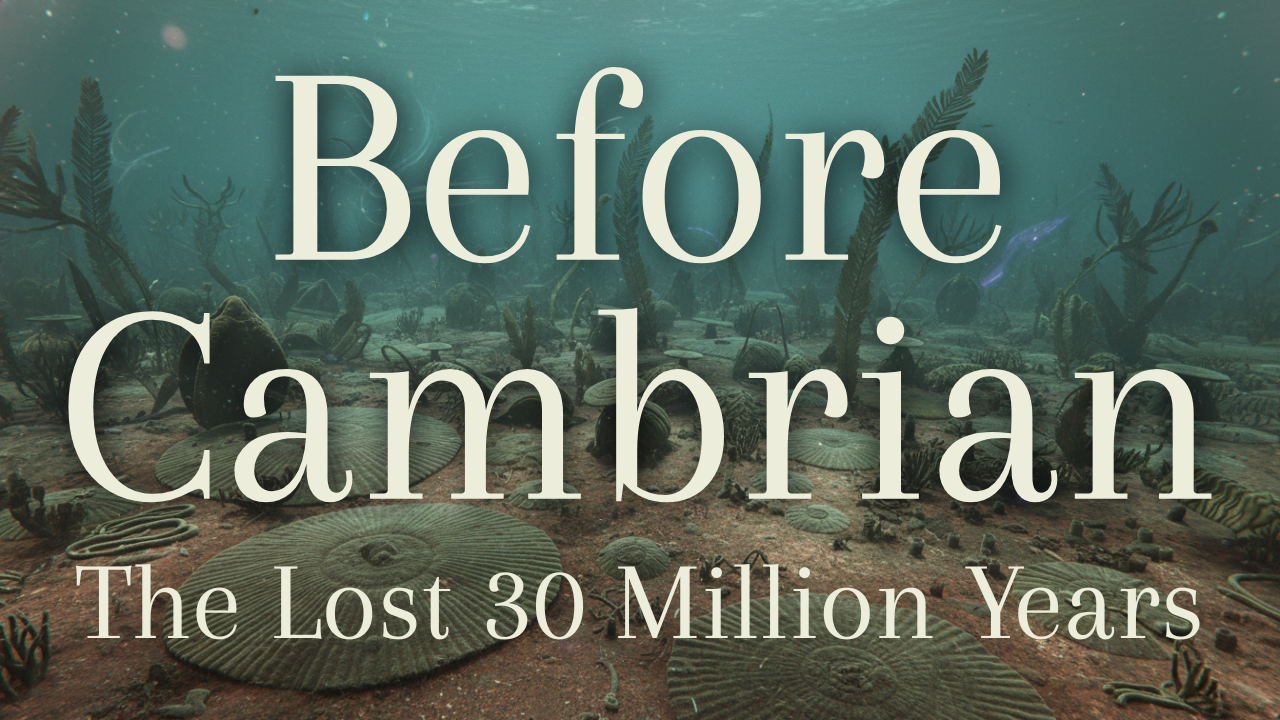
Introduction: Invitation to the Lost “Peaceful Paradise”
Can you imagine what the “first animals on Earth” looked like?
It was hundreds of millions of years before dinosaurs walked the earth, and even further back than the Cambrian Period when trilobites ruled the seas.
Once upon a time, a “paradise” existed on this planet, inhabited by strange yet graceful creatures that fit into none of today’s biological classifications.
They had no eyes, no mouths, and no weapons to attack enemies.
Mysterious creatures that spent their peaceful time just lying quietly on the seabed or swaying in the ocean currents.
This is the “Ediacaran Biota.”
Long considered a “void” in geological history, recent dramatic discoveries and research progress are revealing this era to be the most critical “testing ground” for the evolution of life.
Why did they appear, and why did they suddenly disappear from the face of the earth?
Are they our distant ancestors, or were they “failed works” that got lost in an evolutionary dead end?
In this article, based on the latest scientific findings and a vast amount of research papers, we will unravel the full picture of the “Ediacaran Period” with an overwhelming volume.
From the geological background to the detailed ecology of these strange creatures, and the mystery of their extinction, which is considered the greatest mystery in the history of life.
We invite you on a journey to a profound ancient world that is not found in textbooks.
What you find here is not just a list of knowledge.
It is a grand story to reaffirm what life is, and how slender and miraculous the thread of evolution that leads to us humans truly was.
The ‘Complete Edition’: Everything about Ediacaran Period
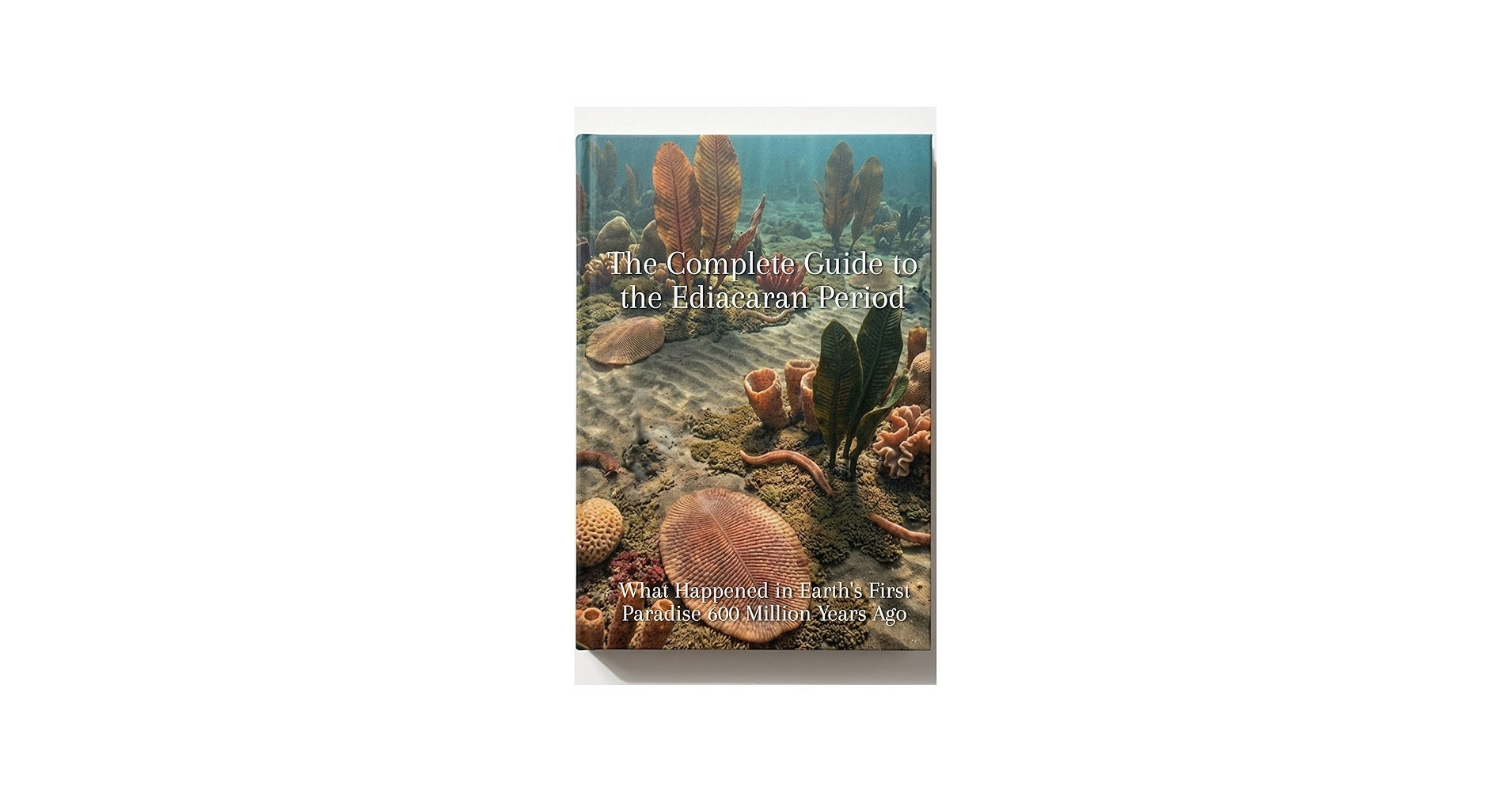
Chapter 1: Dawn of Complex Life – What is the Ediacaran Period?
Definition and Era Classification of the Ediacaran Period
The “Ediacaran Period” refers to the geological era spanning from approximately 635 million years ago to about 538.8 million years ago.
This division marks the finale of the long-lasting Proterozoic Eon and is located at the very end of the Neoproterozoic Era.
In the past, this era was not clearly defined even among geologists.
It was lumped together as part of the “Precambrian” meaning immediately before the “Cambrian Period” which marks the beginning of the Paleozoic Era, or was called the “Vendian” by researchers in Russia and Northern Europe.
However, as unique fossil groups were discovered in this specific chronological stratum worldwide, and their geological and biological importance was recognized, the taxonomic need for international unification increased.
Then, in 2004, the name “Ediacaran Period” was officially ratified by the International Union of Geological Sciences (IUGS).
This was a remarkable achievement, being the first time in 120 years that a new “Period” was established as a geological era classification.
The beginning of the Ediacaran Period is defined by the end of the “Marinoan Glaciation,” also known as “Snowball Earth,” where the entire earth was covered in ice.
As the era of extreme cold ended and the global environment changed drastically, life made a dramatic leap from single-celled to multicellular, and from microscopic sizes to sizes visible to the naked eye.
Its end is defined by the starting point of the well-known “Cambrian Explosion,” that is, the boundary where major animal phyla began to appear continuously.
In other words, the Ediacaran Period is the most dynamic transitional period in which the Earth transformed from a “World of Death” to a “Planet Full of Life.”
Origin of the Name: The Red Hills of Australia
This name “Ediacara,” which is unfamiliar but unforgettable once heard, comes from a place name located in southern Australia.
The “Ediacara Hills” spread out to the west of the Flinders Ranges, about 650 kilometers north of Adelaide.
The word “Ediacara” itself is said to mean “place where water wells up” or “place to wait” in the language of the local indigenous Aboriginal people.
In this place where dry red earth spreads, a great discovery that overturned the history of geology was made in 1946.
Reginald Sprigg, who was working as a mining geologist at the time, discovered strange impression fossils while surveying an old abandoned mine.
The finding of biological fossils visible to the naked eye from strata older than the Cambrian Period was unthinkable in the common sense of the time.
Sprigg’s discovery was initially viewed with skepticism by the academic world, and was about to be dismissed as “misidentification of Cambrian fossils” or “mere rock patterns.”
However, subsequent detailed investigations proved that these were unique biological groups completely different from Cambrian organisms.
In honor of this discovery site, this era was named the “Ediacaran Period,” and the creatures living in this era were named the “Ediacaran biota” or “Ediacaran fauna.”
Currently, the entire Flinders Ranges area, including the Ediacara Hills, is a sacred place visited by researchers from all over the world as the standard type locality where the strata of the Ediacaran Period are best exposed.
When ratified in 2004, the “Global Boundary Stratotype Section and Point (GSSP),” commonly known as the “Golden Spike,” which serves as the standard for this era, was also driven into “Enorama Creek” in these Flinders Ranges.
Why is the Ediacaran Period Important?
As research on the Ediacaran Period progresses, it has become clear that this era has extremely unique and important meaning in the evolution of life.
First, this is the era when “large multicellular organisms” flourished on Earth for the first time.
For billions of years before that, the main actors on Earth were microorganisms such as bacteria and algae.
However, entering the Ediacaran Period, huge creatures, some exceeding 1 meter at maximum, spread across the world’s oceans.
This was the moment when life succeeded in the strategy of “enlarging the body” for the first time, and it was the first step in evolution toward organisms with complex tissues and organs.
Second, the morphology of the Ediacaran biota is too unique.
Many of them show no traces of having a “mouth,” “anus,” or “digestive tract” like modern animals.
Also, there were many organisms that had not only bilateral symmetry but also rotational symmetry or self-similar shapes like fractal structures.
They were “alien-like” entities resembling no other creature on Earth today.
The debate continues as to whether these mysterious creatures are the direct ancestors of modern animals or “failed attempts” that went extinct during the evolutionary process.
Third, the close relationship with the global environment.
The Ediacaran Period coincides with the time when the oxygen concentration in the Earth’s atmosphere and oceans rose, enabling more active life activities.
Also, the theory that their activities changed the seabed sediments and prepared for the explosive evolution of the subsequent Cambrian Period is strong.
In other words, knowing the Ediacaran Period is not just learning about “old fossils,” but also a journey to explore the roots of how this ecosystem we live in was born.
In the next chapter, let’s look in detail at the global environment of that time, the “stage set” that made this miraculous explosion of life possible.
We will approach the dramatic environmental changes of how a paradise of life was built from the extreme state of Snowball Earth.
Chapter 2: Turbulent Earth System – The “Stage Set” that Nurtured Life
Collapse of Supercontinent Rodinia and Formation of Gondwana
The Earth in the Ediacaran Period had a completely different continental configuration than it does today.
Geologically, this era was a “turbulent period of continental drift.”
In the early Ediacaran Period, a huge supercontinent called “Rodinia” existed on Earth, but it was in the midst of breaking apart.
The Rodinia continent was a vast landmass where present-day North America, Australia, Antarctica, India, Siberia, etc., were lumped together, but its splitting created vast shallow seas (neritic zones).
For life, the expansion of this “shallow sea” had a very important meaning.
This is because it is one of the few places where sunlight reaches the seabed and photosynthetic algae can easily thrive.
While Rodinia was splitting apart, movements toward the formation of a new supercontinent were beginning on the other side of the Earth.
This is the “Gondwana continent” that would flourish in the later Paleozoic Era.
The collision and coalescence of this huge landmass including Africa, South America, India, Australia, and Antarctica caused a massive orogenic activity called the “Pan-African orogeny.”
It is believed that this orogeny supplied huge amounts of nutrients (such as phosphorus and iron) to the sea, which promoted the explosive growth of plankton and resultingly raised the energy base of the entire ecosystem.
Return from Snowball Earth
The “Snowball Earth” hypothesis cannot be avoided when talking about the Ediacaran Period.
Until about 640 million years ago, just before the Ediacaran Period began, the Earth was literally a “planet of ice” covered with ice sheets up to near the equator (Marinoan Glaciation).
The average surface temperature dropped below minus 40 degrees Celsius, and it is said that a desperate environment for life continued for tens of millions of years.
However, due to the greenhouse effect of carbon dioxide accumulated by volcanic activity, the Earth warmed rapidly and the ice melted at once.
This is called the “Super Greenhouse.”
The Ediacaran Period opened immediately after environmental stress unparalleled in Earth’s history: this extreme cooling followed by rapid warming.
Interestingly, another ice age visited again for a short period about 580 million years ago, in the middle of the Ediacaran Period.
This is called the “Gaskiers glaciation.”
Although not as large-scale as the conventional Snowball Earth, the explosive radiation of the first Ediacaran biota is seen immediately after this Gaskiers glaciation, strengthening the view that cooling and subsequent recovery became a trigger for biological evolution.
Mystery of Oxygen Concentration: NOXE Theory and DOXE Theory
One of the most leading answers to the question “Why did large organisms appear in this era?” is the “rise in oxygen concentration.”
We live in an atmosphere with an oxygen concentration of about 21% today, but for most of the Precambrian time, the oxygen concentration on Earth was extremely low.
Large amounts of oxygen are needed to maintain a large body and perform complex metabolism.
It has been thought that the “Neoproterozoic Oxygenation Event (NOXE),” in which oxygen spread to the deep sea, occurred in the Ediacaran Period.
However, recent geochemical studies (such as analysis of uranium isotope ratios in sedimentary rocks) have proposed the “DOXE (Dynamic Ocean Oxygenation Event) theory,” which casts doubt on this established theory.
This is the theory that “oxygen concentration was not constantly high, but fluctuated extremely unstable.”
If the oxygen concentration was unstable, the Ediacaran biota may have had a special respiratory system adapted to low-oxygen environments, or evolved a “thin and flat body” to efficiently take in oxygen.
In fact, the fact that organisms such as Dickinsonia have a thin, flat shape like a cushion is consistent with the interpretation that it was to maximize the ratio of surface area to volume and increase the efficiency of cutaneous respiration.
The Ocean of Ediacara: Deposition of Carbonates and Sea of Crystals
The ocean at that time also had a different chemical composition than it does today.
Of particular note is that the saturation of calcium carbonate in seawater was high.
On the seabed, carbonates precipitated due to microbial activity, forming “microbial mats” as hard as rocks.
Unlike the sandy seabed of today, which is loose and unstable, a seabed covered with sticky organic films or hard-solidified layers spread out.
The existence of these “microbial mats” is the biggest factor that determined the lifestyle of the Ediacaran biota.
They lived by attaching to these mats or consuming the mat-like microbes.
Also, traces of huge crystals of “aragonite” growing directly from the seabed like fans (Crystal fans) have been found in the seabed sediments.
This is evidence that the sea at that time contained large amounts of carbonate ions, creating a fantastic scene not seen on Earth today.
Thus, the Earth in the Ediacaran Period was in the midst of dramatic changes: continental drift, severe climate change, and a special marine environment.
This unstable and dynamic environment applied strong evolutionary pressure on life that “you must change to survive,” becoming the driving force for creating completely new forms of organisms.
From the next chapter, let’s look in detail at the “actors” who appeared on this stage, that is, the specific appearance and history of the Ediacaran biota.
When were they discovered, and how did they puzzle scientists?
(…Skipped: Chapters 3 to 4 detail the history of discovery and the classification of the strange Vendian organisms…)
[Special Free Preview: The Stars of Ediacara]
We are specially releasing the full text of Chapter 5, which explains “Dickinsonia” and “Kimberella,” the most popular and mysterious creatures in the history of biological evolution.
Chapter 5: Stars of Ediacara (1) – Proof of Being Animals
Dickinsonia: The 500-Million-Year-Old “Moving Cushion”
The most famous presence among the Ediacaran biota, and constantly central in the history of research, is “Dickinsonia.”
Its appearance is often compared to an “inflated air mattress” or a “huge cushion.”
Its oval body reaches up to 1.4 meters at maximum, but its thickness was only a few millimeters.
A line like a “midline” runs through the center of the body as its name suggests, and countless rib-like structures (isomers) extend to the left and right from there.
Fierce controversy has been waged for over 70 years regarding the identity of this Dickinsonia.
One researcher claimed it was a huge single-celled organism (relative of foraminifera or amoeba), while another thought it was a simple multicellular animal close to modern placozoans.
Furthermore, theories abounded, such as the lichen theory suggesting a fungus like a mushroom, or the theory of a completely unknown extinct race (Vendobionta).
However, in 2018, a decisive discovery was made that put an end to this controversy.
A research team led by Dr. Ilya Bobrovskiy of the Australian National University succeeded in extracting organic molecules from Dickinsonia fossils found in the White Sea region of Russia.
It is amazing in itself that organic matter is detected from fossils 558 million years old, but the analysis revealed that it was “cholesterol.”
Cholesterol is a lipid specific to animal cell membranes and is rarely produced in plants or fungi (they have other types of sterols like ergosterol).
With the discovery of this “molecular fossil (biomarker),” it was scientifically proven with 99.9% certainty that Dickinsonia is a member of the “Kingdom Animalia.”
This can be said to be one of the biggest breakthroughs in the history of Ediacaran biota research.
Also, trace fossils called “Epibaion” have been found as evidence that they crawled on the seabed.
This is thought to be a mark that Dickinsonia stayed on the microbial mat on the seabed for a while, absorbed the nutrients there, and then moved to another place to settle again.
In other words, they were not living rooted like plants, but were “active animals” that moved at their own will and searched for food.
Kimberella: Ancestor of Mollusks Without Shells?
Occupying an important position alongside Dickinsonia is “Kimberella.”
This creature, with a body length of a few centimeters to about 15 centimeters, looks like a slug or a limpet without a shell at first glance.
The biggest feature of Kimberella is that it may have had a retractable organ like an elephant’s trunk called a “proboscis” at the front of its body.
Around the fossils, numerous fan-shaped fine scratches (scratch marks) have been found (given the trace fossil name Kimberichnus).
This is considered evidence that Kimberella was eating while scraping off the microbial mat on the seabed using a hard organ like a radula.
The “radula” is a feeding organ peculiar to modern mollusks such as snails, squids, and octopuses.
Also, on the dorsal side, although not a “shell” itself, there are traces of having a “hood” of cuticular quality (hard layer made of protein etc.).
From these characteristics, it is becoming an established theory that Kimberella is the earliest ancestor of modern mollusks, or an organism located in the Stem group.
If so, it means that shellfish did not appear suddenly in the Cambrian Explosion, but “ancestors of shellfish without shells” had already dominated the sea tens of millions of years before that.
Kimberella had a bilaterally symmetrical body, a distinction between front and back (head and tail), moved using muscles, and ate with a hard mouth, possessing all the characteristics of extremely “modern” animals.
Spriggina: Distant Relative of Trilobites?
“Spriggina,” bearing the name of discoverer Reginald Sprigg, attracts attention as a missing link in evolution.
This creature, about 3 to 5 centimeters in length, looks just like a trilobite or an arthropod like a centipede.
At the tip of the body, there is a bulge like a semi-circular “head” closely resembling the glabella of a trilobite.
Below that, numerous body segments are lined up on the left and right, looking as if there are legs.
From this appearance, Spriggina has long been thought to be the ancestor of arthropods or annelids (relatives of lugworms).
However, observing closely, the aforementioned “glide reflection symmetry (structure where left and right body segments are shifted)” is seen, so it is partly impossible to assert simply that it is the ancestor of trilobites.
In recent interpretations, the possibility is also pointed out that Spriggina is also a type of Proarticulata and is an organism that evolved independently of arthropods.
In any case, Spriggina is one of the earliest organisms to acquire the structure of a “head,” and is an important existence suggesting the direction of evolution, such as protecting oneself from predators or concentrating sensory organs.
These “star creatures” had bilateral symmetry and mobility, and were clearly walking the path of evolution into animals.
However, the creatures introduced in the next chapter have completely different, even more alien and primitive forms.
Flowers of fractals blooming in the deep sea, sessile organisms.
How on earth did they live?
Continue Reading in the Complete Version!
How was it?
What we released in this free version is only a fraction (about 15% of the total) of this grand story.
In the Complete Version (70,000 words), all the following mysteries are unraveled:
- Chapter 2: Turbulent Earth System – Snowball Earth and the Mystery of Oxygen
- Chapter 3: Discovery of Ediacaran Biota – The “Phantom Fossils” that Shook the Scientific World
- Chapter 4: Alien-like Appearance – Strange Forms and Unclassifiable “Vendobionts”
- Chapter 6: Stars of Ediacara (2) – Forests of Fractals and Three Arms
- Chapter 7: Garden of Ediacara – Peaceful Ecosystem Without Predators
- Chapter 8: Miracle of Preservation – Why Did “Soft Bodies” Become Fossils? “Death Mask” Mystery
- Chapter 9-10: Pilgrimage – Deep Sea of Newfoundland and Red Earth of Australia / Treasure Trove of the Far North and Fortress of the Desert
- Chapter 11: Greatest Mystery of Evolution – What Exactly Were They?
- Chapter 12: Collapse of Paradise – Mysterious Mass Extinction: Who Killed Them?
- Chapter 13: Fuse to Cambrian Explosion – Revolution from “Static” to “Dynamic”
- Chapter 14: Frontline of Science – Digital Analysis and Chemistry Reveal the “Truth”
- Chapter 15: Letter from Ediacara – What We Inherited
Further, 9 luxurious appendices are fully included!
- Appendix A: Detailed Chronology of the Ediacaran Period
- Appendix B: Ediacaran Period – Thorough Q&A (Colors? Tastes?)
- Appendix C: Ediacaran Period – Glossary
- Appendix D: Complete List of Major Ediacaran Organisms
- Appendix E: Museums and Research Institutions Where You Can Meet Ediacaran Biota
- Appendix F: Thorough Resource List for Further Learning
- Appendix G: Future Predictions – How Will Ediacara Research Change?
- Appendix H: Origin of Scientific Names – Trivia
- Appendix I: Great Figures in Ediacara Research (Biographies)
Please enjoy the most dramatic drama of life evolution in the complete version.
The ‘Complete Edition’: Everything about Ediacaran Period


コメント