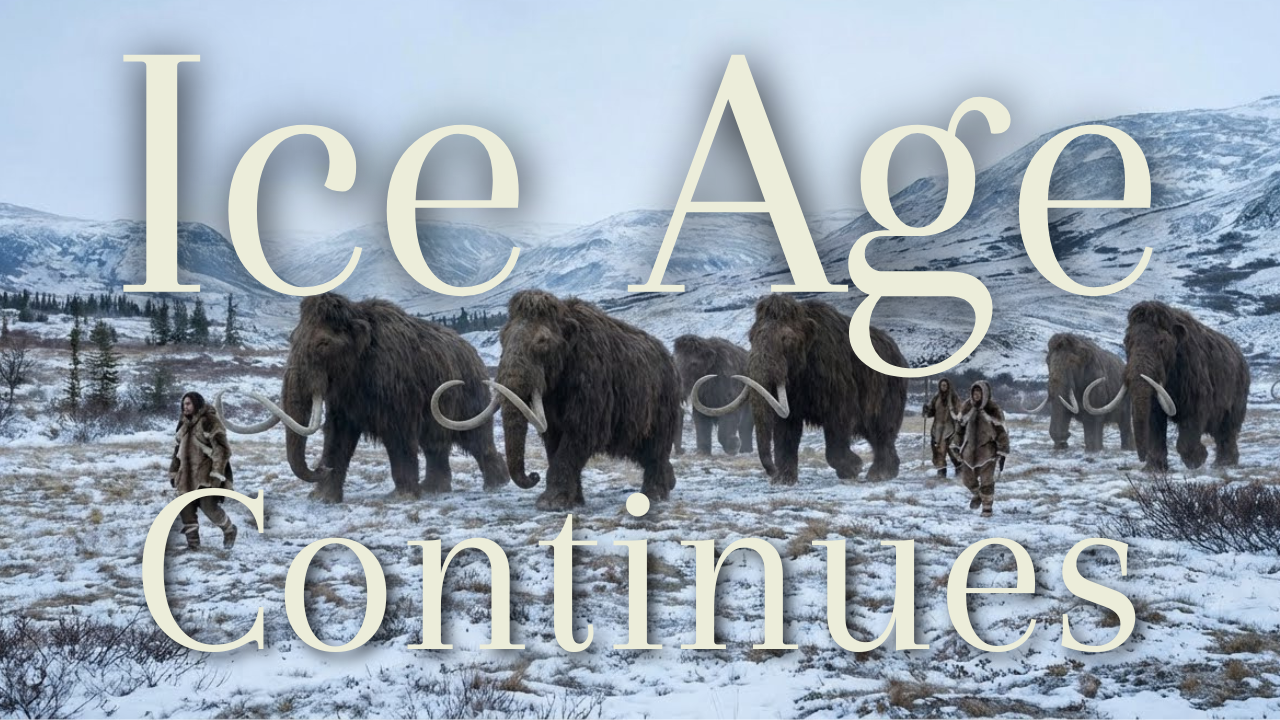
Even as you read this sentence, the Earth is in a geological era known as the “Quaternary Period” (or “Fourth Period”).
Take a look out the window.
The changing seasons, the towering mountains in the distance, and the civilization built by us humans.
All of these exist precisely because of the unique environment of the Quaternary Period.
However, many people may not be familiar with the term “Quaternary.”
Compared to the Jurassic or Cretaceous periods when dinosaurs roamed, its name recognition might be slightly lower, but its importance is second to none.
Why? Because the Quaternary is our direct home.
In this grand article spanning 70,000 characters, we will exhaustively depict the drama of the Earth from 2.58 million years ago to the present.
A white Earth covered in glaciers, grasslands where mammoths strode, and the journey of humanity acquiring intelligence and spreading across the globe.
We will unravel the full picture of this “newest geological era,” sprinkling in the latest research findings not found in textbooks and surprising facts.
By the time you finish reading, the scenery you casually look at every day should look completely different.
Are you ready for a time travel journey?
Let’s depart together on a journey of 2.58 million years.
- Chapter 1: What is the Quaternary Period? Definition and Overview
- 1. Definition of the Quaternary: From 2.58 Million Years Ago to “Now”
- 2. The Origin of the Strange Name “Quaternary”
- 3. Precise Positioning in the Geological Time Scale
- 4. The Biggest Features Characterizing the Quaternary: Glaciers and Humanity
- 5. Aspects as an “Ice Age” Continuing Today
- 6. The Sense of Length of 2.58 Million Years: A Blink in Earth’s History
- 7. Why Learn About the Quaternary: The Foundation of Modern Society
- 8. The Boundary with the Neogene: What Changed
- 9. Quaternary Research Methods: Science as a Time Machine
- 10. About the Structure of This Article
- Chapter 3: The Pleistocene – The Truth of the Ice Age
- 1. Overview of the Pleistocene: 2.58 Million Years to 11,700 Years Ago
- 2. Divisions and Characteristics of Early, Middle, and Late
- 3. The “Chibanian” That Surprised the World
- 4. Reality of the Ice Age: The Whole Earth Was Not Frozen
- 5. The Enormity of Ice Sheets and Sea Level Drop
- 6. Formation of Land Bridges and Animal Traffic
- 7. From 40,000-Year Cycle to 100,000-Year Cycle: The Middle Pleistocene Transition
- 8. The World of the Last Glacial Maximum (LGM)
- 9. Younger Dryas: The Last Return of Cold
- 10. Topographic Heritage Left by the Pleistocene
- Chapter 8: Rise and Fall of Megafauna – Kings of the Ice Age
- 1. What is Megafauna? The 40kg Wall
- 2. Bergmann’s Rule: Why Do Bodies Get Bigger in Cold Regions?
- 3. Mammoth and Mastodon: Similar but Different Statues
- 4. Woolly Rhinoceros and Irish Elk: Adaptation to Extreme Cold
- 5. Predators: Saber-toothed Tiger and Cave Lion
- 6. South American Anomalies: Glyptodon and Megatherium
- 7. Australian Giant Birds and Marsupials
- 8. Japanese Megafauna: Naumann Elephant and Yabe’s Giant Deer
- 9. Why Did They Disappear?
Chapter 1: What is the Quaternary Period? Definition and Overview
Understanding the Quaternary Period is synonymous with understanding the modern Earth’s environment itself.
First, let’s firmly grasp the definition and basic framework of what this era is all about.
Technical terms will appear, but rest assured, we will break them down one by one.
1. Definition of the Quaternary: From 2.58 Million Years Ago to “Now”
The Quaternary Period covers the most recent era in the geological time scale.
Its beginning is defined as approximately 2.58 million years ago, and surprisingly, its end has not yet been decided.
In other words, it is an era that is continuing right now.
If we liken the Earth’s history to a long calendar of 4.6 billion years, the Quaternary is merely the last few seconds before the New Year’s Eve bell begins to toll.
However, in this brief period, the Earth’s surface temperature fluctuated violently, landforms were carved out, and ecosystems were drastically replaced.
From a geological common sense perspective, it is a “momentary event,” but its content is characterized by extreme density.
2. The Origin of the Strange Name “Quaternary”
Why is it the “Fourth” period?
Many may wonder where the First, Second, and Third went.
Actually, this name derives from the history of geology in the 18th century.
In 1760, Italian mineralogist Giovanni Arduino proposed classifying geological strata into four major groups.
He called the oldest rock layers the “Primary,” the subsequent layers containing fossils the “Secondary,” the newer unconsolidated layers the “Tertiary,” and the newest top layers of soil and sand the “Quaternary.”
Later, as more detailed geological surveys progressed, the classifications of Primary and Secondary were replaced by names like Paleozoic and Mesozoic, and fell out of use as formal academic terms.
However, only the names Tertiary and Quaternary remained for a long time.
Currently, the term “Tertiary” has also been removed from formal classification, replaced by “Paleogene” and “Neogene,” but “Quaternary” alone continues to reign as a formal name, carrying its historical background.
It can be said that the history of trial and error walked by the discipline of geology is carved into this name.
3. Precise Positioning in the Geological Time Scale
Just as an address has a prefecture, city, and town, geological time also has a hierarchical structure.
To write the “address” of the Quaternary accurately, it is “Phanerozoic Eon, Cenozoic Era, Quaternary Period.”
The structure is such that a “Period” is included within an “Era,” the largest division, and further “Epochs” are included within that.
The Quaternary is further subdivided into two epochs: the “Pleistocene” and the “Holocene.”
The Pleistocene covers the majority of the Quaternary and corresponds to the so-called Ice Age.
On the other hand, the Holocene refers to the relatively warm and stable period from the end of the last glacial period, about 11,700 years ago, to the present.
Understanding this hierarchy will make it easier to organize the timing of climate change and biological evolution explained in later chapters.
4. The Biggest Features Characterizing the Quaternary: Glaciers and Humanity
There are two decisive features that distinguish the Quaternary from other eras.
They are “the expansion of glaciers due to cooling” and “the emergence and development of humanity.”
There have been cold periods in Earth’s history before, but an era that repeated cooling and warming as periodically and violently as the Quaternary is rare.
Dramatic changes, where much of the Northern Hemisphere’s land was covered in thick ice sheets and sea levels dropped by more than 100 meters, were repeated over and over again.
And this harsh environmental change was the “cradle” that promoted our human evolution.
If the environment were stable, organisms would not need to evolve.
Humanity is the organism that enlarged its brain, used tools, and developed sociality to adapt to the dizzyingly changing climate.
In other words, it is no exaggeration to say that without the Quaternary Period, we would not exist today.
5. Aspects as an “Ice Age” Continuing Today
Many people think “the Ice Age is over,” but by definition, we are still in an “Ice Age.”
The geological definition of an Ice Age is “the existence of large-scale ice sheets on the ground.”
Currently, huge continental ice sheets still exist in Antarctica and Greenland.
Therefore, the Earth is still in a state of an Ice Age.
The present is merely a temporary warm rest period called an “interglacial period” within a long Ice Age.
Based on past patterns, a cold glacial period should visit again eventually.
This recognition that “it just happens to be warm now” is a very important perspective when thinking about modern climate change issues, especially global warming.
We need to distinguish between warming as a natural cycle and anthropogenic warming.
6. The Sense of Length of 2.58 Million Years: A Blink in Earth’s History
2.58 million years is a tremendous length from a human sense, but it is only about 0.05% of the Earth’s 4.6 billion year history.
If Earth’s history were scaled to a one-year calendar, the Quaternary would begin around 8:00 PM on December 31st.
And the Holocene, where humanity built civilization, is a time of less than the last 0.1 seconds before the New Year’s bell finishes ringing.
However, in this extremely short period, we have left massive traces in the strata, enough to remain as fossils.
Plastic, concrete, radioactive materials.
These will be important keys (index fossils) for future geologists to identify the Quaternary strata.
The gap between the shortness of time and the magnitude of the changes that occurred during it is the fun and fear of the Quaternary.
7. Why Learn About the Quaternary: The Foundation of Modern Society
Geology is often thought of as a study of learning the past, but Quaternary research is also a study for thinking about the “future.”
Many of the plains and basins we live in were formed by river activities and sea level changes in the Quaternary.
Much of the groundwater we use is stored in Quaternary strata.
And many of the earthquake and volcanic disasters we face are caused by faults and volcanoes that have been active in the Quaternary.
In other words, our very living infrastructure is a product of the Quaternary.
Urban planning, disaster prevention, resource development, and climate change countermeasures.
Many of the challenges modern society faces cannot be solved without correctly understanding the nature of the geological era called the Quaternary.
Knowing the Quaternary leads to solidifying our footing.
8. The Boundary with the Neogene: What Changed
The beginning of the Quaternary, that is, the boundary line with the Neogene, is defined by very clear criteria.
They are “the onset of global cooling” and “geomagnetic reversal.”
It used to be considered 1.8 million years ago, but as research progressed, clear evidence of cooling was found at an older 2.58 million years ago, so the definition was revised.
At this point 2.58 million years ago, a geomagnetic reversal phenomenon called the Matuyama-Gauss boundary occurred.
Furthermore, it has been confirmed that fluctuations in oxygen isotope ratios contained in seafloor sediments became larger, and continental ice sheets began to expand in the Northern Hemisphere.
In other words, the moment the switch was flipped, changing the Earth’s system mode from “warm and stable” to “cold and unstable,” was the opening of the Quaternary.
9. Quaternary Research Methods: Science as a Time Machine
Because the Quaternary is a new era, it has the advantage that evidence remains fresh.
Rocks from older eras are often metamorphosed by heat and pressure, but Quaternary strata are still soft, and sometimes pollen, plant seeds, and insect wings from that time remain in their original form inside.
Scientists restore the appearance of past forests through “pollen analysis,” estimate past temperatures in units of 0.1 degrees through “oxygen isotope analysis,” and identify the age of strata through “tephra (volcanic ash) chronology.”
By combining these high-tech analysis methods, we can even know the weather of an era with no written records.
Quaternary research can be said to be time travel using the power of science.
10. About the Structure of This Article
In this article, we will explain the fascinating world of the Quaternary systematically and in detail.
In the following chapters, we first approach the mechanism of cooling and the reality of the Ice Age.
After that, we follow the changed topography, giant animals, and the steps of humanity, and finally move on to future predictions.
We will spin a story so that you can understand the Quaternary as a connection of the entire Earth system, rather than fragmentary knowledge.
Now, let’s step into the world of the “Pleistocene,” where the Earth began to freeze.
A dynamic spectacle beyond our imagination spreads out there.
(…Skipped content…)
Chapter 3: The Pleistocene – The Truth of the Ice Age
Within the large framework of the Quaternary, the period occupying more than 99% of its time is the “Pleistocene.”
In English, it literally means “Most (Pleisto) New (Cene).”
When you hear the word “Ice Age,” the image that generally comes to mind is exactly this world of the Pleistocene.
However, the Pleistocene was not just a cold era.
It is a turbulent era where the Earth’s rhythm changed significantly, and a new player called humanity stood on the stage.
1. Overview of the Pleistocene: 2.58 Million Years to 11,700 Years Ago
The Pleistocene refers to the period from 2.58 million years ago, the beginning of the Quaternary, to 11,700 years ago, when the last glacial period ended.
During these more than 2.5 million years, the Earth has repeated “glacial periods (cold periods)” and “interglacial periods (warm periods)” many times.
The number reaches dozens of times for major ones alone.
It wasn’t frozen all the time; warm periods like the present and periods dominated by severe cold went back and forth like a pendulum.
This drastic change in environment can be said to be the biggest feature of the Pleistocene.
2. Divisions and Characteristics of Early, Middle, and Late
Because it is such a long period, the Pleistocene is further subdivided into “Early,” “Middle,” and “Late.”
In the Early Pleistocene (2.58 million to 774,000 years ago), although ice sheets began to expand, the cycle was still relatively short (about 40,000-year cycle), and the amplitude of fluctuations was not as extreme as it is now.
Entering the Middle Pleistocene (774,000 to 129,000 years ago), the climate change cycle shifted to an approximately 100,000-year cycle, and the cold of the glacial periods became more severe and lasted longer.
The Late Pleistocene (129,000 to 11,700 years ago) is the most recent era including the Last Glacial Period, and it is also the time when Neanderthals and Homo sapiens were active.
These three divisions are not just divisions of time, but represent mode changes of the Earth system.
3. The “Chibanian” That Surprised the World
The period in the Middle Pleistocene, from about 774,000 to 129,000 years ago, is now called the “Chibanian.”
This name, officially decided in 2020, comes from the “Chiba Section” stratum located along the Yoro River in Ichihara City, Chiba Prefecture.
This place was recognized as the location where the evidence of the last “geomagnetic reversal (Matuyama-Brunhes boundary)” in Earth’s history remains most clearly in the world.
It was the first achievement where a Japanese place name was adopted for a geological era name, and it was also an event that showed the high level of Japanese geology to the world.
The Chibanian period overlaps with the important time when the temperature difference of the Ice Age intensified and humanity began to leave Africa and spread to the world.
4. Reality of the Ice Age: The Whole Earth Was Not Frozen
From the word “Ice Age,” you might imagine a state like “Snowball Earth” where the entire Earth is covered in snow and ice.
However, the Ice Age of the Pleistocene was not that extreme.
Tropical rainforests still existed near the equator, and forests and grasslands spread in mid-latitude regions.
What was covered in ice sheets was mainly the northern half of the North American continent (Laurentide Ice Sheet), from Northern Europe to the Scandinavian Peninsula (Fennoscandian Ice Sheet), and Antarctica.
In the Japanese archipelago as well, glaciers existed in Hokkaido and the high mountain zones of the Japanese Alps, but the plains of Honshu were not covered in ice.
Rather, it is thought that vast grasslands and coniferous forests spread under a dry and cool climate.
5. The Enormity of Ice Sheets and Sea Level Drop
Nevertheless, the scale of the ice sheets at that time was unimaginable.
The thickness of the ice sheet covering the North American continent is said to have reached over 3,000 meters.
When such a large amount of water is fixed on land as ice, naturally the amount of water in the sea decreases.
During the coldest period (Last Glacial Maximum: about 21,000 years ago), the global sea level was about 120 meters lower than at present.
Both Tokyo Bay and the Seto Inland Sea dried up and became land.
Land extended far offshore from the current coastline, and many of the continental shelves had become grasslands.
6. Formation of Land Bridges and Animal Traffic
The seabed revealed by the sea level drop became “land bridges” connecting continents and islands, or continents to continents.
The famous Bering Strait (between Russia and Alaska) became the “Bering Land Bridge (Beringia),” serving as a migration route for mammoths and humans from Asia to North America.
The Japanese archipelago was no exception.
Hokkaido was connected to the Eurasian continent via Sakhalin, and mammoth fauna crossed over.
On the other hand, Honshu, Shikoku, and Kyushu were connected to the Korean Peninsula, and Naumann elephants and giant deer arrived.
However, the Tsugaru Strait, which has a deep trench, was not completely connected, so a clear boundary line (Blakiston’s Line) was created between the biota of Hokkaido and Honshu.
The geography of the Pleistocene had a completely different appearance from the current map.
7. From 40,000-Year Cycle to 100,000-Year Cycle: The Middle Pleistocene Transition
In the middle of the Pleistocene, from about 1 million to 700,000 years ago, a “Mid-Pleistocene Transition (MPT)” occurred where the pattern of climate change changed significantly.
Until then, glacial and interglacial periods were repeated in an approximately 40,000-year cycle corresponding to changes in the Earth’s axial tilt.
However, after this period, it shifted to a longer cycle of about 100,000 years.
The exact cause of why the cycle changed has not yet been completely unraveled.
One theory is that the ice sheets became too large and took time to melt, or that the decrease in atmospheric carbon dioxide concentration was involved.
In any case, due to this shift to a 100,000-year cycle, glacial periods became longer and colder, and the severity of the Earth’s environment increased.
8. The World of the Last Glacial Maximum (LGM)
The climax of the Pleistocene can be said to be the “Last Glacial Maximum (LGM)” that visited about 21,000 years ago.
During this period, the global average temperature is estimated to have been about 5 to 6 degrees Celsius lower than at present.
Looking only at the numbers, it doesn’t seem like a big difference, but a 5-degree drop globally is a catastrophic change for the ecosystem.
Boston and London were buried under thick ice, and even in Japan, the average temperature was 7 to 8 degrees lower than now, and the area around Tokyo had a climate like that of southern Hokkaido today.
A dry, dusty world where strong winds blow.
That was the appearance of the Earth during the LGM.
9. Younger Dryas: The Last Return of Cold
About 12,900 years ago, when the long glacial period ended and the Earth was heading toward warming, an event occurred where intense cold suddenly returned.
This is called the “Younger Dryas” period.
The name comes from the fact that a large amount of pollen from the alpine plant “Dryas octopetala,” which prefers cold climates, was found in strata from this period.
The cause is thought to be that the North American ice sheet melted and a huge freshwater lake (Lake Agassiz) burst, causing a massive amount of cold freshwater to flow into the Atlantic Ocean, stopping the flow of warm currents (thermohaline circulation).
This return of cold lasted for about 1,000 years, after which warming resumed at an amazing speed, and we plunged into the Holocene.
The end of the Pleistocene was by no means gentle, but a dramatic finale.
10. Topographic Heritage Left by the Pleistocene
Many of the landscapes we see today were carved by Pleistocene glaciers and rivers.
The U-shaped valleys of the Alps and sharp peaks like the Matterhorn are due to glacial erosion.
The fjords of Northern Europe and the Great Lakes of North America were also born when ice sheets scraped the earth.
In Japan as well, river terraces (stepped terrain) and the Kanto Loam layer covering the Kanto Plain (volcanic ash from Mt. Fuji and Hakone volcanoes) are legacies of the Pleistocene.
The era called the Pleistocene has ended, but its scars are still deeply carved into our landscape.
(…Skipped content…)
Chapter 8: Rise and Fall of Megafauna – Kings of the Ice Age
The ground of the Quaternary was truly a “Land of Giants.”
The ancestors or close relatives of animals seen in current zoos possessed huge bodies unimaginable by today’s standards.
They were called “Megafauna” and lived strongly through the world closed in ice.
In this chapter, we reconstruct the appearance of the kings of the Ice Age, whom our ancestors must have witnessed and sometimes fought.
1. What is Megafauna? The 40kg Wall
Biologically, animals weighing more than 44 kg (about 100 pounds) are sometimes defined as megafauna.
However, megafauna spoken of in the context of the Quaternary are true giants with weights in tons.
Mammals of sizes that do not exist in modern terrestrial ecosystems, such as 6-ton mammoths, 3-ton giant sloths, and 2-ton giant armadillos, strutted across continents all over the world.
They reigned at the top of the ecosystem and formed part of the landscape of that time.
2. Bergmann’s Rule: Why Do Bodies Get Bigger in Cold Regions?
Why did Ice Age animals become so huge?
One theory explaining the reason is “Bergmann’s Rule.”
In endotherms, the larger the body, the smaller the ratio of body surface area to weight, making it difficult for body heat to escape.
In other words, in a cold environment, a larger body has better energy efficiency and is advantageous for survival.
On the same principle that bath water does not cool down easily, a giant body like an elephant was able to maintain body temperature even in extreme cold blizzards.
Furthermore, by equipping themselves with abundant body hair and thick subcutaneous fat, they had taken complete measures against the cold.
3. Mammoth and Mastodon: Similar but Different Statues
Speaking of the icon of the Ice Age, it is undoubtedly the “Woolly Mammoth.”
Twisted huge tusks, fluffy long hair, and small ears (to prevent frostbite).
They mainly ate grass in the grasslands (Mammoth Steppe).
On the other hand, the “Mastodon,” which is often confused with it, was a relative of the elephant more adapted to the forest environment and ate tree branches and leaves.
From the completely different shape of their teeth, we know that the two clearly segregated their habitats.
In places like the North American continent, these two types of giant elephants lived in the same era.
4. Woolly Rhinoceros and Irish Elk: Adaptation to Extreme Cold
Famous alongside the mammoth is the “Woolly Rhinoceros.”
Current rhinos live in the tropics, but the woolly rhino wore thick fur and had a flat horn to push aside snow to find food.
Also, the “Irish Elk (Megaloceros)” had huge antlers exceeding 3 meters in width.
These antlers are thought to have been used for sexual display (courtship), but because they became too large, they might have been inconvenient for moving in the forest.
5. Predators: Saber-toothed Tiger and Cave Lion
If there are huge herbivores, there are also huge carnivores that hunt them.
“Smilodon (Saber-toothed Tiger)” had knife-like canine teeth as long as 20 centimeters.
These fangs were specialized weapons for tearing the prey’s throat in one blow.
Also, “Cave Lions,” which were a size larger than current African lions, lived on the Eurasian continent.
Their appearance left in cave paintings had no mane, so they seem to have had a slightly different appearance from current lions.
6. South American Anomalies: Glyptodon and Megatherium
The South American continent was a treasure trove of strange megafauna that evolved uniquely because it was isolated from other continents for a long time.
“Glyptodon” is a giant armadillo about the size of a Volkswagen Beetle.
Covering its whole body with hard armor plates, it was like a living tank.
“Megatherium” is a giant sloth reaching 6 meters in length.
Unlike current sloths, it could not hang from trees, walking slowly on the ground and standing up on its hind legs to eat leaves from tall trees.
7. Australian Giant Birds and Marsupials
The Australian continent also had unique giants.
“Diprotodon” is the largest marsupial in history (a relative of the wombat), about the size of a hippo.
There was also a flightless giant bird called “Genyornis” that exceeded 2 meters in height.
They built a peaceful paradise until humans arrived in Australia.
8. Japanese Megafauna: Naumann Elephant and Yabe’s Giant Deer
There was megafauna in Japan too.
The representative is the “Naumann Elephant.”
It was slightly smaller than a mammoth and was widely distributed in the Japanese archipelago during warm periods.
At Lake Nojiri in Nagano Prefecture, a large number of stone tools and bone tools used by humans have been found along with fossils of Naumann elephants, providing solid evidence that “elephant hunting” was carried out in the Japanese archipelago as well.
Also, “Yabe’s Giant Deer (Sinomegaceros yabei)” with huge antlers was part of the Japanese landscape along with the Naumann elephant.
9. Why Did They Disappear?
Most of these thriving giant animals disappeared from the earth with the end of the Pleistocene.
The remaining terrestrial megafauna today are only a small part, such as African elephants and rhinos.
Why did they go extinct while only small animals survived?
We will examine the mystery in detail in Chapter 10, but there is no doubt that the balance of the Earth’s ecosystem changed significantly due to their disappearance.
(※In the following chapters, specifically from Chapter 10 onwards, we will explain in detail the ‘true culprit of mass extinction’, ‘human evolution’, and the ‘future of the Anthropocene’. Did humans exterminate the mammoths? Or was it climate change? Please enjoy the conclusion based on the latest research results in the full version.)
The ‘Complete Edition’: Everything about Quaternary Period


コメント