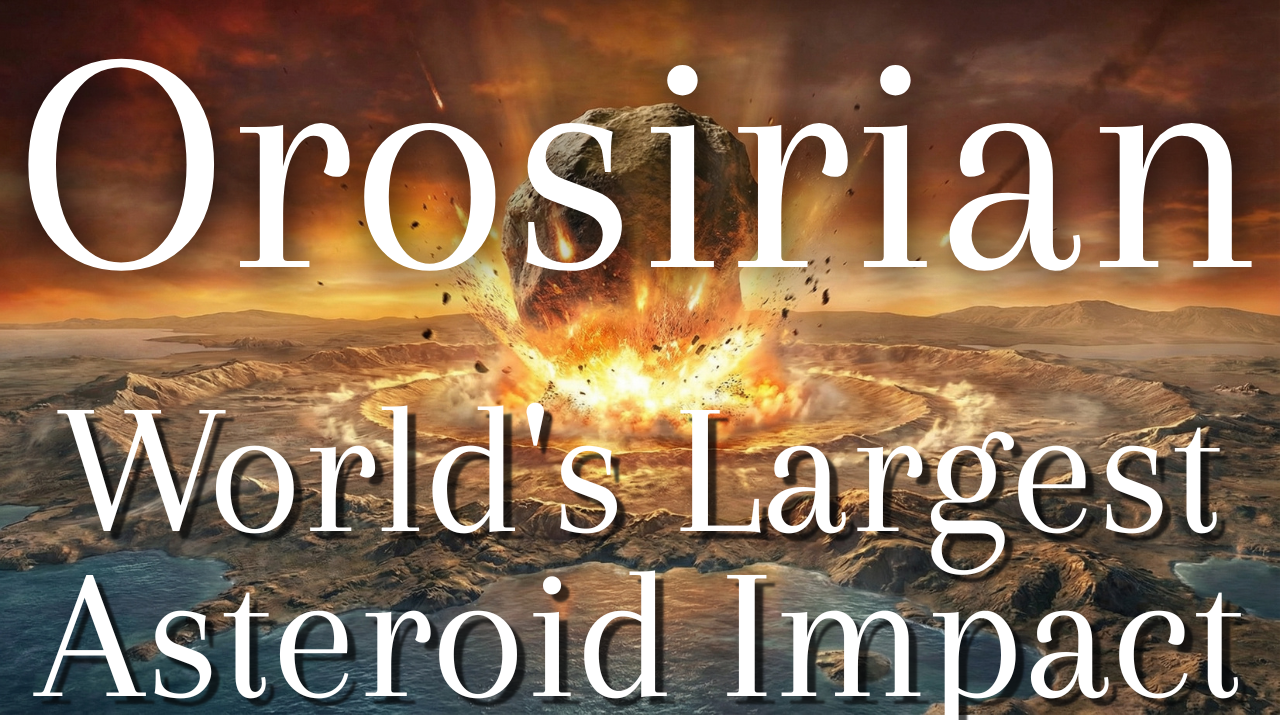
- Orosirian Period Explained: How Giant Asteroid Impacts and the Oxygen Revolution Shaped Earth 2 Billion Years Ago
- What Is the Orosirian Period? Definition, Timeline, and Meaning
- The Vredefort Impact: Earth’s Largest Asteroid Crater and the Day the Sky Fell
- The Orosirian’s Hidden Legacy: Why This Era Powers Your Smartphone and Car
Orosirian Period Explained: How Giant Asteroid Impacts and the Oxygen Revolution Shaped Earth 2 Billion Years Ago
The ground beneath your feet, the air you breathe.
Have you ever imagined how much pain our planet endured—how dramatically it transformed—in the process of creating these “everyday” things we take for granted?
In all of Earth’s 4.6-billion-year history, no other period witnessed such an extreme coexistence of destruction and creation as the Orosirian Period, positioned in the middle of the Paleoproterozoic Era.
Around 2.05 billion years ago, Earth reached a decisive turning point.
The skies were beginning to fill with unprecedented concentrations of oxygen, spurring the evolution of life—while simultaneously, enormous asteroids exceeding 10 kilometers in diameter rained down upon the surface, delivering cataclysmic impacts powerful enough to melt the crust itself.
During this era, the ancient ocean—sometimes called “the ocean Orosirian”—served as a grand experimental laboratory where iron and oxygen engaged in massive chemical reactions, giving birth to many of the mineral resources we enjoy today.
If you believe that “Earth’s history is merely a quiet succession of sediment accumulation,” that perception will be completely overturned by the time you finish reading this article.
The name “Orosirian” derives from the Greek word meaning “mountain range.”
True to its name, this was an era of dynamic crustal movements—violent continental collisions that thrust up enormous mountains, paving the way for the formation of the supercontinent Columbia (also known as Nuna).
But that’s not all.
This period saw the Vredefort Impact—one of the largest asteroid impact events in Earth’s history—whose scars remain etched into the South African landscape even 2 billion years later.
Furthermore, in the history of life, this was when eukaryotes first appeared, marking the early stages of evolution from bacterial dominance toward complex life forms.
In this article, we will explore this little-known era of upheaval—the Orosirian—based on the latest geological findings and evidence.
The ‘Complete Edition’: Everything about Orosirian Period
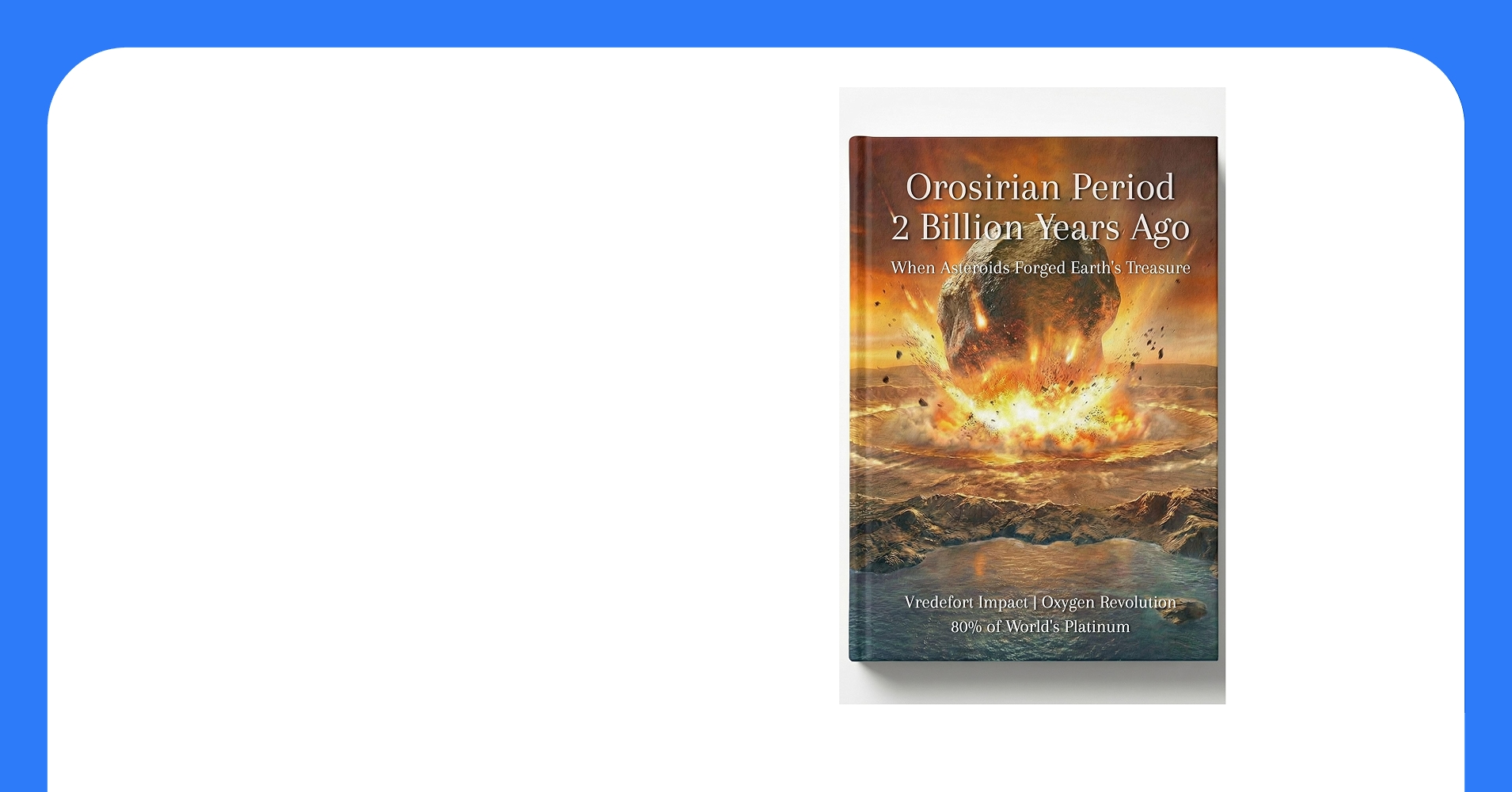
Liberal Arts Bundle

What Is the Orosirian Period? Definition, Timeline, and Meaning
To unravel Earth’s history, we must first understand its temporal framework.
The term “Orosirian” may be unfamiliar to those without a background in geology.
However, this geological period is recognized as one of the most important phases in Earth’s maturation—the transition from “youth” to “adolescence.”
According to the International Commission on Stratigraphy (ICS), the Orosirian is the third of four periods that divide the Paleoproterozoic Era.
Specifically, it spans from approximately 2.05 billion years ago (2.05 Ga) to approximately 1.8 billion years ago (1.8 Ga)—a duration of roughly 250 million years.
These figures—”2.05 Ga” and “1.8 Ga”—are not arbitrary boundaries.
They represent points where global environmental changes and geological events clearly shifted.
The Orosirian was preceded by the Rhyacian Period and followed by the Statherian Period.
Let us touch upon the origin of this period’s name.
The word “Orosirian” derives from the ancient Greek “orosira,” meaning “mountain range.”
Why “mountain range”?
Because this era represented the zenith of orogenic activity (mountain-building) in Earth’s history.
Two billion years ago, plate tectonics had begun functioning in earnest, with continental drift and collision occurring frequently in patterns similar to modern times.
Stable continental cores (cratons) from around the world collided violently, and it was during this period that enormous mountain ranges were formed.
For example, the Trans-Hudson Orogeny, which shaped North America, and the Svecofennian Orogeny visible in the Scandinavian Peninsula are events that symbolize the Orosirian.
These orogenic movements did more than simply build mountains.
They triggered metamorphic processes and magmatic activity in the deep crust, creating the conditions for numerous metal ore deposits.
Additionally, the Orosirian is known as a period of “dramatic global atmospheric and oceanic environmental change.”
Following the end of the Huronian glaciation in the preceding Rhyacian Period, Earth was heading toward warming.
But this was no simple warming.
As atmospheric oxygen levels continued to rise, methane—a greenhouse gas—was being broken down, leaving the climate balanced precariously.
To explore “Orosirian meaning” is to understand how Earth’s systems were attempting to transition from “chaos” to “order.”
During this era, the length of a day was shorter than today—estimated at approximately 19 to 20 hours.
The Moon was closer to Earth, appearing enormous in the night sky, and tidal forces were more powerful.
Imagine it.
A rapidly rotating Earth, a giant Moon illuminating the night sea, and rugged mountains rising violently beneath an atmosphere beginning to fill with oxygen.
That is the primordial landscape of the Orosirian.
The Vredefort Impact: Earth’s Largest Asteroid Crater and the Day the Sky Fell
Approximately 2.023 billion years ago.
Shattering the silence of the early Orosirian, the greatest tragedy in Earth’s history began.
At a point roughly 120 kilometers southwest of present-day Johannesburg, South Africa, a massive asteroid estimated at 10 to 15 kilometers in diameter struck Earth.
This is the Vredefort Impact.
The Vredefort Dome formed by this collision is registered as a UNESCO World Heritage Site—the oldest and largest confirmed asteroid impact structure on Earth.
The destructive power of this “Orosirian asteroid impact” exceeded all imagination.
Calculations suggest the collision’s energy was hundreds of millions to billions of times that of the Hiroshima atomic bomb.
At the moment of impact, the asteroid and surface rock instantly vaporized and melted, becoming ultra-high-temperature plasma.
An enormous crater approximately 300 kilometers in diameter formed instantaneously.
This is large enough to contain the entire Kanto Plain of Japan.
At the impact center, the crust was gouged out to depths of tens of kilometers, and in reaction, deep rocks near the mantle surged up to the surface at once.
This is the origin of the “dome” structure visible today.
Surrounding rocks were shattered by shock waves and transformed into a special rock called “pseudotachylite.”
This forms when rock instantly melts and vitrifies from frictional heat—and large quantities are found around Vredefort.
The impact’s effect on Earth’s environment was the most dramatic among “Orosirian period events.”
The massive dust and aerosols kicked up by the collision reached the stratosphere, blocking sunlight.
This is the so-called “Impact Winter.”
A fatal darkness for photosynthetic organisms may have persisted for months to years.
Additionally, atmospheric nitrogen combusted from the impact’s heat and fell as acid rain.
This is thought to have lowered the pH of the ocean surface layer, causing further damage to ecosystems.
Ironically, however, this “destruction” also served a “preservation” function.
The impact’s shock greatly deformed layers including the aforementioned Bushveld Complex, burying them deep or conversely uplifting them, creating conditions where ore deposits could survive uneroded to the present day.
One theory suggests that South Africa’s gold veins (Witwatersrand Basin) are so well preserved precisely because the Vredefort impact acted like a protective lid over the strata.
The Orosirian was thus also an era of “tremendous coincidences.”
The Bushveld magma and the Vredefort asteroid.
The miracle of these two events occurring in the same location, around the same time, is what makes present-day South Africa a resource powerhouse.
The Orosirian’s Hidden Legacy: Why This Era Powers Your Smartphone and Car
If the Orosirian era had not existed, our modern civilization, particularly the high-tech industry, might not have been possible.
This is not an exaggeration—the ore deposits formed during this era fundamentally support modern industry today.
To redefine “Orosirian meaning” from an economic perspective, it becomes a “storage vault of resources.”
First, the “Bushveld Complex” of South Africa.
The platinum and palladium produced here are indispensable for automobile exhaust catalytic converters.
They are also extremely important as electrodes for fuel cells advancing toward a hydrogen society.
The fact that nearly 80% of the world’s platinum reserves resulted from a single igneous event 2.05 billion years ago is a geological miracle.
Next, the “Sudbury Igneous Complex” of Canada.
The nickel and copper here are main materials for stainless steel, alloys, and electric vehicle (EV) batteries, with demand rising annually.
Thanks to an asteroid from space melting the crust and concentrating metals, we can efficiently mine resources.
And we must not forget South Africa’s “Witwatersrand Basin” gold.
While the gold itself formed before the Orosirian, there is a strong theory that the Vredefort Impact and its resulting crustal deformation played a preservation role (like a protective box) for these gold veins.
In other words, approximately 40% of all gold humanity has ever obtained may exist today precisely because of the Orosirian asteroid impact.
We use smartphones, drive electric vehicles, and enjoy clean air thanks to the drama of destruction and regeneration that occurred 2 billion years ago.
Continue Reading: The Complete Orosirian Story
Thank you for reading this far.
What you’ve just experienced is only the beginning of the Orosirian’s incredible story.
The complete article spans 15 chapters with comprehensive information, revealing even more dramatic events and their lasting impact on our world:
- Chapter 2: The “oxygen yo-yo phenomenon” — Why did atmospheric oxygen levels spike and crash wildly during this era?
- Chapter 3: The Lomagundi-Jatuli Event — The largest carbon isotope anomaly in Earth’s history and what it reveals about ancient life.
- Chapter 9-10: The Sudbury Impact — Another mega-asteroid struck 170 million years after Vredefort, creating Canada’s “Nickel Capital.”
- Chapter 12: The Emergence of Eukaryotes — When one cell swallowed another, complex life became possible.
- Chapter 13: The Canfield Ocean — How a “sulfur-scented poison sea” may have stalled evolution for a billion years.
- Appendices A-D: Detailed timeline, technical glossary, community Q&A, and a worldwide guide to Orosirian geological sites.
Why were there no animals yet?
Why did continents gather during this specific era?
And where did the mitochondria inside your cells actually come from?
All the answers await in the complete version.
The ‘Complete Edition’: Everything about Orosirian Period
Liberal Arts Bundle

コメント