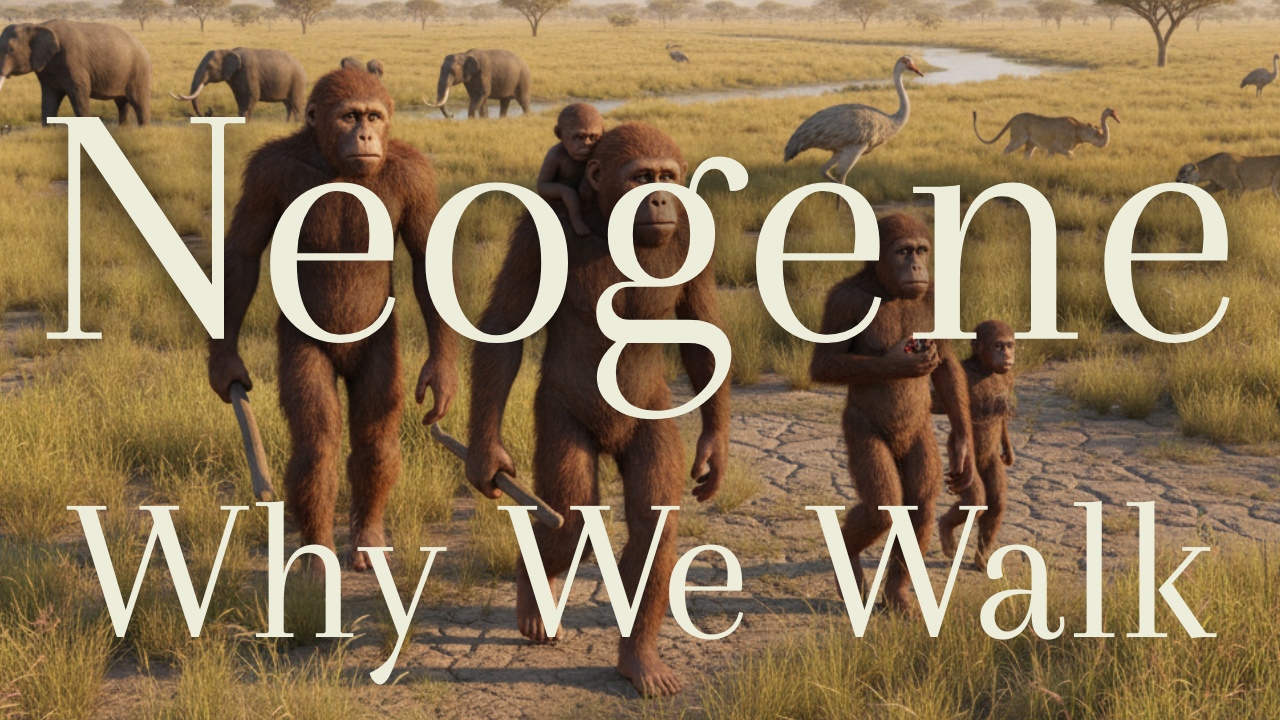
There used to be a world that was both familiar and famously alien.
The climate was cooling, stripping away ancient forests and replacing them with vast, open grasslands.
This is the Neogene Period.
Spanning from approximately 23.03 million years ago to 2.58 million years ago, this geological era is arguably the most critical for understanding the modern world.
Why?
Because it was during this time that the “Earth as we know it” was finalized.
The Himalayas rose to pierce the sky.
The Mediterranean Sea dried up and was reborn.
The Japanese archipelago separated from the Eurasian continent to form its distinctive arc.
And, perhaps most significantly for us, a certain group of primates left the safety of the trees to walk upright on the plains.
This article is a comprehensive journey through the 20 million years of the Neogene.
We will explore the dramatic geological shifts, the explosive evolution of mammals like horses and elephants, the reign of the megalodon in the oceans, and the humble beginnings of the human lineage.
Welcome to the era that shaped our today.
The ‘Complete Edition’: Everything about Neogene Period
Chapter 1: Defining the Neogene Period
What is the Neogene?
The Neogene Period is the second of the three periods that make up the Cenozoic Era, the “Age of Mammals.”
It follows the Paleogene Period and precedes the Quaternary Period (the period we typically associate with ice ages and humans).
Strictly defined by the International Commission on Stratigraphy (ICS), the Neogene covers the timeframe from 23.03 million years ago (Ma) to 2.58 Ma.
It is subdivided into two distinct epochs:
- Miocene Epoch (23.03 – 5.33 Ma): The longer, earlier phase characterized by significant mountain building and the expansion of grasslands.
- Pliocene Epoch (5.33 – 2.58 Ma): The shorter, later phase where the climate cooled significantly, leading up to the glacial cycles of the Quaternary.
Roughly speaking, the Neogene is the bridge between the hothouse world of the distant past and the icehouse world of the recent past.
The “New” Third Period
The term “Neogene” comes from the Greek words neos (new) and genos (born/kind), meaning “new born” or “new age.”
Historically, geological time was divided into Primary, Secondary, Tertiary, and Quaternary.
The “Tertiary” covered most of the Cenozoic.
However, as geology advanced, it became clear that the younger part of the Tertiary was distinct from the older part.
The older part became the Paleogene, and the younger, more modern-looking part became the Neogene.
The Neogene is characterized by fossils of animals and plants that are clearly related to, often direct ancestors of, modern species.
Chapter 5: The Explosion of Mammals and the Age of Grasslands
The Co-evolution of Grass and Grazers
The spread of grasslands (savannas, steppes, pampas) triggered an evolutionary arms race.
Before this, most herbivores were browsers, eating soft leaves in forests.
Grass is different.
It is tough, abrasive (containing silica), and grows from the ground up.
To survive on the open plains, animals needed two things:
1. Speed: To escape predators in a landscape with no hiding spots.
2. Specialized Teeth: High-crowned (hypsodont) teeth that could withstand the constant grinding of abrasive grass.
This led to the rapid evolution of modern grazing mammals: horses (Equidae), antelopes, camels, and cattle.
The evolution of the horse family, from small forest dwellers like Anchitherium to swift grazers like Hipparion and eventually Equus, is a direct record of this grassland expansion.
Giants of the Neogene
The Neogene supported a breathtaking array of megafauna.
Proboscideans (Elephants): This was the golden age of elephants. They were everywhere. Weird forms like the shovel-tusked Platybelodon and the four-tusked Gomphotherium roamed the wetlands.
Chalicotheres: Bizarre relatives of horses and rhinos that looked like gorillas, walking on their knuckles and pulling down tree branches with large claws.
Carnivores: As prey grew faster, so did predators. The “Bone-crushing dogs” (Borophagus) and early saber-toothed cats (Machairodus) evolved to take down large grazers.
Chapter 6: The Neogene Ocean and the Megalodon
The Rule of the Megalodon
In the oceans, mammals had returned to the sea (whales and seals) and were thriving.
This abundance of high-fat food sources allowed for the evolution of the largest shark to ever live: Otodus megalodon.
Reaching lengths of up to 15-18 meters (three times the size of a Great White), Megalodon was the apex predator of the Miocene seas.
Its bite force was strong enough to crush the skull of a prehistoric whale.
However, as the Pliocene cooling set in, the warm waters Megalodon preferred disappeared.
Whales migrated to colder, food-rich polar waters where Megalodon couldn’t follow.
Starved and outcompeted by smaller, more agile sharks (like great whites), the giant faded into extinction.
Desmostylians: The Mystery Beasts
The North Pacific was home to a unique order of marine mammals found nowhere else and at no other time: the Desmostylia.
Creatures like Desmostylus and Paleoparadoxia looked somewhat like hippos or walruses.
They had distinct, column-like teeth bound together (hence the name “Desmostylus” – bound pillars).
They likely fed on seaweed or seagrass in coastal waters.
They are an iconic part of Japan’s Neogene fossil record but went extinct before the period ended.
Chapter 8: The Dawn of Humanity
Leaving the Trees
The drying of Africa was the catalyst for our own story.
As the unified rainforests of Africa broke apart into patchy woodlands and savannas, our primate ancestors faced a choice.
Stay in the shrinking trees, or venture onto the dangerous ground.
The split between the lineage of chimpanzees and the lineage of humans (hominins) occurred around 6 to 7 million years ago, in the late Miocene.
Fossils like Sahelanthropus tchadensis (7 Ma) and Orrorin tugenensis (6 Ma) show the earliest signs of bipedalism.
Chapter 9: The Formation of the Japanese Archipelago
The Opening of the Sea of Japan
For Japanese geology, the Neogene is the defining era.
At the start of the period, Japan was still attached to the eastern edge of the Eurasian continent.
Around 25 to 15 million years ago, a massive rifting event occurred.
The crust stretched and broke, and seawater rushed in to form the Sea of Japan.
As Japan tore away from the mainland, intense underwater volcanism erupted.
This history is recorded in “Green Tuff” – layers of greenish volcanic ash found all along the Sea of Japan coast.
A Land of Volcanoes and Mountains
Following this separation, the collision of the Izu-Bonin arc (riding the Philippine Sea Plate) into central Honshu began.
This compression uplifted major mountain ranges, including the Japan Alps.
Virtually all of Japan’s major topographical features, from its coastline to its mountain spines, were carved during the violent birth pangs of the Neogene.
Full Version Table of Contents
This free version is just a glimpse effectively 10% of the whole story.
The complete paid version covers:
-
- Part 1: Fundamentals of the Neogene
- ✅ Chapter 2: The Geological Timescale
- ✅ Chapter 3: Continental Drift (Himalayas, Panama)
- ✅ Chapter 4: Climate Change and Global Cooling
- ✅ Chapter 7: The Green Revolution (C4 Plants)
- ✅ Chapter 9: Formation of the Japanese Archipelago (Japan Sea, Green Tuff) [Full Detail]
- Part 1: Fundamentals of the Neogene
-
- Part 2: World Tour & Regional Guide
- ✅ Chapter 11: North America (Rockies & Prairies)
- ✅ Chapter 12: South America (The Lonely Continent)
- ✅ Chapter 13: Europe (Mediterranean Salinity Crisis)
- ✅ Chapter 14: Africa (Rift Valley & Human Origins)
- ✅ Chapter 15: Asia (Monsoons)
- Part 2: World Tour & Regional Guide
- Special Features & Data Files
- ✨ Special: Japan’s Regional Fossil Guide
- ✅ Detailed Neogene Timeline
- ✅ Biological Encyclopedia (Megalodon, Desmostylus, etc.)
Discover the dramatic story of our planet’s transformation and the origins of the Japanese archipelago.
All the answers are in the full version.
The ‘Complete Edition’: Everything about Neogene Period


コメント