When you look back at Earth’s history, you might imagine the Jurassic period where dinosaurs roamed, or the Cambrian period where trilobites dominated the seas.
Or perhaps you imagine the African savannah where our ancestors took their first steps.
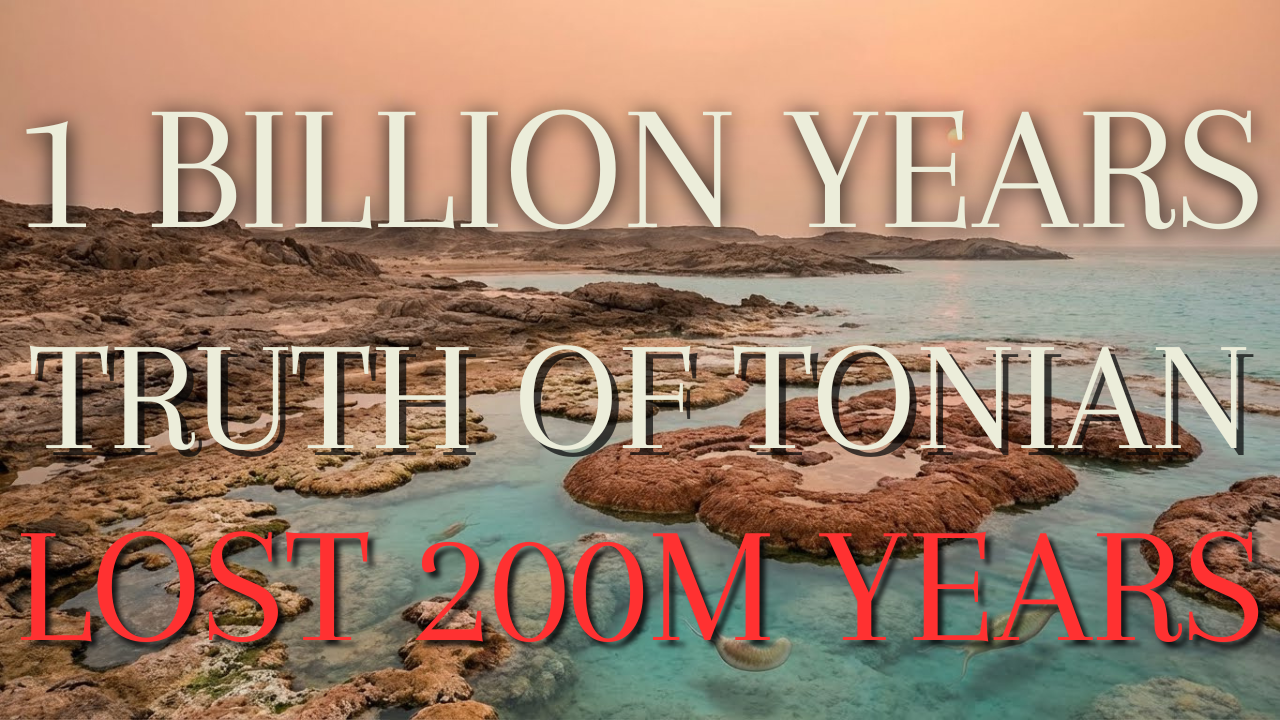
But did you know that far earlier than those times, 1 billion years ago, there was a decisive turning point on Earth toward the “life-filled planet” we know today?
The name of that era is the Tonian Period.
Spanning approximately 280 million years from 1 billion to 720 million years ago, this period has long been treated like a “blank page” in geology textbooks.
This is because no conspicuous large animal fossils were found, and the geological record was fragmentary.
However, dramatic research progress in recent years is revealing that this era was a true revolutionary period for the Earth system.
Imagine.
A majestic scene where the supercontinent Rodinia, containing all continents united as one, lay directly under the Earth’s equator.
The moment when that supercontinent was torn apart by the immense power of the Earth’s interior, birthing the great ocean that would become the prototype of the current Pacific.
And the fact that in the ancient seas wrapped in silence, lives small enough to be seen only with a microscope possessed complex bodies for the first time, laying the foundation for the coming age of animals.
The Tonian Period is the era when Earth awakened from a “boring planet” to a “dynamic planet.”
Without this era, the subsequent formation of the ozone layer, the Cambrian Explosion, and even the birth of humanity might not have happened.
In this article, we will journey in detail through this mysterious world of 1 billion years ago, based on the latest geological discoveries and paleontological results.
We have covered everything about the Tonian Period, from the latest papers in the English-speaking world to findings from the Japanese geological community, and even seeds of controversy still unresolved.
Why did the supercontinent split?
Why did life diversify in this era?
And how was the “Snowball Earth,” the greatest cooling event in Earth’s history that visited at the end of the Tonian Period, prepared?
Come, let’s begin an exploration into a lost world, crossing 1 billion years of time.
This is not merely a record of the past.
It is a grand biography to know how this blue planet we live on was completed.
The ‘Complete Edition’: Everything about Tonian Period

- Chapter 1: What is the Tonian Period? The Dawn of Earth 1 Billion Years Ago
- Chapter 6: The Mystery of Oxygen Concentration: Atmosphere and Ocean Chemistry of the Tonian Period
- Chapter 9: Road to Multicellular Animals: Tonian Animal Ancestors
- Chapter 13: Calculated Cataclysm at End of Tonian: Prologue to Sturtian Glaciation
- Read the Full Version: Unraveling the Missing Links of 1 Billion Years Ago
Chapter 1: What is the Tonian Period? The Dawn of Earth 1 Billion Years Ago
The Tonian Period is the era that marks the beginning of the Neoproterozoic Era in the geological time scale.
Its duration points to the approximately 280 million years starting from roughly 1 billion years ago (1000 Ma) and ending 720 million years ago (720 Ma).
The length of time of “280 million years” is far longer than the entire Mesozoic Era when dinosaurs lived (about 180 million years), a vast expanse of time compared to which human history is but a blink of an eye.
However, despite being such a long period, the Tonian Period is hardly known to the general public.
The reason is that this era corresponds to the eve of the explosion of “visible life.”
Large animal fossils clearly visible to the naked eye appear only after entering the Cryogenian Period, the Ediacaran Period, and the Cambrian Period that follow the Tonian.
So, was the Tonian Period an “era of nothing”?
No, the fact is quite the opposite.
This era was a period of “preparation and accumulation” rarely seen in Earth’s history, both geologically and biologically.
Origin and Meaning of the Name “Tonian”
The unfamiliar word Tonian drives from the Greek word “tonas”.
This word means “stretch” or “tension.”
Why was the name “stretch” given to a geological era?
That is because the greatest geological event characterizing this era was the “stretching” of the crust associated with the breakup of the supercontinent Rodinia.
On the Earth’s surface at that time, there existed the massive supercontinent Rodinia where all continents were merged.
From the middle to the latter half of the Tonian Period, mantle plumes rose beneath this supercontinent, and forces worked to tear the huge continent apart.
The land was stretched, thinned, and eventually cracked, allowing the sea to enter.
This “state of tension where the earth is torn apart” is the identity of this era.
It was in 2004 that this name was formally approved by the International Commission on Stratigraphy (ICS), but geologists had noticed the strata patterns unique to this era even before that.
That is because evidence that stable continents entered an active phase and sedimentary basins began to form was found here and there.
Positioning of the Tonian Period in Earth’s History
The Tonian Period is the starting point of the “Neoproterozoic,” which corresponds to the very end of the “Proterozoic Eon,” the third of the four major divisions of Earth’s history.
This positioning is extremely important.
Immediate before the Tonian Period, an era called the “Mesoproterozoic” had continued for about 600 million years.
The Mesoproterozoic is an era where Earth’s environment and biological evolution are said to have progressed extremely slowly, and is often called the “Boring Billion” by geologists.
The Tonian Period is the era that put an end to this “boring era.”
Crossing the 1 billion year mark, Earth’s system began to change dramatically.
The atmospheric oxygen concentration, which had been stable at a low level until then, began to show signs of rising, ocean chemical composition changed, and eukaryotes (organisms with nuclei in cells) began to diversify.
In other words, the Tonian Period can be said to be the moment when the switch from a “static Earth” to a “dynamic Earth” was flipped.
If there had been no “run-up period” called the Tonian Period, the subsequent explosive evolution of life would likely not have occurred.
Boundaries Defining the Tonian Period
Geological era boundaries are usually defined by the appearance or extinction of specific fossils, or clear geological events (GSSP: Global Boundary Stratotype Section and Point).
However, the number “1 billion years ago,” which is the beginning of the Tonian Period, is currently no more than a numerical division defined as a “Global Standard Stratigraphic Age (GSSA).”
In other words, a worldwide common rock reference point clearly indicating “from here is the Tonian Period” has not yet been established.
This is because 1 billion-year-old strata have often undergone metamorphism (alteration by heat or pressure) when viewed globally, making it difficult to find well-preserved continuous strata.
On the other hand, the end of the Tonian Period, “720 million years ago,” is defined by a very clear event.
That is the beginning of the “Sturtian Glaciation,” where the entire Earth is said to have been covered in ice.
The period up until immediately before this dramatic cooling event began is the Tonian Period, and as soon as the ice age begins, the baton is passed to the Cryogenian Period.
Therefore, research on the Tonian Period is, in a sense, a process of unraveling the mystery of “why Earth rushed from a warm era into the extreme state of global freezing.”
The key to that answer lies in the breakup of the supercontinent starting around 850 million years ago in the Tonian Period, and the accompanying changes in volcanic activity and weathering.
From the next chapter, let’s look in detail at the world before the opening of the Tonian Period, that is, how the “Boring Billion” came to an end, starting from that background.
Chapter 6: The Mystery of Oxygen Concentration: Atmosphere and Ocean Chemistry of the Tonian Period
For life on Earth, especially large multicellular organisms, oxygen is an essential energy source.
Therefore, knowing “what oxygen concentration was like” in the Tonian Period just before animals appeared is extremely important for exploring our roots.
It used to be the dominant theory that oxygen concentration rose rapidly around the end of the Proterozoic (Neoproterozoic Oxygenation Event: NOE).
However, the latest research results paint a more complex and dynamic world.
Complex Truth of the “Oxygenation Event”
Atmospheric oxygen concentration in the Tonian Period is thought to have been on an upward trend compared to the previous “Boring Billion,” but it was still far below current levels (about 21%), estimated at perhaps several percent to 10%.
A more important change was happening in the “ocean” rather than the atmosphere.
The ocean before the Tonian Period is thought to have been a “toxic ocean (Canfield Ocean)” with slight oxygen only in the surface layer, and the deep layer anoxic and rich in hydrogen sulfide.
Entering the Tonian Period, massive amounts of nutrient salts (phosphorus, iron, etc.) flowed from land into the sea due to Rodinia continent breakup and orogeny.
This caused photosynthetic algae (eukaryotic algae and cyanobacteria) to bloom, producing large amounts of organic matter.
Burial of this organic matter on the seabed left clearer oxygen that should have been used for decomposition, resulting in a gradual increase in seawater oxygen concentration.
However, it still took time for the entire deep sea to be completely filled with oxygen.
The sea of the Tonian Period seems to have been in a very unstable chemical state where “oxygenated waters,” “iron-rich anoxic waters,” and “hydrogen sulfide-rich anoxic waters” were intricately mixed in a mosaic depending on location and depth.
It is possible that this instability itself placed a strong selection pressure on life: “adapt to oxygen or perish.”
Adaptation to high oxygen environments opened the path to multicellular animals performing energy-efficient metabolism (aerobic respiration).
Chapter 9: Road to Multicellular Animals: Tonian Animal Ancestors
We have talked about algae and single-celled organisms so far, but what you are most curious about is probably the point of when “animals (multicellular animals)” were born.
It was once thought that the appearance of animals was much later, in the “Cambrian Explosion (approx. 540 million years ago)” or the preceding “Ediacaran Biota (approx. 575 million years ago).”
However, the “molecular clock” method, which estimates biological divergence times by calculating back from DNA mutation rates, has continued to suggest that the origin of animals is much older.
According to molecular clock calculations, it is highly likely that the common ancestor of the animal kingdom was born in this very Tonian Period (around 800-700 million years ago).
So, is there fossil evidence?
Subject of Controversy: Otavia antiqua
Always appearing here is a small fossil called “Otavia antiqua.”
Discovered in Tonian strata in Namibia (approx. 760 million years ago), this fossil is minute, less than 1 millimeter in size, but had a structure with irregular holes.
The discoverers claimed this to be the “oldest sponge (Porifera).”
If this is true, animals already existed in the Tonian Period.
However, there is still fierce controversy over this interpretation.
Many researchers suspect this is not an animal, but a single-celled organism like a foraminiferan, or merely an inorganic sedimentary structure.
Since decisive evidence (e.g., sponge-specific spicules) has not been found, the treatment “it might be an animal, but cannot be concluded” is common at present.
Still, many scientists do not deny the fact itself that “something corresponding to animal ancestors (pre-metazoans)” was in the Tonian sea.
For example, friends of choanoflagellates, which possess genes close to modern sponges, would have already existed in this era.
Repeating experiments toward multicellularity, they had already taken the “first step toward animals” at an invisible level.
Chapter 13: Calculated Cataclysm at End of Tonian: Prologue to Sturtian Glaciation
720 million years ago. The end of the Tonian Period coincides with the beginning of the most dramatic and harsh event in Earth’s history.
That is the start of the “Sturtian Glaciation.”
This was the first and largest of the “Snowball Earth (Global Freezing)” events where the entire Earth was covered in ice up to near the equator.
Why Did the Tonian Period End?
In the strata at the end of the Tonian Period, a negative carbon isotope ratio anomaly (negative excursion) even more intense than the Bitter Springs Anomaly, called the “Islay Anomaly,” is carved.
This indicates that the Earth system reached a catastrophic turning point.
What is considered the direct trigger is the formation of the “Franklin Large Igneous Province” spreading in current northern Canada.
Around 716 million years ago, accompanying the breakup of the supercontinent Laurentia, one of the largest volcanic activities in history occurred.
You might think, “Shouldn’t volcanic activity cause warming?”
However, ironically, the lava (basalt) erupted at this time spread exactly on land near the equator.
Pouring tropical rain rapidly weathered the new lava, sucking up atmospheric CO2 to the limit.
Furthermore, sulfuric aerosols scattered into the stratosphere by eruptions may have blocked sunlight, causing rapid cooling (volcanic winter).
Due to these combined factors, Earth’s temperature fell below the threshold, and ice sheets expanding from polar regions finally reached the equator.
Once ice covers the Earth, white ice reflects sunlight (albedo effect), and Earth becomes locked as an “ice planet” that will never warm again.
Thus, the warm world of the Tonian Period where bacteria and algae prospered and sought evolution into animals came to be closed under ice kilometers thick.
The end of the Tonian Period was the beginning of a great trial for life.
However, only those who survived this ice age would obtain tickets to evolve into “large animals” in the next Ediacaran Period.
Read the Full Version: Unraveling the Missing Links of 1 Billion Years Ago
Thank you for reading this far.
This article is just the entrance to the lost era of the Tonian Period.
In the full version, we have prepared detailed content covering the entire aspect of the Tonian Period, beyond what was introduced here.
[Content available in the full version]
- Chapters 2-5: The formation and breakup of Supercontinent Rodinia, and the full mechanism of magnificent crustal movements.
- Chapters 7-8: Explosive evolution of eukaryotes and the true identity of mysterious microfossil “Acritarchs”.
- Chapters 10-12: Fungi advancing on land, Grand Canyon strata, and “Earth’s breathing” told by carbon isotopes.
- Chapters 14-15: Unresolved scientific controversies and the legacy the Tonian Period left for modern times.
- Appendices A-H: Detailed chronology, fossil guide, guide to decoding geochemical data, history of research, etc.
Why did the “Boring Billion” end, and how did Earth carve out the path to the “Planet of Animals”?
Please experience the entire magnificent drama in the full version.
The ‘Complete Edition’: Everything about Tonian Period


コメント