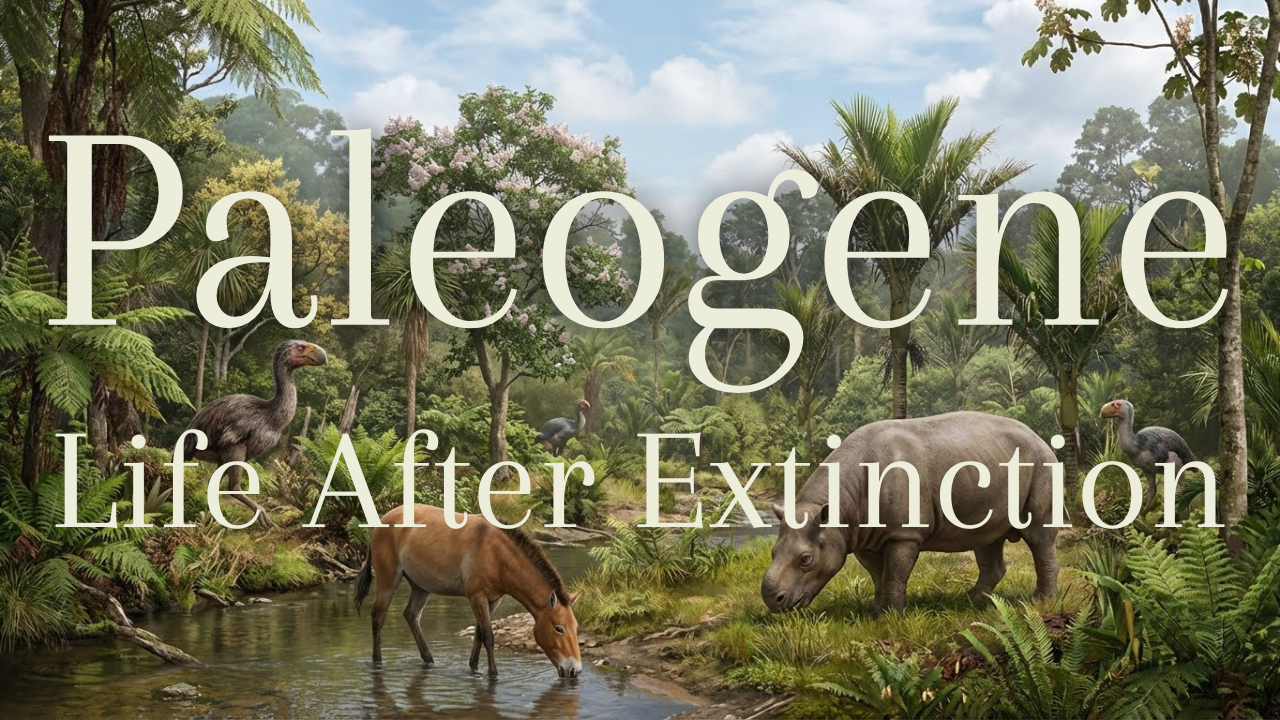
About 66 million years ago, a massive asteroid collided with Earth, wiping out the dinosaurs and many other forms of life.
However, this catastrophic event also marked the beginning of a new era.
That era is the “Paleogene Period.”
“When exactly was the Paleogene?” “What happened to Earth after the dinosaurs went extinct?” “Why were mammals able to evolve so rapidly?”
Many of you may have these questions.
The Paleogene is one of the most dramatic periods in Earth’s history, lasting from about 66 million years ago to about 23.03 million years ago.
In a world that had lost its dinosaur rulers, mammals and birds diversified explosively, laying the foundation for modern ecosystems.
It was a time when giant crocodiles and snakes reigned as apex predators, the first primates began living in the forests, and the ancestors of whales ventured into the seas.
This article provides a thorough explanation of the basic definition of the Paleogene and the “Mass Extinction Event” that heralded its beginning.
The ‘Complete Edition’: Everything about Paleogene Period
Chapter 1: What is the Paleogene? Definition and Origin of the Name
1-1 Basic Definition of the Paleogene
The Paleogene Period is the first period of the Cenozoic Era in the geologic timescale, spanning from about 66 million years ago to about 23.03 million years ago.
This era began immediately after the end of the Cretaceous Period of the Mesozoic Era, following the mass extinction of dinosaurs and many other organisms.
The name “Paleogene” is a combination of the Greek words “palaios” (old) and “genos” (birth, origin).
It means “period of old origin,” referring to the older strata and biota within the Cenozoic Era.
In geologic time classification, the Paleogene is the first of the three “periods” that make up the Cenozoic Era.
The Cenozoic is divided into the Paleogene, the Neogene, and the Quaternary Period, with the Paleogene serving as the crucial foundation.
In the past, the Paleogene and Neogene were collectively called the “Tertiary Period.”
However, as geology advanced, it became clear that significant differences in climate, biota, and geological events existed between these two eras, and they are now treated as separate periods.
In the official geologic time scale established by the International Union of Geological Sciences (IUGS) and the International Commission on Stratigraphy (ICS), the Paleogene is recognized as a clearly independent division.
1-2 Historical Background of the Name
The background behind the name “Paleogene” lies in the history of geological development.
In the early 19th century, geologists were trying to decipher Earth’s history from the layering of strata.
At that time, geologists classified Earth’s history into four major eras based on fossil types and rock characteristics: Primary, Secondary, Tertiary, and Quaternary.
Of these, the “Tertiary” referred to the era after the extinction of dinosaurs but before the appearance of humans.
However, as research progressed, it became apparent that even within this Tertiary period, there were major environmental changes and shifts in biota.
Thus, in the 20th century, the Tertiary was subdivided into the “Paleogene” and “Neogene.”
The prefixes “Paleo-” and “Neo-” indicate the relative age of each era.
A simple naming convention was adopted where the Paleogene is older and the Neogene is newer.
1-3 Position in Geologic Time
Earth’s history spans about 4.6 billion years, but the Paleogene is located in a relatively new era.
Geologic time is broadly divided into four “eons”: Hadean, Archean, Proterozoic, and Phanerozoic.
Of these, the Phanerozoic is the era where fossils are abundant, lasting from about 541 million years ago to the present.
The Phanerozoic is further divided into three “eras”: Paleozoic, Mesozoic, and Cenozoic.
As the first “period” of the Cenozoic, the Paleogene serves as an important bridge connecting the Mesozoic Era to the modern world.
The Cenozoic is often called the “Age of Mammals,” and the Paleogene was the very period that inaugurated this age.
While the Mesozoic was the “Age of Dinosaurs,” after the Paleogene, mammals replaced dinosaurs to reign at the top of the ecosystem.
This dramatic shift was brought about by the mass extinction event approximately 66 million years ago.
The asteroid impact wiped out large reptiles, including dinosaurs, and mammals filled the resulting ecological void.
1-4 Defining Characteristics
There are many features that distinguish the Paleogene from other geologic periods.
The most notable is the explosive diversification of mammals.
Until the end of the Cretaceous, mammals were primarily small, mouse-like creatures.
However, entering the Paleogene, a surprisingly diverse array of mammals appeared, including large herbivores, carnivores, and even ancestors of whales that ventured into the sea.
Birds also underwent significant evolution during the Paleogene.
Birds evolved from dinosaurs, survived the extinction, and acquired various ecological niches in the Paleogene.
Of particular note is that some birds lost their ability to fly and grew to gigantic sizes to become apex predators.
Terror birds like Gastornis, standing over 2 meters tall, played important roles in the ecosystems of the time.
Climate-wise, the Paleogene also has remarkable characteristics.
The Eocene Epoch, in particular, was the warmest period in the Cenozoic, a “Greenhouse Earth” state with almost no ice at the poles.
The presence of crocodiles and palm trees in the Arctic Circle attests to the warmth of the time.
On the other hand, in the Oligocene Epoch, the latter part of the Paleogene, the climate gradually cooled, and ice sheets began to form on Antarctica.
Thus, the Paleogene was also a transitional period from a warm climate to a cooling one.
1-5 Significance of Studying the Paleogene
Studying the Paleogene is extremely important for understanding the modern global environment and ecosystems.
First, we can learn about the ecosystem recovery process after a mass extinction.
The asteroid impact that wiped out the dinosaurs was one of the most devastating environmental destructions in Earth’s history.
However, Earth’s ecosystems recovered magnificently throughout the Paleogene, regaining diversity.
By studying this process, we can gain insights into modern environmental problems.
Also, climate change in the Paleogene attracts attention as an analog for understanding modern global warming.
The “Greenhouse Earth” state of the Eocene was an era when atmospheric carbon dioxide concentrations were much higher than today.
Analyzing climate data and ecosystem responses from this era provides clues to predict the impact of future climate change on Earth.
Furthermore, the Paleogene is the era when our distant ancestors appeared.
The first primates lived in Paleogene forests, and their subsequent evolution ultimately led to the birth of humanity.
Studying Paleogene primate fossils is an essential task in exploring human origins.
Energy resources such as oil and natural gas are also produced from Paleogene strata.
Major oil fields in the Middle East and the Gulf of Mexico are deeply related to Paleogene strata.
Thus, Paleogene research has practical value as well as pure academic interest.
Chapter 2: The Beginning of the Paleogene – The K-Pg Boundary and Mass Extinction
2-1 What is the K-Pg Boundary?
The beginning of the Paleogene is marked by one of the most dramatic events in Earth’s history.
That is the “Cretaceous-Paleogene Boundary” (K-Pg Boundary, formerly known as the K-T Boundary).
“K” stands for the German word for Cretaceous, “Kreide,” and “Pg” is the abbreviation for Paleogene.
This boundary is located about 66 million years ago and functions as a clear line dividing the Mesozoic and Cenozoic eras, that is, the “Age of Dinosaurs” and the “Age of Mammals.”
In strata around the world, the K-Pg boundary can be recognized as a thin layer of clay.
This clay layer contains an abnormally high concentration of iridium, an element that is extremely rare on Earth.
Iridium is abundant in asteroids and meteorites, and this “iridium anomaly” later became the definitive evidence for the asteroid impact theory.
From the K-Pg boundary layer, other evidence indicating a massive impact, such as shocked quartz and microtektites, has also been discovered.
Shocked quartz is a deformed quartz crystal formed only under extremely high pressure and is not generated by normal geological processes on Earth.
2-2 The Chicxulub Impact Event
It has been scientifically established that the cause of the mass extinction at the K-Pg boundary was the collision of a massive asteroid near the current Yucatán Peninsula in Mexico.
The crater formed by this impact is called the “Chicxulub Crater,” and it is a massive structure with a diameter of about 180 kilometers.
The impacting asteroid is estimated to have been about 10 to 15 kilometers in diameter, a rock mass larger than Mount Everest crashing into Earth at a speed of about 70,000 kilometers per hour.
The energy of the impact was equivalent to more than 10 billion Hiroshima atomic bombs, making it one of the largest single events in Earth’s history.
At the moment of impact, shockwaves traveled across the entire planet, and a superheated fireball spread into the atmosphere at the impact site.
A vast amount of rock vapor and dust was released into the atmosphere, enveloping Earth in darkness.
The fact that the impact site was in a shallow sea area with strata containing limestone and sulfates also exacerbated the damage.
The evaporation of these rocks released massive amounts of sulfate aerosols into the atmosphere, causing a long-term sun-blocking effect.
2-3 Mechanism of Mass Extinction
The Chicxulub impact dealt a devastating blow to Earth’s biota through a complex mechanism.
First, immediately after the impact, a state called “Impact Winter” occurred.
Dust and sulfate aerosols floating in the atmosphere blocked sunlight, causing a drastic drop in light energy reaching the surface.
Photosynthesis was inhibited, causing the collapse of food chains starting from terrestrial and marine phytoplankton.
Temperatures also dropped sharply, estimated to have reached below freezing even in tropical regions.
This cooling is thought to have lasted from several months to several years.
On the other hand, immediately after the impact, widespread forest fires occurred due to thermal radiation from the fireball.
Some estimates suggest that about 70% of plants on Earth were burned down.
Furthermore, the sulfates released into the atmosphere fell as acid rain, inflicting additional damage on terrestrial and freshwater ecosystems.
In the oceans, acidification of surface waters caused significant damage to organisms with calcareous shells, such as corals and shellfish.
Due to such complex stresses, it is estimated that about 75% of all species went extinct.
2-4 Extinct Organisms
The most famous victims of the K-Pg boundary mass extinction were, of course, the dinosaurs.
All dinosaurs except birds disappeared in this extinction event.
Dinosaurs like Tyrannosaurus, Triceratops, and Brachiosaurus, which had dominated Earth for over 160 million years, went extinct in a geologically instantaneous period.
However, dinosaurs were not the only ones to go extinct.
Marine reptiles such as mosasaurs and plesiosaurs also went completely extinct.
Pterosaurs likewise disappeared, and large reptiles dominating the sky ceased to exist.
In the oceans, ammonites went completely extinct.
Ammonites were cephalopods that flourished throughout the Paleozoic and Mesozoic eras, and fossils with their spiral shells are very famous.
However, not a single species of ammonite survived beyond the K-Pg boundary.
Many groups of marine plankton also suffered great damage.
Especially, many species of foraminifera and coccolithophores that build calcareous shells went extinct, causing the collapse of the marine ecosystem’s foundation.
2-5 Surviving Organisms
Organisms that survived the mass extinction shared several common characteristics.
First, small body size was advantageous for survival.
Large animals required a lot of food, making survival difficult in an environment where the food chain had collapsed.
On the other hand, small animals could survive on less food, eating seeds, insects, and carrion to overcome the impact winter.
The ability to live underground or underwater also contributed to survival.
Mammals that burrowed underground, crocodiles and turtles living in water, and amphibians hibernating in the soil were protected from the extreme environmental changes on the surface.
Mammals are a representative group of organisms that survived the K-Pg boundary.
Mammals of that time were primarily small, mouse-like creatures, characterized by being nocturnal and omnivorous.
These characteristics were advantageous for surviving in dark and food-scarce environments.
Birds were also an important group that escaped extinction.
However, not all birds survived; many of the more primitive birds went extinct.
It is thought that mainly small, seed-eating or omnivorous species survived.
Reptiles such as crocodiles and turtles also survived.
Since they lived in water and had the ability to fast for long periods, they were able to overcome the crisis.
2-6 Ecosystem Recovery
Earth immediately after the mass extinction was a desolate world.
However, the vitality of life on Earth was amazing, and ecosystems began to recover in a relatively short period.
A few years to decades after the impact, ferns were the first plant group to recover.
Immediately above the K-Pg boundary layer, a “fern spore spike,” a layer with an abnormally high number of fern spores, is found worldwide.
This is evidence that ferns colonized the burnt fields first.
Subsequently, angiosperms (flowering plants) gradually recovered, and forests regenerated.
[Continue reading in the full version] The explosive evolution of mammals and the mystery of “Greenhouse Earth”
So far, we have looked in detail at the “dinosaur extinction event” that marked the beginning of the Paleogene.
However, the true drama of the Paleogene begins here.
How did the small, rat-like mammals that survived the extinction rise to become the rulers of the Earth?
And why did Earth become a “Greenhouse” much hotter than today, with crocodiles living in the Arctic Circle?
In the full version of “The Paleogene Period: A Complete Guide,” we thoroughly explain the following contents
Main contents of the full version
- Detailed breakdown of Paleocene, Eocene, and Oligocene: What happened in each epoch?
- Shocking data of “Greenhouse Earth”: Forests in the Arctic Circle and the true nature of the sudden warming event “PETM”.
- Continental drift and the birth of the Himalayas: The decisive moment when India collided with Asia.
- Amazing evolution of mammals:
- “Pakicetus”, the ancestor of whales that returned from land to sea
- “Andrewsarchus”, the largest terrestrial carnival ever
- Appearance of “early primates”, ancestors of us humans
- Mystery of the giant foraminifera “Nummulites”: The true identity of the organism that became the stone material for the pyramids.
- Metasequoia forests and the emergence of grasslands: How dramatic changes in flora changed the evolution of animals.
The magnificent resurrection drama of life unfolded on Earth after the dinosaurs were gone.
If you want to know the whole picture, please pick up the full version.
▼ Purchase the full version here
The ‘Complete Edition’: Everything about Paleogene Period

コメント