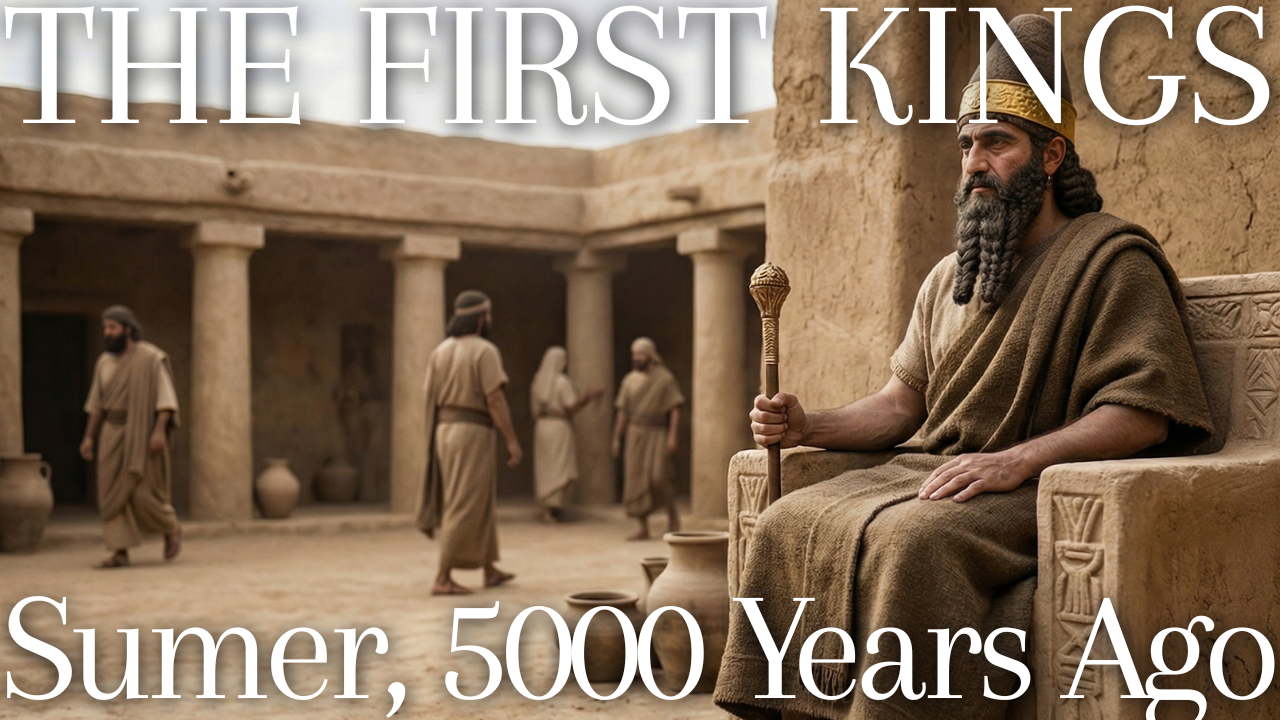
What was the Early Dynastic period of Mesopotamia, and why does it matter today?
If you have heard of ancient Mesopotamia, Sumerian civilization, Uruk, Ur, cuneiform writing, or the Epic of Gilgamesh, you have already touched the edge of one of the most important periods in human history.
The Early Dynastic period, usually dated from around 2900 BCE to around 2350 BCE, was the age when the cities of southern Mesopotamia became true city-states. Kingship became an institution. Temples and palaces managed land, labor, and trade. Writing moved from simple accounting into a tool for preserving law, literature, and historical memory.
It was also an age whose influence still quietly surrounds us. The 60 minutes in an hour and the 360 degrees in a circle both trace back to the mathematical traditions of ancient Mesopotamia. The idea that cities need administration, records, laws, and public works also took early shape in this world.
This article introduces the foundations of Early Dynastic Mesopotamia in a safe, accessible format suitable for both reading and educational video content. The complete version goes much deeper into the archaeology, writing systems, city-states, daily life, technology, and long-term legacy of this extraordinary civilization.
The ‘Complete Edition’: Everything about Early Dynastic Mesopotamia

Try Kindle Unlimited Free for 30 Days!

- What Was the Early Dynastic Period?
- Early Dynastic I, II, and III: The Basic Timeline
- The Geography of Sumer: Rivers, Canals, and the Fertile Crescent
- Major Sumerian City-States
- Why Cuneiform Changed Human History
- Uruk and the Legend of Gilgamesh
- Temples, Kings, and the Organization of Society
- The Legacy of Early Dynastic Mesopotamia
- What the Complete Version Covers
What Was the Early Dynastic Period?
The Early Dynastic period was one of the earliest historical periods of ancient Mesopotamia. It followed the Ubaid, Uruk, and Jemdet Nasr periods and marked a major transition in the history of civilization.
During the earlier Uruk period, the city of Uruk had already become one of the world’s first major urban centers. By the Early Dynastic period, southern Mesopotamia had entered a new stage. Multiple cities became independent political communities, each with its own ruler, patron deity, institutions, and surrounding agricultural territory.
These city-states did not form a single unified country. Cities such as Uruk, Ur, Lagash, Kish, Nippur, Eridu, Umma, and Shuruppak existed side by side, traded with one another, and developed their own identities.
The term “Early Dynastic” reflects the rise of dynasties and kingship. But the word should not be understood as meaning one empire ruled everything. A better way to imagine the period is as a landscape of powerful cities, each with its own ruling house and sacred traditions.
Early Dynastic I, II, and III: The Basic Timeline
Scholars usually divide the Early Dynastic period into three phases: ED I, ED II, and ED III.
ED I, roughly 2900 BCE to 2750 BCE, was a transitional phase. City walls began to appear, and material culture shows increasing regional differences.
ED II, roughly 2750 BCE to 2600 BCE, saw the city-state system mature. Social hierarchy became clearer, seal art developed, and elite tombs began to reveal the growing power and wealth of ruling families.
ED III, roughly 2600 BCE to 2350 BCE, is the best-documented phase. Large numbers of written records survive from this period, especially from Lagash, allowing historians to study land, labor, rations, trade, and administration in detail.
The Geography of Sumer: Rivers, Canals, and the Fertile Crescent
Early Dynastic civilization developed in southern Mesopotamia, in the river valleys of the Tigris and Euphrates. The word Mesopotamia means “the land between the rivers,” and that geography shaped nearly every part of life.
Southern Mesopotamia was part of the Fertile Crescent, but it was not an easy place to farm without organization. Rainfall was limited. The rivers could be unpredictable. Stone, timber, and metal were scarce. To build a stable society, people had to cooperate on a large scale.
Irrigation was the key. Canals brought water from the rivers to fields, making large-scale agriculture possible. Maintaining those canals required planning, labor, leadership, and record keeping. In this sense, the environment helped push Mesopotamian society toward complex institutions.
The same lack of local resources encouraged long-distance trade. Timber, stone, copper, tin, lapis lazuli, and other valuable materials came from Anatolia, Syria, the Iranian plateau, the Persian Gulf, and regions connected to the Indus civilization.
Major Sumerian City-States
Uruk was one of the most important cities in the ancient world. It had already grown into a major urban center before the Early Dynastic period and was also the legendary city of Gilgamesh.
Ur became famous through its royal cemetery and remarkable works of art. Lagash is especially important because its administrative documents reveal how land, labor, rations, and economic activity were managed.
Kish held a special symbolic status because later tradition said kingship after the Great Flood first descended there. Nippur was one of the most important religious centers, closely associated with Enlil and the legitimacy of kingship.
Eridu was remembered as one of the oldest sacred cities and as the city of Enki, god of fresh water and wisdom. Together, these cities show that Sumerian civilization was a network of urban worlds.
Why Cuneiform Changed Human History
Cuneiform is one of the oldest writing systems in the world. Its origins go back before the Early Dynastic period, but it developed significantly during this age.
At first, writing was mainly practical. It recorded goods, labor, grain, animals, and transactions. In a society where temples and palaces managed large quantities of resources, clay tablets made administration possible.
Over time, writing became more flexible. Signs became more abstract, and cuneiform developed the ability to represent sounds and syllables. Scribes could record names, grammar, legal agreements, royal inscriptions, hymns, myths, and stories.
This was a turning point in human history. Once language could be stored on clay, knowledge could travel across generations.
Scribal education became a respected path. Students trained in schools known as eduba, or “tablet houses,” and the scribe became one of the essential specialists of Sumerian society.
Uruk and the Legend of Gilgamesh
No city captures the imagination of Early Dynastic Mesopotamia quite like Uruk.
Uruk was already famous as one of the earliest great cities, but it also became linked to the legendary king Gilgamesh. In the Sumerian King List, Gilgamesh appears as a king of the First Dynasty of Uruk. Later literary tradition transformed him into the hero of the Epic of Gilgamesh.
The stories of Gilgamesh explore friendship, fame, human limits, and the search for meaning. Whether he was historical, legendary, or a mixture of both remains debated. But the tradition around him shows how early Mesopotamians imagined kingship and memory.
Temples, Kings, and the Organization of Society
Early Dynastic society was not simple. It included kings, priests, scribes, artisans, farmers, herders, merchants, laborers, and dependents attached to temples or palaces.
The temple was one of the most important institutions. It was a religious center, but also an economic organization. Temples owned land, employed workers, stored goods, supported craft production, and participated in trade.
The palace also grew in importance. Kings were responsible for public works, justice, and service to the gods. Their authority was usually explained as being granted by divine approval, especially through major gods such as Enlil.
This combination of temple, palace, and private economic activity created a complex society. It already contained many building blocks of later states: administration, law, records, organized labor, public infrastructure, and political legitimacy.
The Legacy of Early Dynastic Mesopotamia
The Early Dynastic period matters because so many later developments began here or took clearer shape here.
The city became a central form of human settlement. The state began to appear as an organized political structure. Writing became a tool for administration, memory, and literature. Mathematical traditions based on the sexagesimal system influenced how later cultures measured time and angles.
Sumerian religion and mythology influenced later Mesopotamian traditions. Sumerian literary themes continued in Akkadian and Babylonian works. Artistic forms such as cylinder seals, votive statues, temple architecture, and inlay work shaped the visual language of the ancient Near East.
Most importantly, Early Dynastic Mesopotamia shows us that civilization was not created all at once. It emerged through environment, labor, belief, memory, and the practical need to organize life in cities.
What the Complete Version Covers
This article has introduced the foundations of Early Dynastic Mesopotamia, but it only opens the door.
The complete version explores the subject in far greater depth, including:
– The full ED I, ED II, and ED III timeline
– The rise of Uruk, Ur, Lagash, Kish, Nippur, Eridu, and other city-states
– Cuneiform writing, scribal education, religion, trade, and daily life
– Technology, major artifacts, a glossary, and an FAQ for structured learning
If you want to understand how the earliest city-states worked, why Sumerian civilization mattered, and how ancient Mesopotamia shaped the foundations of later history, the complete version continues the journey in detail.
Early Dynastic Mesopotamia is one of the places where the human story first became urban, written, organized, and remembered.
The ‘Complete Edition’: Everything about Early Dynastic Mesopotamia
Try Kindle Unlimited Free for 30 Days!


コメント