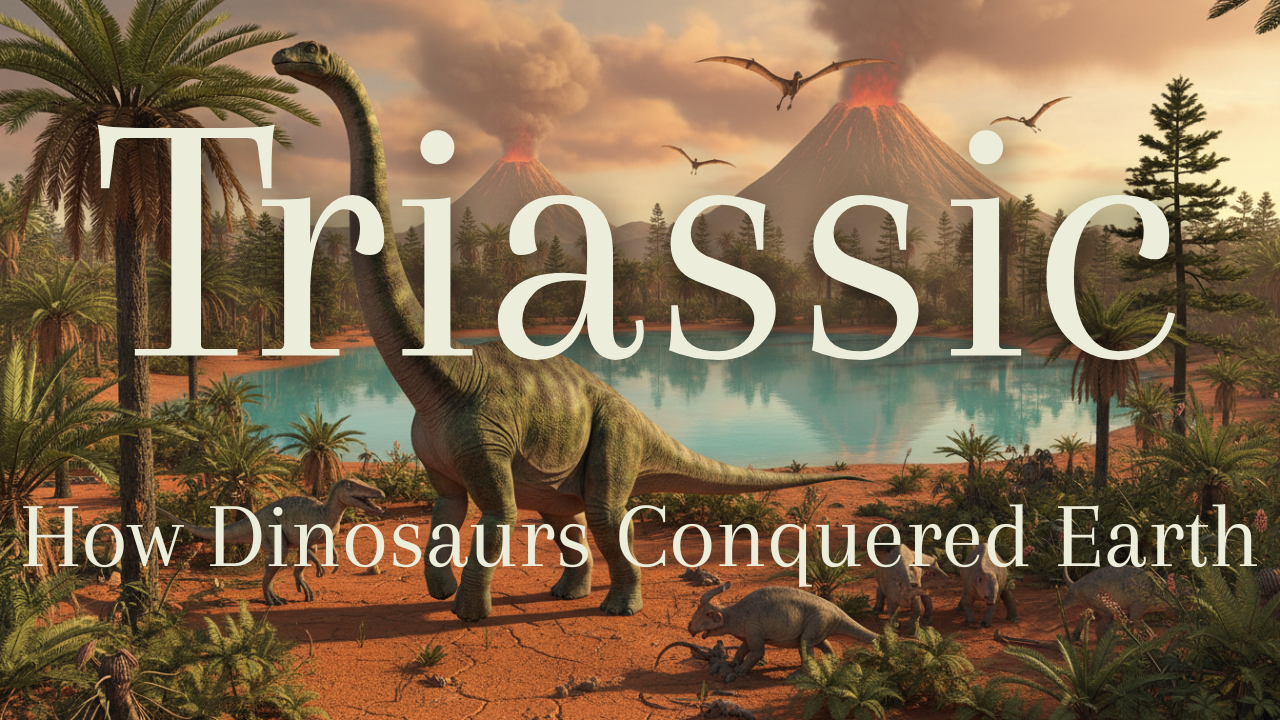
Have you ever heard of the “Triassic Period”?
When most people think of dinosaurs, they picture Tyrannosaurus rex or Triceratops, but these dinosaurs actually lived during the Cretaceous Period—a much later time.
So when and how did dinosaurs first appear on Earth?
The answer lies in the Triassic Period.
The Triassic Period began approximately 252 million years ago and lasted until about 201 million years ago—the first era of the Mesozoic.
During this time, Earth recovered from the largest mass extinction in history, and life embarked on a new evolutionary path.
The first dinosaurs emerged, pterosaurs took to the skies, and the ancestors of mammals were born—all during the Triassic Period.
Yet detailed information about the Triassic remains surprisingly scarce.
“How long ago was the Triassic?” “How is it different from the Jurassic and Cretaceous?” “Why is it called the Triassic?” “What dinosaurs existed then?” Many have wondered about these questions without finding satisfying answers.
This article comprehensively covers:
• Basic information about the Triassic (dates, name origin, time divisions)
• The Pangaea supercontinent and Earth’s environment
• Life’s recovery from the Permian-Triassic mass extinction
• Detailed profiles of Triassic dinosaurs
• The world of marine reptiles, ichthyosaurs, and plesiosaurs
• Evolution of pterosaurs, mammals, and amphibians
• Triassic plants and ecosystem structure
• The Carnian Pluvial Episode—2 million years of rain
• The end-Triassic mass extinction and its causes
• Detailed comparison with the Jurassic and Cretaceous
By the time you finish reading, you will understand that the Triassic was not merely “the beginning of the dinosaur age” but one of the most dramatic turning points in Earth’s history.
Let us begin our journey to Earth 250 million years ago.
The ‘Complete Edition’: Everything about Triassic period

Chapter 1: What is the Triassic Period? — Basic Definitions and Time Divisions
1-1. Definition and Position in Geological Time
The Triassic Period is the oldest of the three periods that make up the Mesozoic Era in the geological time scale.
The name “Triassic” was coined by the German geologist Friedrich von Alberti in 1834.
The geological time scale is a system of dividing Earth’s history based on rock and fossil records.
From largest to smallest, the divisions are: eon, era, period, epoch, and age.
The Triassic is positioned as follows:
Eon: Phanerozoic (the time since the Cambrian when multicellular life flourished)
Era: Mesozoic (known as the Age of Dinosaurs)
Period: Triassic (the first period of the Mesozoic)
The Mesozoic consists of three periods—Triassic, Jurassic, and Cretaceous—progressing in that order through time.
1-2. When Was the Triassic? — Precise Dates and Duration
Thanks to advances in radiometric dating, we now know precisely when the Triassic began and ended.
Start of the Triassic: approximately 251.9 million years ago
End of the Triassic: approximately 201.3 million years ago
Duration: approximately 50.6 million years
In other words, the Triassic began about 252 million years ago and ended about 201 million years ago, lasting roughly 51 million years.
You may sometimes see this referred to as “200 million years ago,” but more precisely, the end of the Triassic was about 200 million years ago, while its beginning was about 250 million years ago.
Fifty million years is approximately 250 times longer than the time since modern humans emerged in Africa.
Over this immense span, Triassic ecosystems underwent dramatic changes.
1-3. Origin of the Name “Triassic”
The name “Triassic” comes from the Latin word “trias,” meaning “three.”
This refers to the fact that Triassic rock layers discovered in southern Germany were clearly divided into three distinct strata.
These three layers are:
1. Buntsandstein: A red sandstone layer
2. Muschelkalk: A limestone layer containing shells
3. Keuper: A diverse sedimentary layer
Because these three layers appeared stacked on top of each other, the period was named “Triassic” (meaning “three-fold”).
Chapter 3: The Dawn of Life — Recovery from the Permian Mass Extinction
3-1. The Permian-Triassic Extinction — The Great Dying
To understand the Triassic, we must first understand what came before.
The Permian-Triassic extinction event, approximately 252 million years ago, was the most devastating mass extinction in Earth’s history.
Known as “The Great Dying,” it eliminated:
• Approximately 96% of all marine species
• Approximately 70% of terrestrial vertebrate species
• About 83% of all genera
Life on Earth came closer to complete annihilation than at any other time.
3-2. Causes of the Extinction
The primary cause is now believed to be massive volcanic activity in what is called the “Siberian Traps.”
This was one of the largest volcanic events in Earth’s history, erupting for about 2 million years.
The volcanic activity released enormous amounts of CO2, causing extreme global warming.
It also released sulfur dioxide, causing acid rain, and potentially released methane from seafloor deposits.
Ocean temperatures rose dramatically, causing widespread oxygen depletion (anoxia).
3-3. The Dead Zone — Early Triassic
Immediately after the extinction, Earth was a hostile place.
The Early Triassic is often called a “dead zone” because ecosystems took millions of years to recover.
For the first 5-10 million years of the Triassic, biodiversity remained extremely low.
On land, one animal dominated—Lystrosaurus, a pig-sized herbivorous synapsid.
In some fossil deposits, Lystrosaurus comprises up to 95% of all vertebrate remains.
3-4. Recovery and the Rise of Archosaurs
Eventually, life began to recover and diversify.
Among the most important developments was the rise of archosaurs.
Archosaurs are a group of reptiles that includes the ancestors of both crocodilians and birds (through dinosaurs).
During the Middle and Late Triassic, archosaurs diversified into numerous forms.
One branch, called “dinosauromorpha,” would eventually give rise to dinosaurs.
Another branch, called “crurotarsans” (or pseudosuchians), would become the dominant land animals of the Triassic before declining.
Chapter 4: Triassic Dinosaurs — Dawn of the Rulers
4-1. What Defines a Dinosaur?
Dinosaurs belong to the archosaur group but have specific anatomical features that set them apart.
The most important feature is their leg posture.
Dinosaurs had an “erect” or “upright” stance—their legs were positioned directly beneath their bodies.
This allowed them to walk more efficiently than sprawling reptiles like lizards or crocodiles.
This upright posture enabled more efficient locomotion, allowing for longer-distance travel and faster running.
4-2. The Earliest Dinosaurs
Dinosaurs first appeared during the Middle to Late Triassic, approximately 240-230 million years ago.
The earliest dinosaur fossils come mainly from South America, particularly Argentina and Brazil.
【Eoraptor】
Location: Argentina
Age: approximately 231 million years ago (Late Triassic)
Length: about 1 meter (3 feet)
Features: A small, lightweight bipedal dinosaur. Likely omnivorous.
The name “Eoraptor” means “dawn thief,” symbolizing the dawn of dinosaur evolution.
【Herrerasaurus】
Location: Argentina
Age: approximately 231 million years ago (Late Triassic)
Length: about 3-6 meters (10-20 feet)
Features: One of the largest Triassic carnivorous dinosaurs. Had sharp teeth and powerful jaws.
★ Want to read the complete version? ★
This free article has introduced you to the basics of the Triassic Period and the fascinating story of dinosaur origins. But there’s so much more to discover!
The complete version includes:
✓ Chapter 5: Triassic Marine Life — Giant ichthyosaurs up to 21 meters long, dolphin-like marine reptiles, and the mysterious placodonts
✓ Chapter 6: Pterosaurs, Mammals & Amphibians — The birth of flying reptiles, tiny mammal ancestors that survived in the shadows, and 6-meter giant amphibians
✓ Chapter 7: Plants and Ecosystems — How ancient forests recovered and formed the foundation of Triassic food webs
✓ Chapter 8: The Carnian Pluvial Episode — The astonishing “2 million years of rain” that may have triggered dinosaur dominance
✓ Chapter 9: The End-Triassic Mass Extinction — How massive volcanic eruptions ended the Triassic and why dinosaurs survived to become Earth’s rulers
✓ Chapter 10: Triassic vs. Jurassic vs. Cretaceous — A detailed comparison of the three Mesozoic periods
✓ Complete FAQ Section — 12 essential questions and answers about the Triassic Period
Get the complete guide to experience the full story of this pivotal era in Earth’s history!
The ‘Complete Edition’: Everything about Triassic period


コメント