
At 4.2 light-years, Proxima Centauri b is the nearest known exoplanet to Earth.
In cosmic terms, that is almost next door. In human terms, it is still unimaginably far away.
Since its discovery in 2016, this planet has become one of the most fascinating targets in modern astronomy. It orbits Proxima Centauri, the nearest star to the Sun, and it lies in the star’s habitable zone, the region where liquid water could exist under the right conditions.
That single fact has made Proxima Centauri b central to the search for life beyond Earth, but caution matters. It is not confirmed to have oceans, air, biology, or an Earth-like surface. What makes it important is that it is close enough and scientifically interesting enough to become one of the first rocky exoplanets we may study in serious detail.
Proxima Centauri b is not a simple story of a second Earth. It is a story about possibility, danger, uncertainty, and the limits of current science.
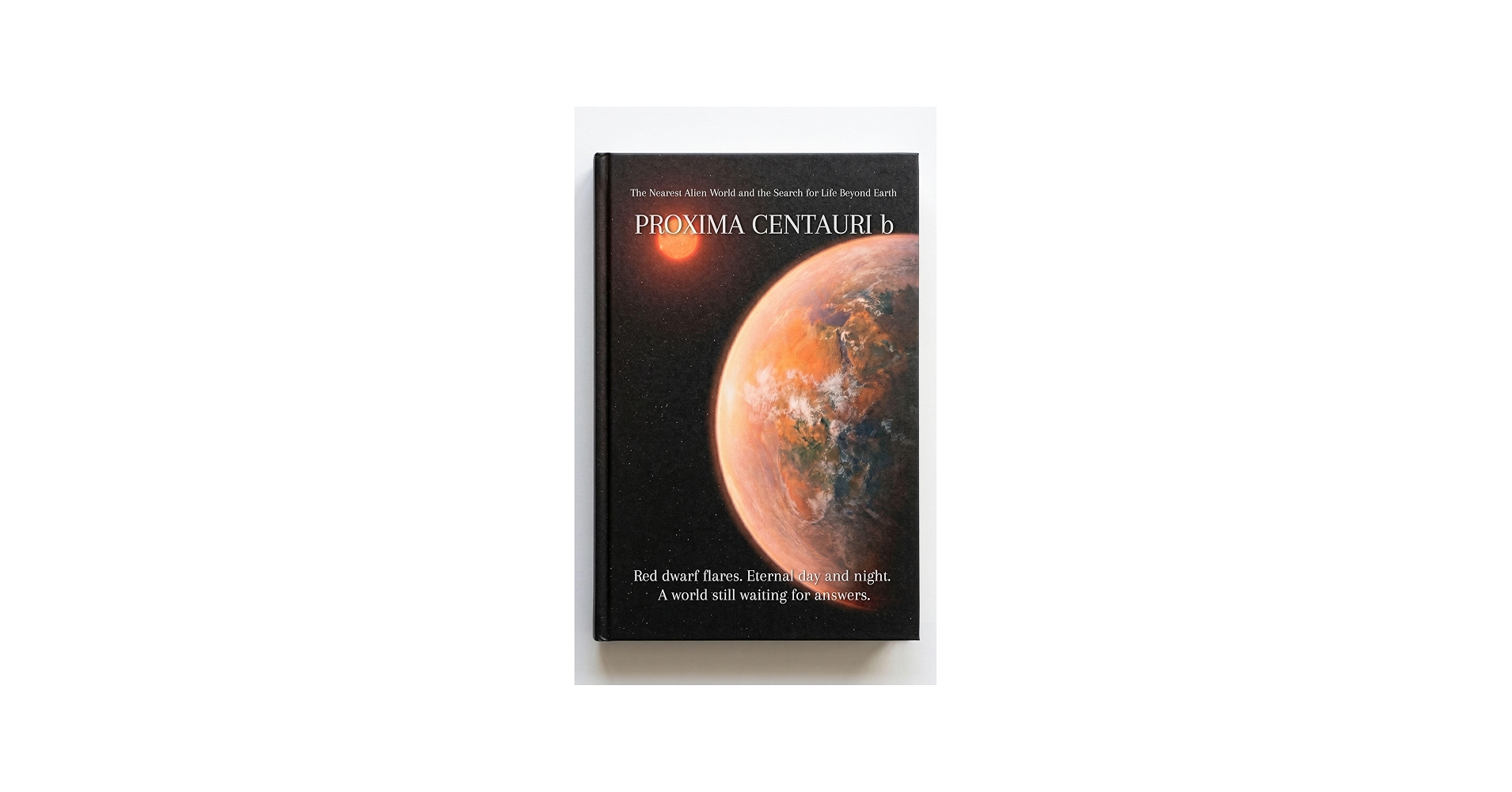
Try Kindle Unlimited Free for 30 Days!

- What Is Proxima Centauri b? The Closest Known Exoplanet to Earth
- Why 4.2 Light-Years Matters for Exoplanets and Future Space Exploration
- Habitable Zone Planets: Why Proxima Centauri b Is Promising but Not Proven Habitable
- Tidal Locking: A World of Eternal Day and Endless Night
- The Terminator Zone: Could Life Survive in Permanent Twilight?
- Red Dwarf Stars and Stellar Flares: The Biggest Threat to Life
- Atmosphere, Water, and the Search for Life Beyond Earth
- Why the Complete Edition Goes Much Deeper
What Is Proxima Centauri b? The Closest Known Exoplanet to Earth
Proxima Centauri b is a planet orbiting Proxima Centauri, a small red dwarf star in the Alpha Centauri system.
It was discovered using the radial-velocity method, which detects the tiny motion of a star caused by the gravity of an orbiting planet.
The planet’s minimum mass is estimated to be about 1.07 times Earth’s mass. That makes it a strong rocky-planet candidate, though its true mass could be higher depending on the angle of its orbit.
Its year is astonishingly short. Proxima Centauri b completes one orbit in about 11.2 days.
Its year is shorter than two weeks on Earth.
This short orbit happens because Proxima Centauri b is extremely close to its host star. Yet because Proxima Centauri is much dimmer than the Sun, that close orbit still places the planet in the habitable zone.
Why 4.2 Light-Years Matters for Exoplanets and Future Space Exploration
Proxima Centauri is about 4.2 light-years away. Light itself takes more than four years to reach Earth from that star.
Compared with the Milky Way, 4.2 light-years is extremely close. Our galaxy is roughly 100,000 light-years across, placing Proxima Centauri practically in our neighborhood.
But for spacecraft, the distance remains overwhelming. At the speed of Voyager 1, the journey would take tens of thousands of years.
This is why Proxima Centauri b is so powerful as an idea: close enough to become a realistic target for future observation, yet distant enough to show how difficult interstellar travel really is.
For future space exploration, the closest known exoplanet is a benchmark for what humanity may one day attempt.
Habitable Zone Planets: Why Proxima Centauri b Is Promising but Not Proven Habitable
Proxima Centauri b lies within the habitable zone of its star.
The habitable zone is the orbital region where a planet receives enough stellar energy that liquid water could exist on the surface, assuming the planet has the right atmosphere and pressure.
This is one of the biggest reasons scientists care about Proxima Centauri b.
However, being in the habitable zone does not mean a planet is actually habitable. Venus and Mars show why: location matters, but atmosphere, temperature, and planetary history matter just as much.
For Proxima Centauri b, the most important unknowns are huge.
Does it have an atmosphere?
If it has one, is that atmosphere thick enough to move heat around the planet?
Does liquid water exist anywhere on the surface?
Does the planet have a magnetic field that can protect its atmosphere from stellar radiation?
Until these questions are answered, Proxima Centauri b remains a potentially habitable world, not a confirmed habitable world.
That uncertainty is exactly what makes it scientifically exciting.
Tidal Locking: A World of Eternal Day and Endless Night
Because Proxima Centauri b orbits so close to its star, it may be tidally locked.
Tidal locking means the same side of the planet always faces the star, much like the same side of the Moon always faces Earth.
If Proxima Centauri b is tidally locked, one hemisphere would experience permanent day while the other would remain in permanent night.
Without an atmosphere, this kind of planet could be brutally divided: one side too hot, the other too frozen.
With a suitable atmosphere, however, the picture changes. Winds could carry heat from the dayside to the nightside, reducing the temperature difference. If oceans exist, ocean currents could also help redistribute heat.
This is one of the most important lessons of exoplanet science: a planet can look impossible at first, but climate physics can create surprising possibilities.
The Terminator Zone: Could Life Survive in Permanent Twilight?
One of the most intriguing ideas about Proxima Centauri b is the terminator zone.
The terminator is the boundary between the dayside and the nightside of a planet. On Earth, this boundary moves constantly as the planet rotates. On a tidally locked world, it could remain fixed in place.
That means Proxima Centauri b may have a permanent twilight region: not fully day, not fully night.
If the dayside is too hot and the nightside too cold, the terminator zone could offer more moderate conditions. Low-angle light from the star might provide energy without extreme heating. Atmospheric circulation could bring moisture and create regions where liquid water is more stable.
Some climate studies of tidally locked planets suggest that these twilight regions may be among the most promising places to search for habitability. This does not mean life exists there; it means the planet may force us to rethink where life could survive.
The most interesting region may not be the center of the dayside. It may be the border between light and darkness.
Red Dwarf Stars and Stellar Flares: The Biggest Threat to Life
Proxima Centauri is a red dwarf star.
Red dwarfs are small, dim, long-lived stars, and they are the most common type of star in the galaxy. Because they are so numerous, understanding planets around red dwarfs is essential to understanding the search for life in space.
But red dwarfs can also be active.
Proxima Centauri produces stellar flares: explosive releases of magnetic energy that can send intense ultraviolet and X-ray radiation into space.
For a planet orbiting very close to its star, this is a serious problem. Stellar flares may damage atmospheric chemistry, increase surface radiation, and help strip away a planet’s atmosphere over long periods.
This balance between destruction and protection is one of the central mysteries of Proxima Centauri b.
It sits in the right region for liquid water, but it lives next to a star that may threaten the atmosphere needed to keep that water stable.
Atmosphere, Water, and the Search for Life Beyond Earth
The most important questions about Proxima Centauri b are still unanswered.
An atmosphere would be crucial. It could protect the surface from radiation, move heat around the planet, and allow liquid water to persist under the right conditions.
Water is equally central. If liquid water exists on the surface, Proxima Centauri b becomes far more interesting for astrobiology. If water exists only as ice, vapor, or deep underground, the question becomes more complicated.
Current technology cannot yet confirm whether Proxima Centauri b has an atmosphere or water.
Future extremely large telescopes may change that. By separating the faint light of the planet from the glare of its star, astronomers may eventually study its spectrum and search for molecules such as water vapor, carbon dioxide, oxygen, ozone, or methane.
Even then, the search will require caution. A single molecule is not enough to prove life; scientists need a broader pattern that makes sense in the context of the whole planet.
The real value of Proxima Centauri b is that it may become one of the first nearby rocky exoplanets where these questions can be tested directly.
Why the Complete Edition Goes Much Deeper
This article covers only the most important entry points: the planet’s distance, orbit, habitable-zone status, tidal locking, terminator zone, stellar flares, atmosphere, water, and the search for life.
The complete edition goes much further.
It explores discovery history, radial-velocity observations, planetary mass and gravity, climate simulations, magnetic fields, atmospheric escape, possible oceans, biosignatures, red dwarf evolution, future telescopes, and whether humanity could ever send probes toward this system.
If this short introduction made you wonder whether the nearest known exoplanet could have air, water, or even conditions suitable for life, the complete edition is designed to answer the next layer of questions.
Proxima Centauri b may not be another Earth.
It may be something stranger, harsher, and more revealing.
And that is exactly why it matters.
The ‘Complete Edition’: Everything about Proxima Centauri b
Try Kindle Unlimited Free for 30 Days!


コメント