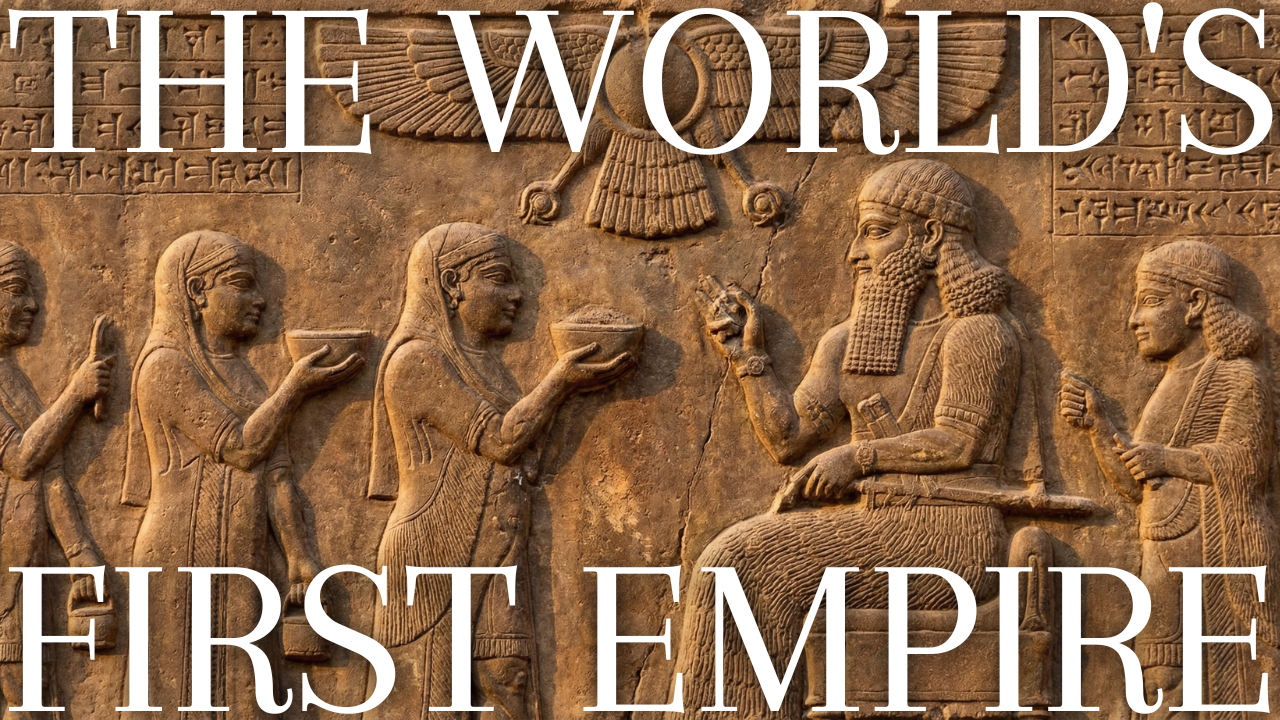
Sargon the Great: The Founding Story of the Akkadian Empire
Most people who have heard the phrase “Akkadian Empire” know it in the abstract — the first empire, somewhere in Mesopotamia, a very long time ago.
Far fewer know the actual story of how it started: a court servant with no recorded family name, a coup in a mid-sized city called Kish, and a decision to build a brand-new capital rather than rule from a throne he had just seized.
That story is worth telling on its own terms, because it explains something that summaries of “the first empire” usually skip over — empires are not declared, they are constructed, one deliberate choice at a time.
What follows is the founding chapter of that construction, in the empire founder’s own historical record as reconstructed by modern scholarship.
Watch the story of Sargon’s rise and explore the questions raised by the Akkadian Empire’s legacy.
The complete edition: explore the Akkadian Empire in thirteen chapters.

Who Was Sargon the Great? The Rise of the Akkadian Empire’s Founder
Before getting to the succession of events, it helps to know that almost everything about Sargon’s early life comes to us filtered through legend written generations after his death.
That does not make the record useless — it makes it a case study in how ancient rulers were remembered, mythologized, and occasionally exaggerated. Here is the account as it has come down to us.
Chapter 2: The Rise of Sargon the Great — Life of an Empire Builder
2-1. Sargon’s Origins and the Legend of His Birth
Sargon, the founder of the Akkadian Empire, is one of the most celebrated rulers in ancient Near Eastern history — a man who left behind a wealth of legend.
His name — “Sharru-kin” in Akkadian — means “the legitimate king,” but this was almost certainly a royal title adopted at his accession, not the name he was born with.
A famous legend has grown up around his birth.
According to the “Legend of Sargon,” compiled in later generations, he was born the illegitimate child of a priestess who served at a temple.
To hide the birth, his mother placed him in a basket and set it adrift on the Euphrates.
The floating basket was discovered by a gardener named Aqqi, who raised Sargon as his own.
This story has drawn considerable scholarly attention because of its striking parallels with the birth story of Moses.
The motif of an infant cast into a river who grows up to become a great leader is a recurring type of ancient heroic myth, and the Legend of Sargon is thought to be one of its earliest examples.
What can be said with reasonable confidence is that Sargon was of Semitic (Akkadian) origin from northern Mesopotamia — though reliable details about his family and early life are scarce, and the line between legend and history is difficult to draw.
2-2. Rise Through the Court of Kish
Sargon first appears in the historical record at the court of Ur-Zababa, king of Kish.
He is recorded as holding the title of “cupbearer” — a chamberlain who served drinks to the king, a position of high trust and close proximity to power.
At the time, Kish was one of the leading cities of northern Mesopotamia, but it was locked in ongoing tension with the Sumerian city-states to the south.
In particular, Lugalzagesi — king of Uruk — was an ambitious ruler who had united the Sumerian cities and was pushing northward.
It was in this unstable political environment that Sargon built his power base.
The most widely accepted view is that Sargon eventually launched a coup in Kish and seized the throne — or alternatively, exploited the power vacuum created when Kish fell to Lugalzagesi.
Either way, Sargon was a rare figure in the ancient world: a man who rose from low birth to become a king.
2-3. The Building of Akkad and the Founding of the Empire
One of Sargon’s first major undertakings was the construction of a new capital — Akkad (Agade).
Rather than ruling from an existing city, he chose to build an entirely new one — a decision that reveals his political instincts.
Existing cities had entrenched temple elites and traditional ruling classes that would have constrained any new dynasty. Building a new capital was a strategy for clearing those obstacles and establishing Sargon’s own authority on his own terms.
Despite millennia of archaeological searching, the exact location of Akkad remains unknown.
It likely stood somewhere between Baghdad and Babylon, but the site may have been obliterated by later city construction or shifts in the river’s course.
With his capital secured, Sargon turned to conquest.
His first major target was Lugalzagesi, who had unified the Sumerian city-states.
Sargon defeated him in battle, brought him to Nippur as a captive, and chained him to the gates of the city’s temple — a public humiliation that sent a message to the entire region.
This victory gave Sargon control over all of southern Mesopotamia and the title “King of Sumer and Akkad.”
2-4. Military Campaigns and the Expansion of the Empire
With Sumer unified, Sargon pressed on.
Ancient records claim he fought 34 battles and won them all — an almost certainly exaggerated number, but one that speaks to his extraordinary military talent.
Campaigning eastward, Sargon conquered Elam (present-day western Iran) and brought major cities like Susa under his control. Elam was a powerful civilization in its own right, and its conquest greatly enhanced Akkad’s prestige.
Campaigning northward, he subdued Upper Mesopotamia and pushed into Syria.
Upon reaching the Mediterranean coast, he proudly recorded the conquest of the “Cedar Forest” (the Lebanon Mountains) and the “Silver Mountain” (the Taurus range) — key sources of timber and metals that were hard to come by in Mesopotamia.
Sargon declared that he ruled from the “Upper Sea” (the Mediterranean) to the “Lower Sea” (the Persian Gulf) — a claim of dominion over virtually all of the known world, and an expression of his self-image as a universal ruler.
He also developed active overseas trade, with Dilmun (modern Bahrain), Magan (Oman), and Meluhha (the Indus Valley civilization) all sending ships and goods to Akkadian ports.
2-5. Sargon’s Governing Policies
What defined the Akkadian Empire was its centralized administrative apparatus.
After each conquest, Sargon dismissed local rulers and installed his own appointed governors in their place.
This brought the entire empire under a single chain of command from the capital, enabling efficient governance across an unprecedented area.
Sargon also established Akkadian as the empire’s official language; administrative documents were drafted in Akkadian. This was a critical policy for integrating diverse peoples who spoke different languages into a single political unit. Sumerian continued to be used in religious and scholarly contexts, but Akkadian became the language of practical governance.
Economically, Sargon standardized weights and measures across the empire, facilitating trade throughout the realm. He also prioritized the security of trade routes, creating conditions in which merchants could travel long distances with confidence.
An inscription records that “5,400 soldiers ate daily before him” — evidence of a standing army. Maintaining professional soldiers was a major military innovation for the time and one of the key reasons for Sargon’s success.
2-6. Sargon’s Later Years and His Legacy
Sargon’s reign is said to have lasted some 56 years — an unusually long time for an ancient ruler.
But his later years were anything but peaceful.
Rebellions broke out repeatedly across the empire, and Sargon himself had to rush to suppress them.
The Sumerian cities in particular kept resisting Akkadian rule, threatening the empire’s stability.
One inscription records that all the Sumerian cities rose against Sargon and besieged the city of Akkad.
Reportedly over eighty years old, Sargon is said to have led the army personally to crush the revolt.
After his death, the throne passed to his son Rimush. But the empire’s instability was not resolved, and Rimush was assassinated in a palace conspiracy. His successor — Rimush’s brother Manishtushu — also met his end through assassination.
This turbulent succession reveals a structural weakness: the empire’s cohesion depended on Sargon’s personal charisma and military genius. Without him, that cohesion gradually eroded.
Yet Sargon’s legacy was immense.
He was remembered as the “first world conqueror” for nearly 2,000 years, held up as the ideal monarch by Assyrian and Babylonian kings alike.
The fact that the Neo-Assyrian king Sargon II deliberately took his name speaks to how powerful that legend remained.
What Sargon’s Rise Reveals About the Akkadian Empire
Two things stand out about this founding period, and neither is really about conquest.
The first is that Sargon treated administration as seriously as warfare — appointed governors, a common official language, standardized weights and measures. Winning territory and holding it turned out to be two very different problems, and he built solutions for both.
The second is that the empire’s stability was tied to one man for its entire founding generation. When Sargon died, two of his successors were assassinated in short order — a pattern that says a great deal about how fragile even a well-administered empire could be without its founder.
Those two tensions — how to govern what you conquer, and how to make an empire survive its founder — run through the rest of the Akkadian Empire’s 180-year history, through the reign of Sargon’s grandson Naram-Sin at the empire’s territorial peak, and into the empire’s eventual collapse.
The full version covers that fuller arc — the empire’s political system and legal order, its economy and long-distance trade networks, its language and religion, its art and architecture, the reign of Naram-Sin, and the climate-driven collapse now known as the 4.2 Kiloyear Event.
This article covers the founding story and key features of the Akkadian Empire, but the full account goes considerably further — into the empire’s administrative mechanics, the trade routes that connected Mesopotamia to the Indus Valley, the religious reforms under Enheduanna, the reign of Naram-Sin, the archaeological evidence, and the still-unresolved question of where the capital Agade actually stood.
The complete text is available on Kindle, and is included in Kindle Unlimited for subscribers. If the history of how empires first came to exist interests you, the Kindle edition covers all thirteen chapters in full.
The complete edition: continue reading on Kindle.
A Guide to Exploring Ancient Mesopotamia
Before Akkad: the Sumerian city-states
- Early Dynastic Mesopotamia: How Sumerian Civilization Built the First City-States — Discover the cities, temples, and political rivalries that preceded Sargon’s empire.
After Akkad: collapse and changing kingdoms
- The Gutians: The Mountain People Who Toppled the Akkadian Empire — Examine the Gutians, the sources that describe them, and the debates surrounding Akkad’s fall.
- When Was the Old Babylonian Period? Dates, Map, and Why Sources Disagree — Follow Mesopotamia’s later kingdoms and learn why historical dates can differ.
Later empires: Assyria and imperial rule
- What Was the Neo-Assyrian Empire? Meaning and Dates — Explore a later Mesopotamian empire and the chronology and institutions behind its expansion.


コメント