The two hundred and sixty years between the fall of Ur III and the rise of Hammurabi produced the written law collections, the private contracts, and the mathematical tradition that Babylonia would inherit. Most surveys skip this stretch of Mesopotamian history or compress it into a paragraph. That compression loses the story of how centralized empire gave way to competing city-states, and why the resulting disorder turned out to be productive.
What follows is drawn from the opening chapters of a longer study of the Isin-Larsa period. It covers two questions: what was this era, and what caused it? The first section frames the period and its evidence. The second traces the collapse of the empire that preceded it — the Third Dynasty of Ur — through administrative tablets, grain prices, and one particularly revealing episode of political betrayal.
The complete edition on Kindle: continue through the history and everyday life of Isin and Larsa

Liberal Arts Bundle: explore this book alongside other English-language guides

- Isin-Larsa Mesopotamia: Two Cities and the Making of Babylonia
- When Was the Isin-Larsa Period? The Collapse of Ur III
- The Isin-Larsa Dynasty Origins: Why the Empire Fell
- Isin-Larsa Old Babylonian: Reading the Evidence
- Beyond the Collapse: What the Full Version Covers
- A Guide to Exploring Ancient Mesopotamia
Isin-Larsa Mesopotamia: Two Cities and the Making of Babylonia
Most people who encounter ancient Mesopotamia meet it twice. They meet Sumer, with its ziggurats and its invention of writing, and they meet Babylon, with Hammurabi’s stela and its list of penalties carved in diorite. Between those two encounters sits a gap of roughly two hundred and sixty years that rarely gets a name in popular accounts, and when it does get one, the name is awkward: the Isin-Larsa period.
The awkwardness is instructive. Historians normally name an era after the power that dominated it — the Ur III period, the Old Assyrian period, the Neo-Babylonian empire. This era gets two names because no single power held it. Two cities in southern Iraq, roughly forty kilometres apart, spent generations competing for the mantle of a fallen empire, and neither one ever finished the job. Around them, a dozen other kingdoms rose, allied, betrayed one another, and vanished.
That untidiness is exactly why the period repays attention. Centralized states leave tidy archives and misleadingly coherent stories. Fragmented ones leave contracts, private letters, lawsuits, school exercises, and the accumulated paperwork of people who had to make their own arrangements because the palace no longer made arrangements for them. The Isin-Larsa period is the moment when Mesopotamian evidence stops being overwhelmingly about the state and starts being substantially about individuals.
The questions this book answers
If you have come to this subject from a search engine, an undergraduate reading list, or a museum label, you probably arrived with some version of the following questions. When was the Isin-Larsa period, and why do sources give slightly different dates? Was it one political entity or many? How does it relate to the Old Babylonian period, a term that seems to overlap with it in confusing ways? What did the two title cities actually control, and what does a map of the era really show? And the question that lurks behind all of these: why should anyone care about a stretch of history that ends in defeat for both of its namesake cities?
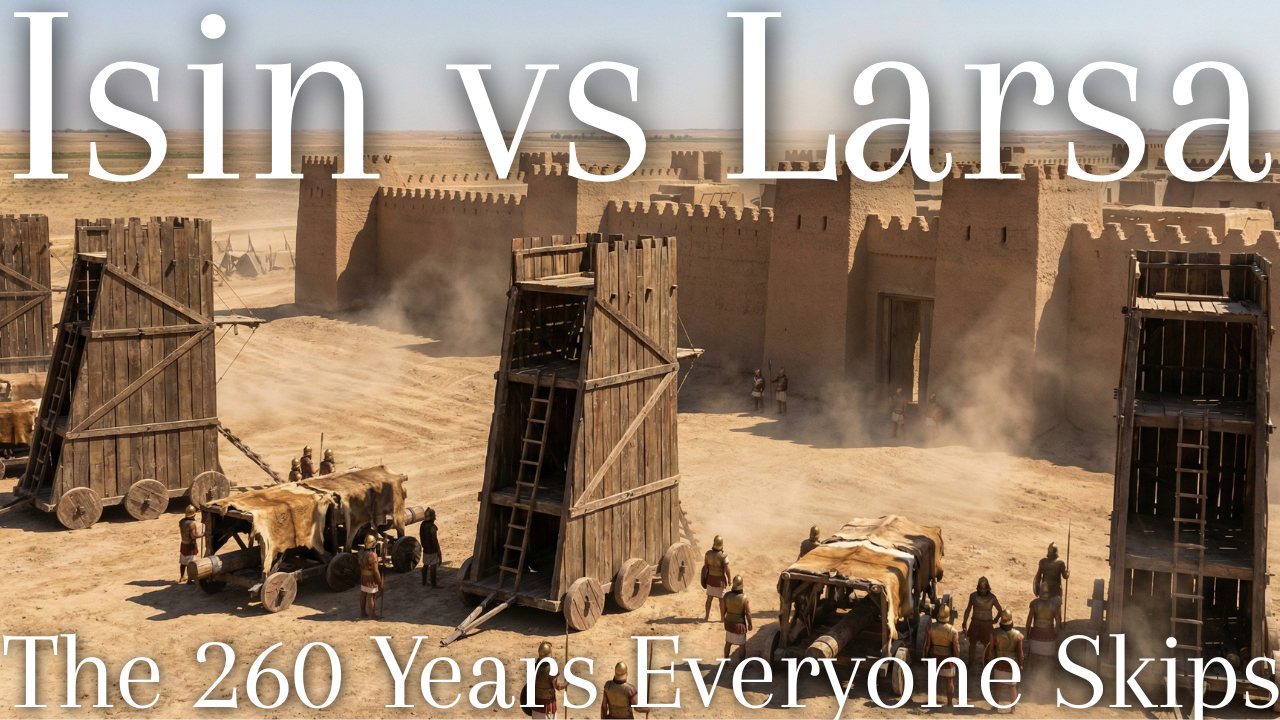
This book takes each of those questions seriously, and it takes them in an order designed to build understanding rather than to catalogue facts. The first chapters establish what collapsed and what replaced it. The middle chapters open up the society — its money, its merchants, its women of business, its schools, its doctors, its farmland and its water. The final chapters return to the political narrative, follow it to Hammurabi’s siege engines outside the walls of Larsa, and then step back to ask what a reader in the present should make of the maps, the misconceptions, and the surprisingly persistent internet searches for an Isin-Larsa flag that never existed.
What you will be able to do afterwards
A history book earns its length by changing how a reader processes new information. By the end of this one, you should be able to look at a chronological chart of Mesopotamia and know precisely where the uncertainty lies and why the same king appears with dates sixty-four years apart in different reference works. You should be able to read a museum label that says “Old Babylonian, c. 1800 BCE” and know which political world that object came from. You should be able to look at a colour-coded map of southern Iraq around 1800 BCE and identify at least three ways in which it is lying to you for the sake of legibility.
More than that, you should have a feel for the texture of the period. Ancient history becomes memorable when it acquires specific people doing specific things: a merchant at Ur receiving a furious letter about substandard copper; a woman at Sippar lending silver at interest from behind the walls of a religious cloister; a schoolboy at Nippur copying a list of tree names onto a lump of clay that would be soaked and reused the following morning. Those people are recoverable from this period in a way they are not recoverable from most of the ancient world, and their recovery is one of the reasons scholars keep returning to it.
A note on evidence and confidence
Everything in the pages that follow rests on cuneiform tablets, excavated buildings, and the interpretive work of Assyriologists over roughly a century and a half. That evidence is uneven. Some decades are illuminated by thousands of dated documents; others are represented by a handful of royal inscriptions and a line in a much later king list. Where the evidence is thin, this book says so rather than smoothing the gap over with confident narrative.
Dates in this book follow the Middle Chronology, the convention used by most reference works and museum catalogues, with the reasons for that choice explained in the second chapter. Regnal years are approximate and marked as such. Where a scholarly disagreement is live — the causes of the collapse of Ur, the reading of a mathematical tablet, the severity of soil salinization — both positions are presented, because a reader who understands why specialists disagree is better equipped than one who has memorized whichever side happened to be summarized first.
How the book is arranged
The organizing principle here is that political narrative alone explains very little. Knowing that Gungunum of Larsa captured Ur is a fact; knowing why a port city mattered enough to fight over, and what its wharves were shipping, converts the fact into an explanation. So the political story is told in two blocks, at the front and the back, with the social and economic material placed between them where it can do the most work.
Chapters one through nine cover the collapse of the previous empire, the chronological framework, the founding and flourishing of the Isin dynasty, the emergence of Larsa as its rival, the contest for the religious capital at Nippur, the geography of the fragmented south, and the third major power in the Diyala valley that the era’s two-city name conveniently forgets. Chapters ten through nineteen turn to the people: the Amorite populations whose leaders founded most of the period’s dynasties, the silver economy and its interest rates, the merchants of the Gulf trade, the businesswomen of Sippar, the schoolrooms of Nippur, the literary canon those schoolrooms fixed, the mathematics they taught, the medicine and divination practised alongside them, the canals and salt that limited what the land could yield, and the excavations that recovered all of it.
Finally, chapters twenty through twenty-two return to politics and close the circle: the extraordinary sixty-year reign that brought Larsa to its zenith, the campaign that ended it, and a final chapter devoted to the practical business of evaluating what you read and see about this era elsewhere. A conclusion draws the threads together, and a bibliography points towards the primary and secondary literature.
Readers who want the narrative alone can take chapters one through nine and twenty through twenty-two as a continuous political history. Readers who came for the society will find the middle section largely self-contained. Nothing is repeated between sections, so a term defined in one chapter is used without redefinition thereafter — a small demand on the reader that keeps the book substantially shorter than it would otherwise be.
The story starts, as it must, with an empire running out of grain.
When Was the Isin-Larsa Period? The Collapse of Ur III
The Third Dynasty of Ur was, by any reasonable measure, the most thoroughly documented state that had ever existed. Its scribes produced administrative tablets at a rate that has left modern collections with well over a hundred thousand catalogued examples, and estimates of the total once written run into the millions. A single tablet might record the delivery of one dead sheep, naming the animal’s condition, the responsible herdsman, the receiving official, the day, the month, and the regnal year.
This was not bureaucratic vanity. The Ur III state, at its height under Shulgi and his successors, ran an economy in which large agricultural estates, herding operations, weaving workshops, and craft production were coordinated through a system of accounts that balanced expected output against delivered output for every unit and every officer. Deficits carried forward. An overseer who failed to deliver his quota accumulated a debt to the crown that followed him, and in some cases followed his heirs.
A machine built for surplus
The architecture of that system deserves a moment’s attention, because its design explains its fragility. Provincial governors, bearing the old Sumerian title ensi, administered core territories in the south and were responsible for delivering fixed contributions to a redistribution centre. A separate military-administrative hierarchy handled the periphery. Standardized measures, a standardized calendar for accounting purposes, and a standardized scribal training produced documents that could be audited across hundreds of kilometres.
Systems like this are extraordinarily efficient at extracting and redistributing a predictable surplus. They are correspondingly poor at absorbing shocks. Every unit’s plan depended on every other unit meeting its plan, and the entire apparatus assumed that the roads between the units remained open, that the canals kept flowing, and that the political centre retained the authority to enforce the accounts.
Consider what that meant in practice for a provincial temple estate. Its labour force was allocated centrally in units of worker-days. Its seed grain arrived from a central store. Its output was earmarked before it was harvested. When the chain broke at any link, the estate had no local market to fall back on, because centuries of central coordination had rendered a local market largely unnecessary. The efficiency and the brittleness were the same property viewed from different angles.
The reign that ran out
Ibbi-Sin came to the throne around 2028 BCE as the fifth ruler of the dynasty, and within a decade the machine was visibly failing. The evidence for the failure is not a chronicle written after the fact but the tablets themselves. Dated documents from outlying provinces simply stop, province by province, as those provinces cease to acknowledge the king’s year names. Eshnunna in the Diyala drops away. Susa in the east goes. Then Lagash, then Umma, then Nippur, until the dating system that had covered the whole of southern Mesopotamia contracts to the area immediately around Ur itself.
Meanwhile the price of grain moved in a way that would be familiar to anyone who has studied a currency crisis. Analysis of the price data from the final years of Ibbi-Sin’s reign indicates that grain reached something on the order of sixty times its customary price. Whatever silver a household held became nearly worthless against the one commodity that mattered. Institutional buyers who had never before needed to purchase grain on any open market suddenly had to.
It is worth pausing on what a sixtyfold rise means in a society without banks, futures markets, or emergency imports at scale. A labourer’s monthly ration allowance, expressed in silver, would buy a fraction of a day’s food. Temples that owed offerings in grain to their gods either defaulted on the offerings or stripped their reserves. Loans denominated in silver became trivially easy to repay for anyone holding grain and catastrophic for anyone holding silver, which inverted the position of creditors and debtors overnight.
The Isin-Larsa Dynasty Origins: Why the Empire Fell
Why the state failed has been argued over for the better part of a century, and the argument has produced four main candidates. The first is environmental. Sediment cores from the Persian Gulf indicate markedly reduced flow in the Tigris and Euphrates in the centuries around 2100 to 2000 BCE, and a broader climatic downturn in the late third millennium has been proposed as a factor in disruptions from the Aegean to the Indus. Less water in the rivers means less irrigation water, which means smaller harvests in a system with no slack.
The second candidate is the movement of Amorite-speaking populations from the middle Euphrates and the western steppe into the settled zone. Ur III kings built a fortification line explicitly described as holding back the Amorites, which tells us both that the movement was real and that the state took it seriously. What that movement consisted of — raiding, seasonal transhumance turning into permanent settlement, gradual demographic infiltration, or armed migration — remains contested, and the answer probably varies by region and decade.
Elam is the third candidate. The kingdom to the east, and specifically the Shimashki dynasty, delivered the final military blow. Ur was besieged and taken, and Ibbi-Sin was carried off into captivity, an event that Sumerian literature commemorated for centuries afterwards. But Elam struck a state already in acute distress; it administered the coup de grâce rather than the wound.
A fourth explanation is internal and structural: the very design described above. A system that maximizes extraction under stable conditions has no reserve capacity. When harvests fell and the roads became unsafe, provincial administrators faced a straightforward calculation. Continuing to ship grain to Ur meant local shortage and local unrest; keeping it meant a survivable winter and, eventually, independence.
One further consideration, less often listed as a cause but important as a condition, is the sheer cost of the Ur III military posture. Campaigns to the north-east against Simurrum and Lullubum recurred so frequently across the dynasty that year names begin to repeat with the formula “for the second time” and “for the third time.” Frontier fortifications required construction and garrisoning. Diplomatic marriages with eastern polities came with dowries and ongoing obligations.
None of this was unusual for an ancient state, and while harvests held it was affordable. It becomes a different matter when revenue contracts. A government committed to expensive frontier maintenance and confronted with falling receipts has three options: raise extraction, cut commitments, or borrow against future surplus. Ur III appears to have tried the first, which is a reliable method of accelerating provincial defection.
Modern treatments of the collapse generally decline to choose a single cause, and the refusal is not fence-sitting. Each factor amplified the others. Reduced river flow shrank the harvest; a shrinking harvest made provincial compliance costly; declining compliance weakened the military capacity that had kept the frontier quiet; a weaker frontier admitted more disruption to agriculture; disrupted agriculture drove prices up further. The system fed on itself.
Ishbi-Erra and the grain that never arrived
One episode from the final years illuminates the whole process, and it happens to introduce the man who founded the first of our two title dynasties. Ibbi-Sin dispatched an official named Ishbi-Erra, described in later tradition as a man of Mari, northwards to purchase grain. Ishbi-Erra bought the grain — a large quantity, according to the correspondence — and then wrote to the king explaining that hostile forces made transport impossible, and that he would require boats and, incidentally, an appointment as governor of Isin and Nippur to secure the shipment.
The letter survives as a school exercise, copied by students for generations afterwards, which means we cannot treat every phrase as verbatim; literary tradition reshaped it. But the underlying situation is confirmed by administrative documents. Ishbi-Erra took Isin, began issuing his own year names, and never sent the grain. The state’s most vital emergency procurement operation became the seed of its principal successor.
Ibbi-Sin’s reply, also preserved in the school tradition, is one of the more painful documents to survive from the ancient world: a king reproaching a subordinate for extortion while having no means whatsoever to compel him. The exchange was copied out by schoolboys three hundred years later as a model of epistolary style, which is its own comment on how thoroughly the episode had entered cultural memory.
Isin-Larsa Old Babylonian: Reading the Evidence
Because the disintegration is visible primarily through dated documents, it is worth explaining how that inference works, since the same method underpins much of what follows in this book. Mesopotamian scribes of this era did not number years from a fixed epoch. They named each year after a memorable event of the preceding year — a military victory, the installation of a priestess, the digging of a canal, the manufacture of a cult object.
A document dated “the year the king destroyed Simurrum” is therefore a political statement as well as a date. Using a given ruler’s year names means acknowledging that ruler’s authority. When an archive in a provincial city switches from Ibbi-Sin’s year names to those of a local strongman, that switch is a declaration of independence recorded in the most mundane possible medium: the header of a receipt for barley.
The sequence of those switches during Ibbi-Sin’s reign gives a chronology of dissolution that no narrative source provides. Combined with the disappearance of the great centralized accounts — the balanced ledgers that had tracked worker-days and animal deliveries across provinces — the pattern shows a state losing its periphery first and its core last, over roughly a decade and a half rather than in a single catastrophic season.
There is a methodological caution worth registering here. Absence of tablets is not always absence of activity; excavation is uneven, and some archives simply have not been found or have not been published. Assyriologists therefore weight the evidence carefully, looking for corroboration in royal inscriptions, in the later king lists, and in the physical record of destruction layers and abandonment at excavated sites. The broad outline of the Ur III dissolution is nonetheless as secure as anything in third-millennium history.
What actually ended
It matters to be precise about what the collapse destroyed and what it left standing. It destroyed a specific political and administrative order: the centralized accounting system, the unified calendar, the provincial governorships, the enforced standardization. It did not destroy the cities. Ur, Uruk, Nippur, Larsa, Isin, Lagash, Umma and their smaller neighbours continued to be inhabited, farmed, and administered locally.
Nor did it destroy the technology of writing, the temple institutions, or the literary tradition — though all three were transformed. The scribal apparatus survived by finding new employers: instead of drafting delivery receipts for a provincial governor, a scribe now drafted a loan contract between two private parties, or a marriage agreement, or a lawsuit record. That reorientation, from state accounting to private documentation, is the single most consequential change of the century that followed, and it is why the Isin-Larsa period gives historians a kind of social access that the Ur III period, for all its tablets, does not.
The literature also survived, but with a new job to do. The great Sumerian city laments, which mourn the destruction of Ur and the abandonment of Sumer by its gods, were composed and written down in the generations after the fall. They read as grief, and they are grief, but they are also political documents produced under the patronage of the kings who claimed to be repairing the damage. A lament that describes Nanna’s shrine in ruins sets up rather neatly the ruler who announces that he has restored it.
One further inheritance deserves mention because it shaped everything that followed. The Ur III state had promoted a particular idea of what a king was: a shepherd appointed by the gods, responsible for justice, for the canals, for the temples, and for the price of barley. That job description outlived the state that formulated it. Every ruler in the following centuries, whatever his ancestry or the size of his territory, presented himself in those terms, and the gap between the rhetoric and the reality of a small kingdom’s actual capacity is one of the recurring tensions of the era.
By roughly 2004 BCE the Third Dynasty of Ur no longer existed as a political fact. What existed instead was a landscape of cities with their own rulers, their own year names, and their own ambitions, connected by canals and by a shared conviction that someone ought to reassemble what had been lost. Two cities in particular thought that someone should be them.
Beyond the Collapse: What the Full Version Covers
The introduction and opening chapter above are excerpted from a longer work that traces the entire Isin-Larsa period from the fall of Ur III to the siege of Larsa in 1763 BCE. The full version continues the political narrative through the founding dynasties of both cities, examines the silver economy and its interest rates, follows the Gulf copper trade through the contracts of individual merchants, and reconstructs the scribal schools where students learned mathematics in base 60. It also covers the written law collections that preceded Hammurabi’s stela, the businesswomen who operated as lenders and investors from within religious cloisters, and the environmental limits — salinization, shifting rivers, shrinking harvests — that constrained everything the kingdoms could achieve.
Read the complete edition on Kindle to follow the rival dynasties, written law, silver economy, Gulf trade, scribal schools and the evidence behind the chronology. Choose the Liberal Arts Bundle to explore this book together with other English-language guides.
The complete edition on Kindle: continue through the history and everyday life of Isin and Larsa
Liberal Arts Bundle: explore this book alongside other English-language guides
A Guide to Exploring Ancient Mesopotamia
Before Isin and Larsa
- Early Dynastic Mesopotamia: How Sumerian Civilization Built the First City-States — Trace the cities, writing and institutions inherited by later Mesopotamian kingdoms.
Babylonia and the later empires
- When Was the Old Babylonian Period? Dates, Map, and Why Sources Disagree — Place the Isin-Larsa kingdoms within the broader Old Babylonian world and its shifting geography.
- What Was the Neo-Assyrian Empire? Meaning and Dates — Explore a later Mesopotamian empire and the evidence used to define its chronology.

コメント