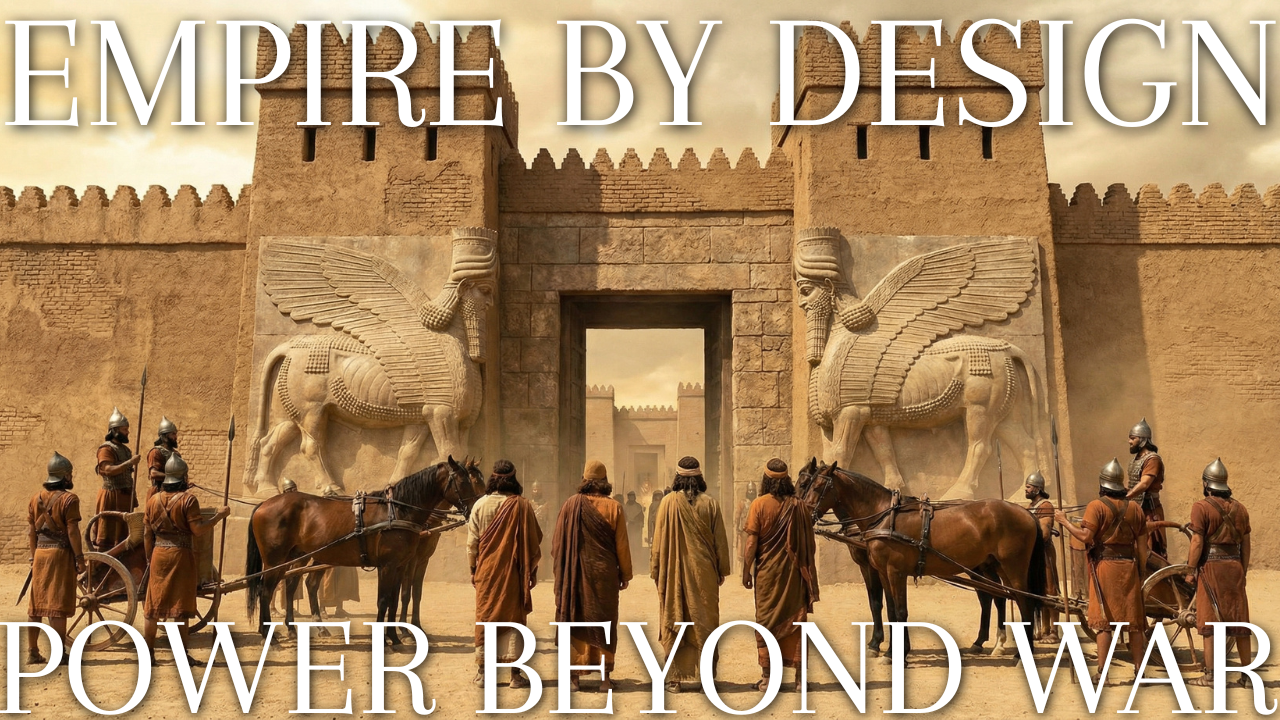
The name “Neo-Assyrian Empire” sounds straightforward until three basic questions appear: did its people use that name, when did the period begin, and why do modern timelines disagree? Those questions matter because a label can quietly shape the story it seems merely to describe.
The locked excerpt below establishes the vocabulary and chronological framework needed to read Assyrian history with care. It focuses on what the label means, how historians anchor the dates, and why several boundary dates can coexist without making the underlying evidence unreliable.
The complete edition on Kindle: Assyria’s rulers, institutions, daily life, and collapse
Liberal Arts Bundle: read this book alongside other English-language guides to ancient civilizations

Chapter One: What “Neo-Assyrian” Actually Means
No Assyrian ever described himself as living in the Neo-Assyrian Empire. If you had stopped a scribe outside the Nabu temple at Kalhu in 720 BCE and asked him what period he lived in, he would have given you the name of that year’s eponym official and looked at you strangely. The term is a modern coinage, applied retrospectively by European and American scholars who needed a way to carve two thousand years of Assyrian history into manageable slices. Understanding that it is a filing label rather than a historical identity clears up more confusion than any other single fact about the subject.
A modern label for an ancient state
Assyriology — the academic study of Mesopotamian cuneiform civilisation — took shape in the middle of the nineteenth century, and like every young discipline it needed periodisation. The scheme that stuck divides Assyrian history into three phases named for the dialect of Akkadian used in the documents of each: Old Assyrian, Middle Assyrian, and Neo-Assyrian. The Old Assyrian period covers roughly the twentieth to the eighteenth centuries BCE, the era of the merchant colonies in Anatolia whose correspondence, recovered by the tens of thousands at Kültepe, gives us one of the most detailed pictures of long-distance trade anywhere in the ancient world. The Middle Assyrian period runs from around the fourteenth to the eleventh centuries, when Assyria first became a territorial power under kings like Ashur-uballit I and Tukulti-Ninurta I. The Neo-Assyrian period is the last of the three, and the one in which Assyria became something the world had not seen before.
Because the scheme is linguistic in origin, “Neo-Assyrian” is doing at least three jobs at once in the literature, and readers who do not notice the shift get lost. It names a historical period. It names a dialect — Neo-Assyrian Akkadian, the northern Mesopotamian variety of the Semitic language written in cuneiform, distinct from the contemporary Neo-Babylonian dialect spoken to the south. And, in art history and archaeology, it names a style: Neo-Assyrian reliefs, Neo-Assyrian glyptic, Neo-Assyrian architecture. A sentence like “this ivory is Neo-Assyrian” is a statement about workshop tradition and date, not about who owned the object. Many of the finest ivories excavated at Nimrud were made by Phoenician and North Syrian craftsmen and arrived in Assyria as tribute or loot.
The “neo” prefix carries no implication of revival or rebirth in the way that terms like Neoclassical or Neolithic do in other fields. It simply means “later”. This trips people up constantly, and it produces one of the odder search queries that circulates around this subject — the doubled “neo neo Assyrian empire”, which appears when someone assumes the prefix must be attaching to a separate entity called the “Neo-Assyrian Empire” and adds another layer. There is only one prefix, and it means late.
What the Assyrians called themselves
The Assyrians had a perfectly clear name for their country: māt Aššur, “the land of Ashur”. The phrase is deliberately ambiguous in the original, and the ambiguity is the point. Aššur was simultaneously the name of the national god, the name of the god’s city on the west bank of the Tigris, and the name of the territory the god’s people held. To expand the land of Ashur was, in Assyrian royal thinking, to expand the god’s domain — a theological argument built into the vocabulary itself. The king styled himself šar māt Aššur, king of the land of Ashur, and in the imperial period accumulated a stack of further titles: king of the universe, king of the four quarters, viceroy of Ashur, great king, mighty king.
The English word “Assyria” reaches us through Greek Assyría, which itself derives from the Akkadian name. The Greeks also produced Syría, and whether the two words share a root has been argued about since antiquity; the discovery of a bilingual Luwian and Phoenician inscription at Çineköy in southern Turkey in 1997, in which the same polity is called “Assyria” in one language and “Syria” in the other, has convinced most scholars that they do. That etymological thread runs directly into the modern world, where the names Syria, Assyrian, and Syriac all sit in complicated relation to one another and to living communities.
Assyria and “the Assyrian Empire”: the same thing, at different scales
A great deal of online confusion comes from treating “the Assyrian Empire” and “the Neo-Assyrian Empire” as two different states. They are not. The Neo-Assyrian Empire is what people usually mean when they say “the Assyrian Empire” without qualification, because it is the phase in which Assyria was unambiguously imperial. But Assyria had been a state for something over a thousand years before that, and it had held empire before, on a smaller scale.
The distinction that matters is not one of identity but of degree and method. Middle Assyrian kings conquered; Tukulti-Ninurta I sacked Babylon in the thirteenth century and carried its king off in chains. What they did not do was build permanent institutional machinery for holding conquered territory indefinitely. Their empire was a system of subordinated kings paying tribute, punctuated by punitive expeditions when the tribute stopped. When a strong king died, the structure contracted. This is the normal shape of ancient conquest states, and it describes the early Neo-Assyrian kings too.
What changed, over the two and a half centuries the period covers, was the invention of a set of administrative instruments that made territory stick: the provincial governorship staffed by an appointee removable at royal pleasure, the standing army paid and equipped by the crown rather than levied from magnates, the deliberate mixing of populations to dissolve local political identity, and a written communications system that let the palace supervise all of it in something close to real time. That is the difference between Assyria and the Neo-Assyrian Empire, and it is a difference in kind rather than in magnitude.
What the empire is known for, and what it should be known for
Ask a general audience what Assyria is famous for and you will get, in rough order: cruelty, chariots, lion hunts, the Bible, and enormous stone bulls with human heads. None of these is wrong. The royal inscriptions do describe flaying rebels alive, piling severed heads, and impaling captives on stakes outside their own city walls, and the palace reliefs illustrate several of these things in careful detail. The lamassu — the human-headed winged bull or lion that guarded palace gateways — is one of the most recognisable images to survive from the ancient Near East. The Hebrew prophets Isaiah, Nahum, and Jonah all wrote with Assyria in view, and the empire’s collision with the kingdoms of Israel and Judah generated some of the most vivid political writing in the biblical corpus.
But the reputation for cruelty needs handling with care, in both directions. It would be wrong to say the atrocities were invented — the archaeology at sites like Lachish and Hasanlu supports violence on the scale the texts describe, and mass graves and destruction layers do not lie. It is equally wrong to imagine that the Assyrians were unusually sadistic by the standards of their neighbours. What was unusual was that they publicised it. The royal inscriptions were a genre with a purpose: they were deposited in foundation deposits addressed to future kings and to the gods, and their descriptions of punishment were arguments that the king had discharged his sacred duty to suppress rebellion against divine order. Broadcasting the consequences of revolt was cheaper than garrisoning every hilltop. The terror was a deliberate instrument of statecraft, aimed at reducing the number of occasions on which force actually had to be used.
The more defensible claim to fame is the one that fits the evidence best. Assyria assembled, for the first time, the standard toolkit of imperial government. Its provincial system, its road and relay network, its resettlement policy, its use of a second language for everyday administration alongside a prestige language for monuments, its practice of taking royal hostages and educating them at court, its integration of religious specialists into political decision-making as a kind of institutional risk assessment — every one of these reappears in the Neo-Babylonian, Achaemenid Persian, Seleucid, and ultimately Roman worlds. When Darius the Great built the Royal Road from Sardis to Susa, he was extending an Assyrian idea. When the Persian chancery ran on Aramaic, it was continuing an Assyrian practice.
The three Assyrias, side by side
The easiest way to hold the periodisation in mind is to see the three phases against one another. The dates below are the conventional ones used in most current handbooks; each boundary is a scholarly convention rather than a sharp historical break.
| Phase | Approximate dates | Political character | Characteristic evidence |
|---|---|---|---|
| Old Assyrian | c. 2000–1750 BCE | City-state of Ashur governed by an assembly and a limited ruler; commercial rather than military reach | Merchant archives from the Anatolian trading colony at Kanesh; loan and partnership contracts |
| Middle Assyrian | c. 1400–1050 BCE | Territorial kingdom competing with Mitanni, Hatti and Babylonia; conquest without permanent provincial machinery | Royal annals, the Middle Assyrian Laws, palace and harem edicts, administrative texts from Ashur and Dur-Katlimmu |
| Neo-Assyrian | 911–609 BCE | Multi-ethnic empire with provinces, standing army, resettlement policy and a state communications network | Royal inscriptions, palace reliefs, the Nineveh state archives, eponym lists, treaties, divination reports |
Between the Middle and Neo-Assyrian phases lies a gap of roughly a century and a half that is thinly documented everywhere in the eastern Mediterranean and the Near East. Assyria did not cease to exist during it. Kings continued to reign at Ashur and their names are preserved, but the volume of surviving text collapses, monumental building stops, and the territory the kings controlled shrank back towards the Tigris.
Scholars distinguish between Assyria, meaning the state and its heartland, and Assyriology, meaning the study of all cuneiform-writing Mesopotamian cultures — Sumerian, Babylonian, Assyrian and their neighbours alike. The discipline took its name from Assyria because the first great decipherment breakthroughs came from Assyrian royal inscriptions excavated in the 1840s, not because Assyria is its only subject. A book described as Assyriological may have nothing to do with Assyria at all.
A last terminological trap concerns the word “empire” itself. Historians argue about whether it should be reserved for states that rule culturally distinct populations through subordinate structures rather than absorbing them, and by that definition Assyria qualifies comfortably from the eighth century onward while its earlier phases are borderline. Some specialists therefore prefer to speak of the Assyrian state before Tiglath-pileser III and the Assyrian empire after him. Nothing important hangs on the choice, provided the reader knows that the vocabulary is describing a process rather than an event.
Getting the label right does practical work. It explains why reference sources give different start dates without any of them being wrong: they are drawing the line at different points in a continuous process, and the process, not the line, is the historical fact. It explains why the same king can be described as ruling “Assyria” and “the Neo-Assyrian Empire” in adjacent sentences. It explains why an object can be Neo-Assyrian in style and Phoenician in manufacture. And it warns against the most seductive error in the whole field, which is to read the empire backwards from its collapse — to treat two and a half centuries of state-building as a long prologue to 612 BCE.
The Assyrians did not know they were doomed. The first requirement is knowing when, precisely, all of this happened, and how anyone can claim to know.
Chapter Two: Dates, Eponyms, and How Anyone Knows
Most reference works give the Neo-Assyrian Empire a lifespan of 911 to 609 BCE. Those are unusually precise dates for a period that ended two and a half thousand years ago, and the precision is not a convention or an approximation. For the core of this period, Assyrian chronology is fixed to the year — in one famous case, to the day — and it is fixed by evidence that can be checked independently by anyone with an astronomical almanac. This chapter explains how, because knowing the mechanism tells you exactly how much weight the dates will bear.
The year named after a man
Assyrian scribes did not count years from a fixed origin the way we count from a notional year one. They named each year after an official. The office was called the limmu, usually anglicised as eponym, and the man who held it gave his name to the year in which he served: documents were dated “in the eponymy of Nergal-eresh” or “in the eponymy of Bur-Sagale” rather than by a number. The king himself normally took the eponymy in the first full year after his accession, followed in a roughly fixed sequence by the commander-in-chief, the chief cupbearer, the palace herald, the chief steward, and then the provincial governors in an order that reflected the pecking order of the provinces.
A dating system built on names only works if everybody has the list, so the Assyrian state maintained and distributed one. Several copies survive, some as bare sequences of names, others — the versions scholars call the Eponym Chronicle — with a terse line of annotation beside each year recording the year’s principal event: a campaign to a named country, a plague, a revolt, the dedication of a temple, the death of a king. These are the driest documents imaginable and among the most valuable, because they let historians build a continuous, unbroken year-by-year framework running from the early ninth century down to the middle of the seventh.
The system’s strength is also its limit. An eponym list gives you sequence, not absolute position. It tells you that the eponymy of Bur-Sagale came thirty-seven years after the eponymy of someone else, but nothing about where in our calendar either sits. To convert a relative sequence into calendar dates, you need at least one point where the Assyrian record touches an event that can be dated astronomically.
The eclipse that anchors everything
That point exists, and it is the reason Assyrian chronology is firmer than that of any other second- or early-first-millennium Near Eastern state. Beside the eponymy of Bur-Sagale of Guzana, the Eponym Chronicle records two things: a revolt in the city of Ashur, and, in the month Simanu, an eclipse of the sun.
Solar eclipses are computable backwards with enormous accuracy. Working out which total solar eclipse was visible from Assyria in the relevant window produces exactly one candidate: the eclipse of 15 June 763 BCE. That single identification converts the entire relative sequence into absolute dates. Because the eponym lists run continuously in both directions from that year, every event annotated in them acquires a calendar date, and because royal reigns are tied into the eponym sequence, so does every reign. The resulting framework is secure from roughly 910 BCE down to the reign of Ashurbanipal, and it is one of the sturdiest chronological anchors in ancient history.
It is worth pausing on how much this does. It means that when a royal inscription says a campaign against Damascus took place in a given eponym year, we can say the campaign took place in, for example, 796 BCE, and cross-check it against Babylonian, Israelite, and Egyptian material. It means the biblical books of Kings and the Assyrian annals can be laid alongside one another and made to speak to the same calendar — which is why the chronology of the Hebrew monarchy is itself largely built on Assyrian synchronisms rather than the other way round. And it means that arguments about Assyrian chronology, where they occur, are arguments about the margins, not the middle.
Why the start date is argued about
If the framework is that firm, why do sources disagree about when the empire began? Because the disagreement is not chronological but definitional. Everybody agrees on which king reigned in which year. What people are choosing between is which of several plausible turning points deserves to be called the beginning.
The most common answer, 911 BCE, is the accession year of Adad-nirari II. He is a defensible choice: he campaigned aggressively and repeatedly to the north and west, he pushed the frontier back out towards where it had stood in the Middle Assyrian heyday, and he concluded a negotiated border settlement with Babylonia sealed by a dynastic marriage — the behaviour of a state that has stopped fighting for survival and started managing its neighbourhood. With him the annals become continuous again after the long thin stretch.
A significant body of scholarship prefers 934 BCE, the accession of his father Ashur-dan II, on the grounds that the recovery clearly begins with him. Ashur-dan’s inscriptions describe returning displaced Assyrians to abandoned villages, rebuilding granaries, distributing ploughs, and stockpiling grain — the unglamorous preconditions for everything Adad-nirari did afterwards. On this reading, choosing 911 mistakes the first visible harvest for the planting.
A third position, argued by historians more interested in institutions than in territory, puts the real beginning at 745 BCE with the accession of Tiglath-pileser III. Their case is that everything before him is a large conquest kingdom of a familiar ancient type, and that the empire in any meaningful sense — provincialised, standing-army-based, systematically resettling its populations — is his creation. This has the merit of identifying the genuine structural discontinuity, and the drawback of discarding a century and a half of history that contemporaries certainly experienced as Assyrian domination.
None of these positions is a mistake. When you encounter conflicting start dates, you are seeing three defensible readings of the same secure evidence, and the useful response is to ask which turning point the writer thinks matters rather than which of them is right.
Why the end date is cleaner, and still not simple
The endpoint is less contested. Nineveh fell to a combined Babylonian and Median army in 612 BCE, but the Assyrian state did not end there. A last king, Ashur-uballit II, was proclaimed at Harran in the far west and held out with Egyptian support until 610, when he was driven from the city; a counter-attack in 609 failed. After that there is no Assyrian king and no Assyrian army, and 609 is therefore the conventional terminal date.
Some accounts prefer 612, on the reasonable grounds that a rump regime in a frontier city propped up by a foreign power is not an empire. Others extend to 605 BCE and the battle of Carchemish, where Nebuchadnezzar destroyed the Egyptian expeditionary force that had been the last external prop of the Assyrian cause. The choice again reflects what the writer thinks the empire essentially was — a capital, a dynasty, or a coalition.
Where the chronology is genuinely soft
Honesty requires naming the weak points. The Assyrian King List, a separate document that gives reign lengths back into the third millennium, is demonstrably tendentious in its earlier sections: it harmonises rival lines into a single succession and assigns implausibly long reigns to shadowy early figures. It is reliable for the Neo-Assyrian period, where the eponym lists cross-check it, and progressively less so the further back it goes.
There are also short stretches within the empire where the sequence is murky. The years between the death of Ashurbanipal and the accession of Sin-shar-ishkun involve at least two other claimants, and the eponym lists thin out badly after about 649 BCE, precisely when the political situation becomes most confused. The result is that the last generation of Assyrian history — the generation that lost the empire — is the worst-documented part of the whole period. Dates in the 630s and 620s carry error bars that dates in the 730s do not, and Ashurbanipal’s own death is variously placed between 631 and 627 depending on how one reads the Babylonian evidence.
Finally, the Assyrian year began in the spring, in the month Nisannu, which means every Assyrian regnal year straddles two of our years. Converting to a single BCE figure introduces an unavoidable ambiguity of a few months, which is why careful scholarship often writes dates as 705/704 rather than 705. Popular accounts drop the second figure, and nothing is lost so long as nobody tries to build an argument on the difference.
The reigns, in order
Because the eponym framework fixes the reigns, a complete list of Neo-Assyrian kings with dates can be given without the hedging that such lists require for most ancient states. The following covers the period from the recovery to the end. Dates are accession to death or deposition, and the handful of marked cases are where the evidence permits argument.
| King | Dates BCE | Noted for |
|---|---|---|
| Ashur-dan II | 934–912 | Agricultural and military recovery of the heartland |
| Adad-nirari II | 911–891 | Frontier restoration; negotiated border treaty with Babylonia |
| Tukulti-Ninurta II | 890–884 | Consolidation along the Khabur and middle Euphrates |
| Ashurnasirpal II | 883–859 | New capital at Kalhu; systematic terror as policy |
| Shalmaneser III | 858–824 | Thirty-four campaigns; Qarqar; the Black Obelisk |
| Shamshi-Adad V | 823–811 | Civil war at accession; Babylonian campaigns |
| Adad-nirari III | 810–783 | Minority under the regency of Shammuramat |
| Shalmaneser IV | 782–773 | Power devolving to provincial magnates |
| Ashur-dan III | 772–755 | Plague, revolt, the eclipse of 763 |
| Ashur-nirari V | 754–745 | Deposed amid revolt at Kalhu |
| Tiglath-pileser III | 745–727 | Provincial, military and resettlement reforms |
| Shalmaneser V | 727–722 | Siege of Samaria; deposed |
| Sargon II | 722–705 | Fall of Samaria; Musasir; Dur-Sharrukin; killed in battle |
| Sennacherib | 705–681 | Nineveh rebuilt; Lachish; Babylon destroyed; assassinated |
| Esarhaddon | 681–669 | Babylon rebuilt; conquest of Egypt; succession treaties |
| Ashurbanipal | 669–631 (end date debated) | Library at Nineveh; civil war; destruction of Elam |
| Ashur-etel-ilani | 631–627 | Contested succession |
| Sin-shumu-lishir | 626 | Usurper; a matter of months |
| Sin-shar-ishkun | 627–612 | Lost Babylonia; died at the fall of Nineveh |
| Ashur-uballit II | 612–609 | Rump kingship at Harran; the last Assyrian king |
The first is the clustering: four of the five longest and most consequential reigns fall between 745 and 631, meaning that the empire at its greatest extent was governed by a remarkably small number of long-lived rulers, each with time to see a policy through. The second is the ending. From Ashurbanipal’s death to the last Assyrian king is at most twenty-two years and contains five claimants, two of whom overlap. Rapid turnover at the top is visible in the dates alone, before any narrative explains it.
One further caution about the table: regnal dates in different handbooks may differ by a year in either direction for the pre-Tiglath-pileser kings, and the discrepancy is almost always the spring new year rather than a real disagreement. Ashurbanipal’s terminal date is the genuine exception, and the range given reflects an active argument among specialists rather than editorial carelessness.
Cross-checks from outside Assyria
Assyrian chronology is not a closed system, which is the strongest reason to trust it. The Babylonian Chronicle series, compiled by scribes in the south with no interest in flattering Assyrian kings, records many of the same events and independently confirms the framework. Ptolemy’s Canon, a Greek astronomical king list compiled in Roman Egypt, preserves reign lengths for Babylonian rulers including several Assyrian kings who also held the Babylonian throne, and its figures were themselves anchored to dated astronomical observations. Egyptian synchronisms, particularly for the Kushite Twenty-fifth Dynasty during the Assyrian invasions, add a third independent line of confirmation.
Where these systems touch, they agree — not always to the month, but reliably to the year. That convergence of a Mesopotamian administrative practice, a Greek astronomical tradition, and Egyptian dynastic records is what makes the Neo-Assyrian Empire the earliest period in world history that can be discussed with confident absolute dates throughout.
Why Neo-Assyrian Empire Dates Still Matter
Ancient chronology is more than a row of dates. It is a method for separating secure sequence, modern convention, and genuine uncertainty, so that a reader can judge claims instead of simply memorising them.
This post is an excerpt from the full version. The full version also covers imperial geography, provincial government and communications, and the political and environmental setting of Assyria’s collapse. Those themes are presented as connected parts of a longer history rather than isolated facts. The discussion also follows the empire’s afterlives in archaeology, museums, and modern identity without disclosing those chapters here.
Read the complete edition on Kindle to continue through Assyria’s geography, kings, government, military, religion, daily life, and collapse. Choose the Liberal Arts Bundle to explore this book together with other English-language guides.
The complete edition on Kindle: Assyria’s rulers, institutions, daily life, and collapse
Liberal Arts Bundle: read this book alongside other English-language guides to ancient civilizations
A Guide to Exploring Ancient Mesopotamia
Before the Assyrian Empire
- Early Dynastic Mesopotamia: How Sumerian Civilization Built the First City-States — Explore the cities, institutions, and writing traditions that preceded the later empires.
The empires that followed
- Understanding the Neo-Babylonian Empire in Ancient Mesopotamia — Clarify the name and chronology of the Babylonian state that rose during Assyria’s final decades.
- Achaemenid Empire Meaning, Pronunciation, and Origins Before Cyrus — Follow the royal name and Near Eastern setting of the Persian empire that came next.

コメント