Long before the pyramids rose along the Nile and centuries before the first pharaoh united Egypt, a dynamic prehistoric tradition transformed the river valley.
Between roughly 3800 BC and 3100 BC, the communities of Upper Egypt developed sophisticated craft traditions, established thriving trade routes, and built the social foundations of the future pharaonic state.
Known to modern archaeologists as the Naqada culture, this formative era offers an essential window into how Egyptian civilization took shape from early desert settlements.
The ‘Complete Edition’: Everything about the Naqada culture on Kindle

Liberal Arts Bundle: read this book alongside other English-language guides to ancient civilizations

- What Is Naqada Culture: Origins and Core Traits in Ancient Egypt
- From Naqada 1 Culture to Naqada II Culture: Phases and Chronology
- The Spread of Naqada Culture Egypt and the Four Evidence Types
- Flinders Petrie, the New Race, and the Naqada Culture People
- A Guide to Exploring Prehistoric Egypt and the Ancient Near East
What Is Naqada Culture: Origins and Core Traits in Ancient Egypt
The Naqada culture takes its name from Naqada, a town on the west bank of the Nile in what is now Qena Governorate in Upper Egypt. In the 1890s the desert edge near the town yielded thousands of graves that did not resemble anything known from pharaonic Egypt. Their pottery, their burial positions and their grave goods belonged to an earlier world. Archaeologists eventually adopted the name of the site for the whole cultural tradition those graves represented, much as European prehistorians name cultures after a type site where a distinctive assemblage was first recognized.
That naming convention matters because it explains a common source of confusion. Naqada is not the name of a people, a kingdom or a language. Nobody in the fourth millennium BC called themselves Naqadans. The term is an archaeologist’s label for a recurring package of material traits, found across many sites, that changed over time in recognizable ways. When this book speaks of the Naqada people, it means the communities who made and used that package, without implying that they shared a single identity in their own minds.
Readers who encounter the subject in other languages will find the same label carried over. Japanese scholarship, for instance, writes it as ナカダ文化, and Egyptian, French and German works use their own transliterations of the same town name. The underlying concept is identical everywhere: a prehistoric cultural sequence of Upper Egypt, defined by its material remains and divided into phases.
An archaeological culture is a pattern, not a population count. It is recognized when the same kinds of objects, buildings and burial customs recur together across a region and a span of time. For the Naqada culture, the core of that pattern includes burial in oval or rectangular pits on the low desert, bodies usually placed on their side in a contracted position, a characteristic range of handmade pottery, cosmetic palettes of fine-grained greenish stone, chipped flint tools of exceptional quality, and personal ornaments in shell, stone and later metal.
The pattern is not static. The pottery shapes and decorations change, the palettes change from geometric to animal forms and then to carved ceremonial pieces, graves become larger and more varied, and the distribution of sites expands. Archaeologists use those changes to divide the culture into successive phases. The phases are best understood as convenient slices of a continuous development rather than sharply separated eras.
One consequence is that the boundaries of the culture, both in time and on the map, are always partly a matter of definition. At its start, the Naqada culture grows out of, or alongside, the earlier Badarian tradition of Middle Egypt. At its end, it shades into the material culture of the first Egyptian dynasties, so smoothly that the line between late Naqada and early pharaonic is drawn as much by the appearance of royal names as by any change in everyday objects.
The standard division splits the culture into Naqada I, Naqada II and Naqada III, each with lettered subphases such as Naqada IIB or Naqada IIIA. Older literature uses different names for the first two phases. Naqada I was long called the Amratian, after the cemetery of el-Amra near Abydos, and Naqada II was called the Gerzean, after Gerzeh in the north near the Fayum. You will still meet those terms in museum labels and older books, and they refer to the same material.
Because of these parallel naming systems, writers sometimes speak of Naqada cultures in the plural, treating each phase as a culture of its own. That usage is defensible for Naqada I and Naqada II, which differ markedly in pottery and burial practice. It is less helpful for Naqada III, which is often called Dynasty 0 or the Protodynastic period because it overlaps with the first rulers whose names were written down. This book treats the three phases as stages of one long tradition, while noting where each one introduced something new.
Understanding how these stylistic traits developed across time requires examining the chronological sequence and the geographic boundaries that framed early Egyptian society.
From Naqada 1 Culture to Naqada II Culture: Phases and Chronology
The following overview summarizes the phases.
| Phase | Older name | Defining features | Radiocarbon anchor |
|---|---|---|---|
| Naqada I | Amratian | Black-topped and polished red pottery, white cross-lined bowls, rhomboid palettes, mainly Upper Egyptian distribution | Badarian ends c. 3800–3667 BC; transition IB/IC c. 3690–3605 BC |
| Naqada II | Gerzean | Decorated marl-clay pottery, animal-shaped palettes, wider trade, larger elite tombs, spread northward | Transition IIB/IIC c. 3498–3413 BC |
| Naqada III | Protodynastic, Dynasty 0 | Serekh signs and early writing, royal imagery, cultural uniformity from Delta to Aswan | Transition IID/IIIA c. 3352–3297 BC; accession of Aha c. 3111–3045 BC |
These ranges are the narrower, roughly two-in-three probability ranges from the model.
Measured from the end of the Badarian to the accession of Aha, often treated as the first king of the First Dynasty, the Naqada sequence spans roughly 563 to 730 years in the most likely range of the radiocarbon model. The authors of that study summarize the period of state formation as about six to seven centuries. That is longer than a single lifetime by an order of magnitude, yet short compared with the many thousands of years of pharaonic history that followed.
Within that span the pace of change was uneven. Naqada I was comparatively long and, as far as the surviving evidence goes, locally focused. Naqada II brought a burst of innovation in crafts, trade and display. Naqada III compressed the emergence of kings, administration and writing into a few generations. A reader who imagines a smooth ramp from village to kingdom will miss the moments of acceleration, and those moments are where much of the scholarly argument concentrates.
At its core the Naqada culture belongs to Upper Egypt, the southern stretch of the Nile Valley between roughly the bend of the river near Abydos and the First Cataract at Aswan. Three centres dominate the record: Naqada itself, Abydos to the north, and Hierakonpolis to the south. Each has an exceptional cemetery and settlement history, and each appears repeatedly in this book.
The terms Upper and Lower Egypt confuse many first-time readers, because Upper Egypt lies to the south on a modern map. The names follow the river, not the compass. The Nile flows northward from the cataracts toward the Mediterranean, so upstream, or upper, means south, and downstream, or lower, means the broad Delta in the north. Ancient Egyptians themselves thought in these terms, and the later royal titles that speak of the Two Lands refer to exactly this division.
Naqada material culture did not stay in the south. During Naqada II its pottery, burial customs and objects appear progressively further north, until by Naqada III the material culture of the Delta is hard to distinguish from that of Upper Egypt. To the south, Naqada goods reached Lower Nubia, where a distinct culture known to archaeologists as the A-Group traded with and borrowed from Egypt.
The material remains scattered along the valley tell a story of gradual cultural integration, linking local cemetery traditions to the broader ecological setting of the Nile.
The Spread of Naqada Culture Egypt and the Four Evidence Types
The importance of the Naqada culture lies in what it produced. Many of the features that define pharaonic Egypt can be traced back into the fourth millennium BC. Elaborate burial and the provisioning of the dead, the ideological weight placed on the king as a smiter of enemies, boats as vehicles of ritual and power, the falcon as a royal symbol, cosmetic palettes turned into monuments, and the first written signs all have Naqada roots. When the First Dynasty begins, it inherits rather than invents most of these.
A second reason for its importance is that it offers one of the clearest cases anywhere of the formation of a territorial state. Mesopotamia produced city-states, while Egypt produced, at a very early date, a single kingdom stretching some hundreds of kilometres along a river. Understanding how that happened requires the Naqada evidence, which is why debates about it feed directly into wider arguments about inequality, warfare, trade, ideology and environmental change in early complex societies.
Finally, the Naqada culture matters to the people who live in the region today and to everyone interested in Africa’s past. For much of the twentieth century, writers explained Egypt’s early civilization by appeals to foreign invaders. The weight of evidence now points firmly to a largely indigenous development, shaped by contact with neighbours but rooted in the Nile Valley and its deserts.
The Naqada culture is usually filed under the heading Predynastic Egypt, and the label is both useful and misleading. It is useful because it marks a period before the dynasties of kings recorded in later Egyptian king lists. It is misleading because it defines a long and inventive stretch of history by what it was not yet. A society described as pre-something invites the reader to see it only as a waiting room for the pharaohs.
Recent syntheses have pushed against that habit. Alice Stevenson’s review of the period for the Journal of Archaeological Research, which covers roughly 4500 to 3000 BC, argues that state formation in Egypt was uneven rather than a straight line, with regional trajectories that advanced, stalled and diverged. Fieldwork in the Delta and in Sudan, together with new dating methods, has made the older picture of a single march from south to north harder to sustain. Throughout this book, the Naqada communities are treated as worth understanding on their own terms, even when the questions asked of them concern what came next.
A related caution concerns hindsight. Because we know that a kingdom eventually emerged, it is tempting to read every rich grave as a proto-king and every symbol as a step toward the crown. Others project the First Dynasty backward onto people who may have had quite different ambitions. Keeping both possibilities open is part of reading the evidence well.
Nearly everything we know about the Naqada culture comes from four kinds of evidence. The first and most abundant is the cemeteries, which survived because they lay on dry desert ground above the reach of the annual flood. The second is settlements, which are much harder to find because many lie under modern fields, towns and silt. The third is the human body itself, preserved as skeletons and, in a few cases, as naturally desiccated soft tissue. The fourth is art and imagery, from painted pots to carved ivory and rock drawings in the desert.
Each kind of evidence carries its own bias. Cemeteries overrepresent the treatment of the dead and the goods families chose to bury. Settlements are known mostly from a handful of excavated areas. Bodies survive unevenly and were collected selectively by early excavators. Imagery was produced for particular purposes, often by and for a privileged few. A balanced picture depends on reading these sources against one another, and the most productive recent research does exactly that.
The first of those sources, the cemetery, is also where the story of discovery begins. The graves that Flinders Petrie opened at Naqada in the 1890s gave the culture its name, and his misreading of them gave twentieth-century archaeology one of its most instructive mistakes.
Uncovering this deep prehistoric sequence began in the late nineteenth century with an unexpected excavation that initially baffled European scholars.
Flinders Petrie, the New Race, and the Naqada Culture People
In the winter of 1894 to 1895, William Matthew Flinders Petrie arrived at Naqada with a modest team and a large ambition. He was already the most energetic excavator working in Egypt, known for insisting that pottery sherds and small finds deserved as much attention as statues and inscriptions. North of Naqada, his younger colleague James Quibell worked at Ballas on behalf of the Egyptian Research Account, a fund Petrie had set up to train students in the field. Together the two sites produced one of the largest excavated samples of prehistoric burials ever recovered in a single season.
The scale still impresses. In the introduction to the volume that reported the season, Petrie wrote of close to three thousand graves and two towns, worked over four or five months. Later archival reconstruction by the Griffith Institute in Oxford breaks the Naqada portion into three cemetery areas: 58 graves in the small Cemetery T, 883 burials in Cemetery B near Kom Belal, and 1,918 burials in what Petrie called the Great New Race Cemetery, also known as Cemetery N. Those three figures alone come to more than 2,800 burials, before the Ballas graves are added.
Speed came at a price. Many graves had been robbed in antiquity or recently, and the recording methods of the 1890s, though advanced for their time, would horrify a modern excavator. Plans were schematic, many skeletons were not kept, and objects were assigned numbers in series that did not always separate the two sites. The Griffith Institute record warns that finds from Ballas were numbered in the same sequence as those from Naqada, so an object bearing a low number from that season may have come from either place. Museum curators still wrestle with this problem when they try to reunite objects with their graves.
The graves were shallow pits dug into the gravel of the low desert, usually oval or roughly rectangular. Most held a single body lying on its side with knees drawn up toward the chest, the head often toward the south. Around the body lay pots, some red with polished black rims, some painted with white lines or red designs, some coarse and plain. Many graves also held flat stone palettes stained with green pigment, flint knives and bracelets, beads of shell and stone, ivory combs and small figurines.
None of this looked like the Egypt that nineteenth-century scholars knew. There were no inscriptions, no coffins of the familiar kind, no mummification in the pharaonic manner and no objects bearing the names of kings. The pottery was handmade rather than wheel-thrown, and its shapes and decorations had no parallel among the dynastic material that filled museum cases in London, Paris and Cairo. The cemetery was clearly ancient, but where in Egyptian history did it belong?
Petrie also excavated settlement remains, the two towns of his introduction. The southern of these, later known as South Town, lay on a spur of the low desert and contained the remains of mudbrick structures, including a thick wall that Petrie thought might have been defensive. The ancient name of the place in dynastic times was Nubt, often translated as Gold Town, and it was the cult centre of the god Seth.
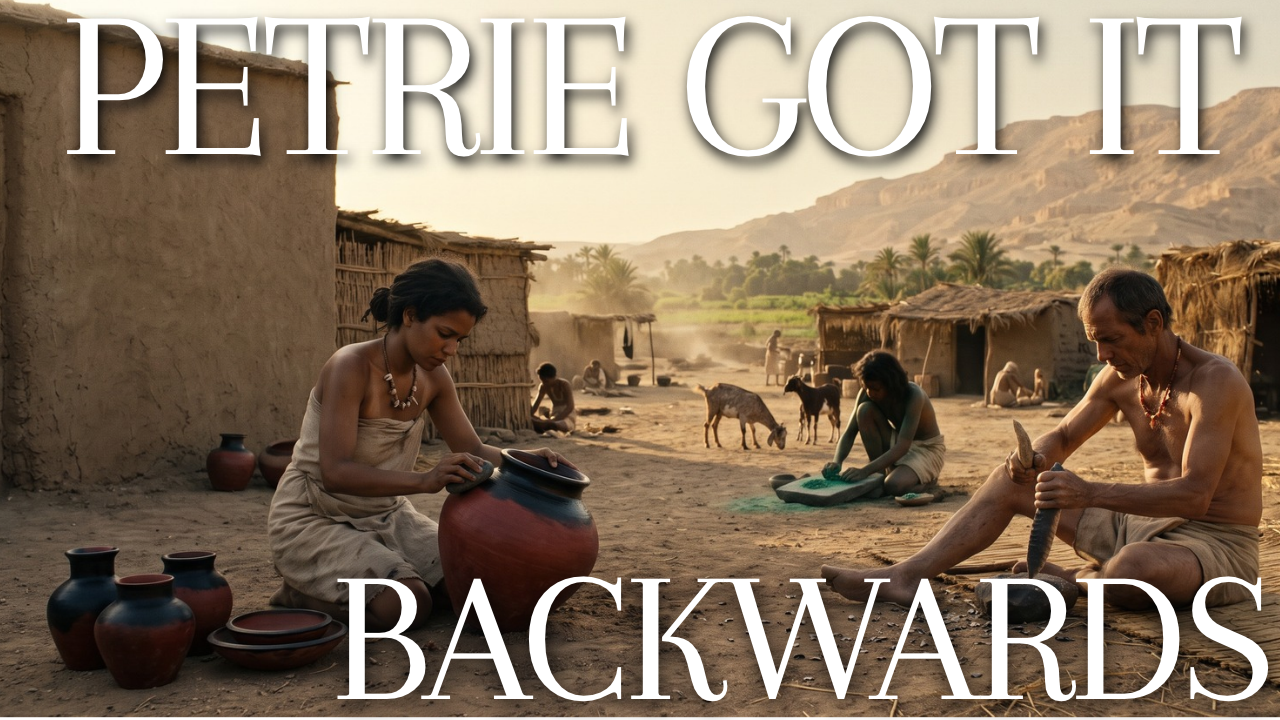
Petrie’s answer to the dating question was confident and wrong. He concluded that the graves belonged to a foreign population that had invaded Egypt during the turbulent period between the Old and Middle Kingdoms, the era now called the First Intermediate Period. He called them the New Race. In his reading, these newcomers had arrived from outside, practised customs alien to Egyptians, and left behind cemeteries that looked nothing like those of the native population.
The reasoning was not absurd given the evidence available to him. The burials were unlike any known Egyptian tradition, the First Intermediate Period was thought to be a time of disorder and foreign intrusion, and no stratified site yet tied the material to a firm date. Petrie also worked within an intellectual climate that habitually explained cultural change through the movement of peoples, and often of races ranked by supposed capacity. The New Race label fitted that climate perfectly.
It was Quibell, according to the Griffith Institute’s account of the season, who first suggested that the burials were prehistoric rather than intrusive. The decisive public argument came from Jacques de Morgan, then Director of the Egyptian Antiquities Service, whose work at sites in Upper Egypt in the following years placed similar material before the beginning of the dynasties. Within a few years Petrie accepted the correction. The New Race became the predynastic Egyptians, and Naqada became the type site of Egyptian prehistory.
Petrie’s error had an unexpectedly useful consequence. Once he accepted that the Naqada graves predated the dynasties, he faced a new problem: how to order thousands of graves that contained no written dates. His solution, developed over the following years, was a method that still underpins prehistoric chronology. He grouped graves by the types of pottery they contained and arranged them into a sequence in which pottery forms appeared, peaked in popularity and faded away.
The mistake also left an intellectual shadow. The idea that Egyptian civilization owed its spark to an incoming group did not disappear when the New Race was redated. It resurfaced in the early twentieth century as the dynastic race theory, which proposed that a more advanced population, often imagined as coming from Mesopotamia, had conquered the Nile Valley and founded the monarchy. Its persistence in popular writing is one reason the history of the New Race is worth knowing.
For all its flaws, the 1894 to 1895 excavation gave archaeology a sample of unprecedented size. Nearly three thousand burials from a single district meant that patterns could be detected statistically, even if Petrie did not use that word. It became possible to see which pottery types tended to occur together, which graves were unusually large or rich, and how the cemeteries were laid out. Few prehistoric sites anywhere in the world had produced so much comparable material by the end of the nineteenth century.
The different cemeteries already hinted at social distinctions. Cemetery T, by far the smallest with its 58 graves, included some of the largest and best-furnished tombs at the site. Cemetery N, with nearly two thousand burials, contained the bulk of the population.
Quibell’s work at Ballas, a little to the north, followed the same pattern on a smaller scale. The joint publication, Naqada and Ballas, appeared in 1896 and became the foundational report for the period. Because the objects of the two sites were registered together, the Ballas material is often treated simply as part of the Naqada assemblage. For broad questions of chronology and typology this hardly matters. For questions of local variation and site-by-site comparison it introduces real uncertainty.
Like most excavators of his day, Petrie worked under an arrangement that allowed a share of the finds to leave Egypt. Objects from Naqada went to the sponsors of the excavation and from there to museums across Britain, Europe, North America and beyond. Today pottery, palettes and flints from the 1894 to 1895 season are held in collections from the Petrie Museum at University College London to regional museums that received small allocations a century ago.
That dispersal has two faces. It made predynastic Egypt visible to the world and placed study material within reach of generations of scholars. It also scattered grave groups, so that the pots from a single burial might now sit in several countries, sometimes without reliable labels. Modern projects that reconstruct those groups from archival notes and museum registers are rescuing information that the excavators recorded but did not publish, and they increasingly allow old excavations to answer new questions.
Naqada did not cease to matter once Petrie left. In 1897, de Morgan excavated an immense mudbrick tomb near the town that belonged to the very end of the period, and later surveys returned to the region to map the cemeteries and settlements that Petrie had only partly explored. From 1978 onward, Fekri Hassan led a programme of survey and excavation in the Naqada region that refined the picture of its settlements and their environment.
The district’s significance thus spans the whole culture. Its cemeteries gave the culture its name and its first chronology, its settlement on the desert spur offers a rare view of an early town, and its late monumental tomb stands at the threshold of the First Dynasty. Few sites anywhere can claim to illustrate both the beginning of a research tradition and the end of the society it studied.
Petrie did not dig alone. According to the Egypt Exploration Society’s history of the site, his workforce at Naqada came from Quft, a town on the east bank not far away, and these men excavated a very large area, including about three thousand graves. Petrie trained such workmen in the careful recovery of small finds, and families from Quft went on to work on excavations across Egypt for generations, carrying a tradition of field skill that many later archaeologists relied upon. The Naqada season was thus also an episode in the formation of a professional Egyptian excavation workforce, a contribution too often left out of accounts that name only the European directors.
The site continued to attract researchers long after Petrie. Thomas Hays surveyed the area between 1975 and 1977, Claudio Barocas worked there from 1977 to 1986, and Fekri Hassan excavated at Nubt between 1978 and 1981, later publishing with Joris van Wetering and Geoffrey Tassie on decorated ceramics, urban development and an early dynastic cemetery. The geomorphologist Karl Butzer also studied the site’s setting. Each generation brought new questions to the same ground, from typology and chronology to environment and urbanism.
The history of the Naqada excavation is not merely an anecdote about a famous man’s mistake. It demonstrates how interpretation depends on the framework an excavator brings to the ground. Petrie’s evidence did not change when he abandoned the New Race; his framework did. Once the graves were understood as Egyptian and prehistoric, the same pots, palettes and bodies became evidence for the deep roots of Egyptian civilization rather than for its interruption.
It also shows the long life of excavated data. Material dug up in a few frantic months in the 1890s still feeds research on chronology, social structure and population history. Petrie himself turned that material into a chronological method within a few years, and that method, refined by his successors and anchored by radiocarbon, is how every date in this book was obtained.
The discovery of the Naqada culture overturned Victorian assumptions about Egyptian origins, proving that the roots of pharaonic civilization grew directly out of prehistoric Nile communities.
What began as an archaeological mystery in the sands of Upper Egypt has become the foundation for understanding the birth of one of humanity’s earliest states.
By re-examining these early graves, settlements, and artifacts, modern researchers continue to uncover the gradual steps that linked local villages into a unified kingdom.
This post presents an excerpt from the opening chapters of the full version, which explores the comprehensive history of predynastic Egypt.
The complete volume investigates in detail the industrial-scale breweries discovered at early urban settlements, the bioarchaeological evidence of health and daily labor across non-elite cemeteries, and the remarkable inscribed bone tags of Tomb U-j that mark the earliest appearance of phonetic writing in the Nile Valley.
Readers interested in following the complete archaeological journey from remote desert camps to the threshold of the First Dynasty will find the entire narrative unfolded across twenty-three in-depth chapters.
You can continue with the complete English edition of The Naqada Culture of Ancient Egypt on Kindle, or explore this title alongside other ancient history guides in the Liberal Arts Bundle.
The ‘Complete Edition’: Everything about the Naqada culture on Kindle
Liberal Arts Bundle: read this book alongside other English-language guides to ancient civilizations
A Guide to Exploring Prehistoric Egypt and the Ancient Near East
Prehistoric Cultures Along the Nile
- When Did Egyptian Civilization Begin? Dates and the Nile — Explains how archaeologists date the transition from early Nile Valley settlements to the First Dynasty.
- What Was Maadi-Buto Culture? Names, Sites, and Evidence — Looks at the northern Lower Egyptian tradition that interacted with and merged into Naqada material culture.
- Fayum A Culture: Egypt’s First Farmers at a Desert Lake — Examines the earliest agricultural communities around Lake Qarun before Upper Egypt’s rise.
- El Omari Culture: Egypt’s Neolithic Village at Wadi Hof Explained — Covers the Neolithic settlement south of Cairo and its evidence for early crafts and burials.
Early States in the Ancient Near East
- The Akkadian Empire: How Sargon the Great Built the World’s First Empire and What Destroyed It — Traces how early territorial rule emerged in Mesopotamia through inscriptions and archaeological layers.
- What Was the Neo-Assyrian Empire? Meaning and Dates — Clarifies the chronological framework and terminology behind one of the ancient Near East’s major empires.

コメント